
PET Silicone Tape for Enclosure Gasket-Land Masking
Application Solutions · Powder-Coated Enclosures
PET Silicone Tape for Enclosure Gasket-Land Masking
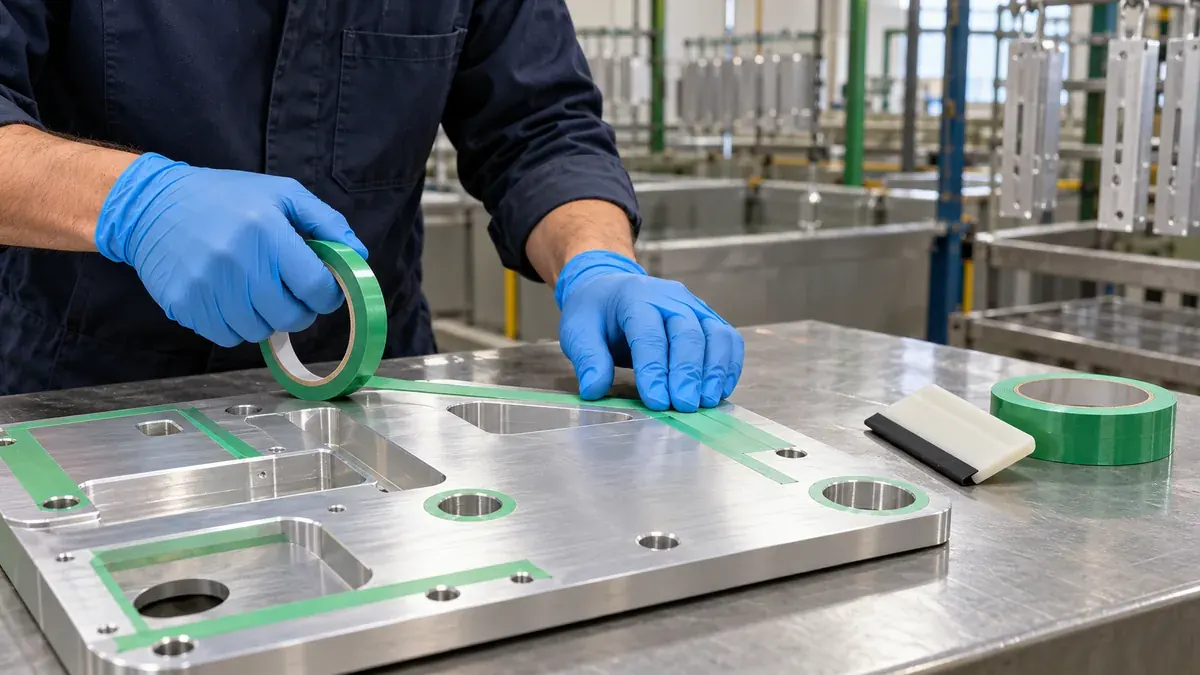
PET silicone tape for enclosure gasket-land masking can keep a defined sealing flange free from powder coating while the door or housing receives its finished surface. The mask must follow the released gasket path, tolerate the qualified finishing cycle, and remove without damaging the coating edge or the surface that the gasket must contact.

Quick Answer
Use PET silicone masking tape only where the enclosure drawing, coating plan, and gasket design identify a coating-free contact land. Define the inner and outer mask edges, corner treatment, hinge and fastener interruptions, overlap position, and removal stage before production. The tape is a temporary process aid; it does not by itself prove ingress protection, electrical continuity, corrosion resistance, or gasket life.
Define the Gasket-Land Boundary
An enclosure door can use a preformed gasket, a foam strip, a molded seal, a liquid-applied gasket, or another sealing architecture. Some designs need coating on the complete flange; others require a controlled bare-metal or specially finished land. The responsible enclosure owner must decide. Operators should not infer the boundary from a bend line, weld bead, or the visible width of a gasket.
Map every interruption in the seal path. Hinges, latch hardware, welded studs, cable entries, drain features, corner welds, and fastener holes can change the mask route. A tape strip that bridges an unsupported opening may lift during pretreatment or oven exposure. A strip placed too far inward can narrow the gasket contact area; one placed too far outward can expose metal that the corrosion plan expected to be coated.
| Enclosure feature | Masking question | Release-document check |
|---|---|---|
| Straight flange | Which edge defines the gasket contact width? | Datum, land width, and coating-edge tolerance |
| Formed corner | Can the tape follow the radius without wrinkling? | Inside radius, relief, overlap, and permitted seam |
| Hinge or latch zone | Does hardware interrupt the sealing path? | Keep-outs, assembly sequence, and access |
| Weld or joint | Is the surface height within the mask and gasket design? | Finish standard, gap, burr, and inspection method |
| Drain or vent feature | Must it remain open through coating? | Separate protection method and final function test |
Select the PET Silicone Tape Construction
Backing thickness and edge definition
PET film provides a thin, dimensionally stable masking face for many industrial finishing operations. Backing thickness influences handling, corner conformity, tear resistance, and the step formed at the powder edge. A thicker film may be easier to handle on a long flange, while a thinner film may follow a radius more readily. Neither advantage establishes suitability without a line trial.
Adhesive and the complete process history
Silicone pressure-sensitive adhesive influences initial hold, heat response, peel behavior, and the chance of transfer to the real surface. Record cleaning, pretreatment, rinsing, drying, spray, cure, cool-down, storage, and removal. The oven setpoint does not equal the temperature at the adhesive line, especially on doors and housings with different sheet thicknesses or reinforcing members.
Surface condition and downstream gasket contact
Oil, conversion-coating residue, moisture, dust, fingerprints, burrs, and rough weld dressing can create channels under the mask. Define when masking occurs relative to washing and drying. After removal, inspect the land using the cleanliness method accepted by the gasket and enclosure owner; do not introduce an unqualified solvent or abrasive cleanup step.
Compare Mask Formats and Corner Designs
| Mask format | Potential fit | Main control point |
|---|---|---|
| Straight slit roll | Long flanges, prototypes, or mixed enclosure sizes | Operator alignment, stretch, joints, and corner folds |
| Precut corner pieces | Repeated corner geometry with straight connecting runs | Joint position, overlap, liner, and orientation |
| One-piece die-cut frame | Stable door geometry and repeated production | Tolerance, liner support, waste removal, and placement datum |
| Segmented frame set | Large formats or geometry around hardware | Kit identity, sequence, gaps, and piece count |
| Reusable masking fixture | Robust recurring geometry with suitable access | Fit, cleaning, distortion, storage, and maintenance |
For a converted frame, specify the inner and outer perimeter, corner radii, hinge and fastener reliefs, split liner, pull tabs, orientation marks, allowed splice policy, and packaging. Long unsupported rails can stretch when removed from a liner. A carrier sheet or staged liner can hold geometry until the mask is registered to stable enclosure datums.
Recommended Masking and Removal Workflow
- Confirm the released stack. Match enclosure, gasket, coating, mask drawing, and work instruction.
- Identify the datum. Mark the correct flange edge without using the gasket as a cutting guide.
- Inspect the enclosure. Reject sharp burrs, oil, moisture, loose residue, or distorted corners.
- Prepare the mask. Protect slit rolls and converted frames from dust and bent edges.
- Apply without stretch. Seat the tape progressively along straight runs and formed corners.
- Control every joint. Place butt joints or overlaps only where the released design permits.
- Burnish the perimeter. Apply consistent pressure with the approved tool.
- Inspect before coating. Check width, wrinkles, gaps, hardware clearance, and piece count.
- Run the qualified cycle. Do not change coating settings to compensate for a weak mask.
- Remove and inspect. Follow the approved temperature, direction, speed, and cleanup method.
Validate the Mask and Seal Stack Together
Use representative enclosure sizes, metals, pretreatments, weld conditions, flange flatness, coating rack positions, operators, thermal masses, and removal delays. Flat coupons can screen adhesion and residue, but they cannot reproduce a formed corner, a door weld, a long sealing rail, or the alignment between door and housing.
| Validation group | What to observe | Release evidence |
|---|---|---|
| Placement | Land width, corner position, seams, keep-outs, and repeatability | Drawing, gauge, fixture, or approved image standard |
| Process hold | Edge lift, shrinkage, wrinkles, powder creep, and trapped liquid | Inspection through the complete finishing sequence |
| Removal | Tearing, fragments, residue, staining, and coating-edge damage | Defined removal window and accepted method |
| Gasket assembly | Contact path, compression, closure force, hardware clearance, and rework | Checks defined by the enclosure and gasket owners |
| Finished enclosure | Ingress, corrosion, appearance, continuity, and service requirements | Applicable product-level qualification, not tape data alone |
Troubleshoot Masking Defects by Failure Mode
Powder under the mask can result from contamination, incomplete pressure, a wrinkle, a joint facing the spray path, film recovery around a corner, or a tape width that bridges a step. Residue can involve the exact adhesive, surface treatment, heat history, removal delay, peel direction, or an incompatible cleanup method. Edge chipping can be related to powder bridging, coating thickness, cure state, or removal path.
Do not automatically widen the masked band. An oversized bare zone may reduce coating coverage and move the gasket onto an unintended surface. Correct the datum, geometry, material, pretreatment sequence, application method, or removal instruction, then repeat the relevant qualification.
↑ Back to contentsRelated Products and Articles
Frequently Asked Questions
Should an enclosure gasket land always be left uncoated?
No. The enclosure, coating, gasket, corrosion, and certification design must define the required surface. Some gasket systems contact a coated flange; others use a specified coating-free or separately treated land.
Can the gasket itself be used as the masking template?
Not unless the released work instruction explicitly defines that method. A soft gasket edge is not necessarily a controlled manufacturing datum and cutting near it may cause damage or contamination.
Is a die-cut frame better than hand-applied PET tape?
A die-cut frame can improve repeated geometry, corner control, and liner handling. Slit tape remains useful for prototypes or mixed sizes when alignment and joint controls are adequate.
When should PET silicone tape be removed?
Use a removal window established on the actual coating cycle and enclosure. Part temperature, cure state, adhesive construction, access, coating-edge risk, and workplace safety all matter.
What information belongs in an enclosure masking RFQ?
Provide door and housing drawings, gasket path, land width, metal and pretreatment, powder and cure profile, corner geometry, mask format, removal stage, volume, and acceptance tests.
Plan a Controlled Gasket-Land Masking Trial
Share the enclosure drawing, gasket and flange stack, protected boundary, metal finish, pretreatment, measured cure profile, corner geometry, masking sequence, removal condition, production volume, and product-level tests. JIAO TAO TAO can help shortlist PET silicone roll or converted-frame formats for evaluation.
Discuss enclosure gasket-land maskingCustom Die-Cut Tape for Optical Encoder Disc Masking
Custom Die-Cut Tape for Smart Meter Display Window Bonding
Related Article
Need help choosing the right industrial tape?
Send us your application details, including temperature, surface material, size, quantity and current problem. Our team will help recommend a suitable tape material or custom die-cut solution.

simon@jiaotaotao.com


+86-136 1277 5969


+86-136 1277 5969
