
How to Qualify PET Silicone Tape for Anodizing Masking
Industrial Tape Application Guide
How to Qualify PET Silicone Tape for Anodizing Masking
Qualify PET silicone tape for anodizing masking by bath chemistry, immersion sequence, geometry, edge sealing, removal and real-part validation.
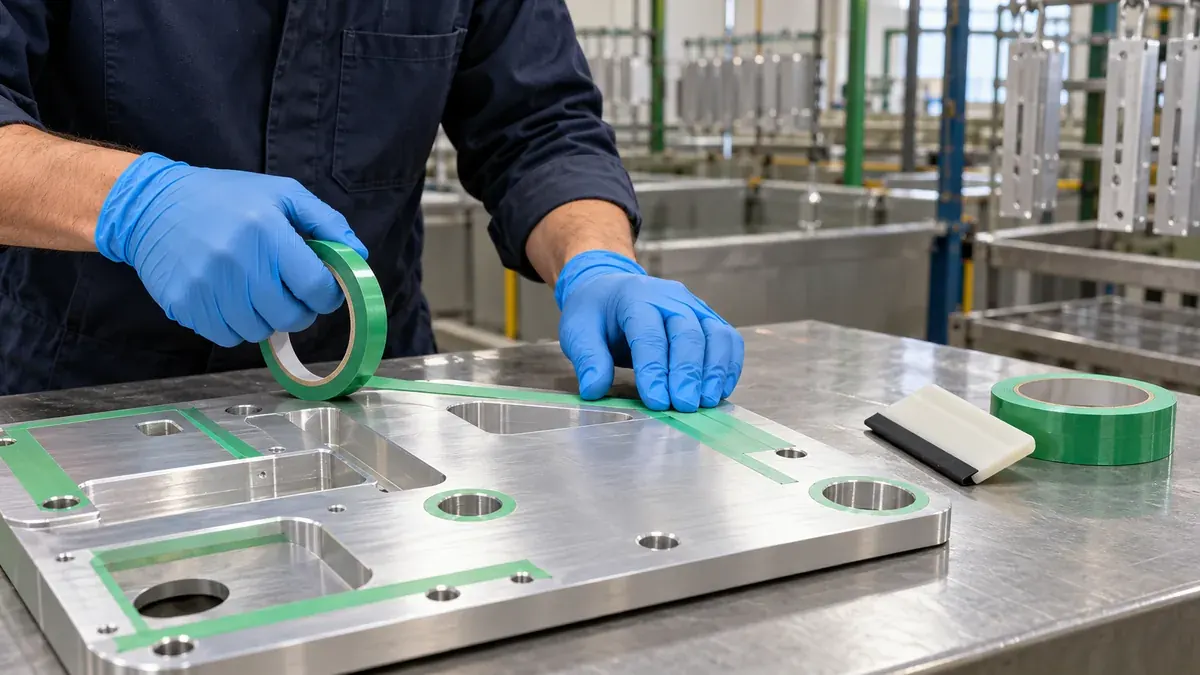
PET silicone tape for anodizing masking should be approved against the exact bath sequence, part alloy, geometry and downstream operations—not from a temperature rating alone. This guide is for finishing engineers, anodizing suppliers, buyers and quality teams who need a repeatable way to protect contact pads, sealing lands, threaded zones or cosmetic boundaries. The practical conclusion is to treat tape, edge design, application pressure, immersion time, rinsing, sealing and removal as one qualified process.
Anodizing uses chemically aggressive baths and electrical current. The finishing owner must define PPE, ventilation, bath control, racking, electrical contact and waste procedures. Tape evaluation should begin on representative coupons or sacrificial parts outside production. Technical content reviewed: .
Define the Anodizing Process Before Selecting Tape
Write down the anodizing type and every wet-process step that the mask will see. A tape that survives one sulfuric-acid sequence may behave differently in chromic acid, hardcoat, pre-clean, etch, desmut, dye or seal chemistry. Record solution family, concentration controlled by the finisher, temperature, immersion time, agitation, rinse sequence and whether the part is dried or reheated before demasking.
| Process input | What to record | Why it changes masking risk |
|---|---|---|
| Anodizing route | Type I, II, III or customer-specific route; bath chemistry and control revision | Chemical exposure and temperature differ |
| Exposure sequence | Clean, etch, desmut, anodize, rinse, dye, seal and drying steps | Failure may start before the anodizing bath |
| Part surface | Alloy, temper, machining fluid, roughness, oxide condition and cleanliness | Controls wet-out and leakage paths |
| Mask geometry | Flat, hole, recess, edge, thread, sealing land or electrical contact zone | Controls stress, bridging and edge length |
| Downstream need | Bonding, painting, sealing, welding, electrical contact or cosmetic inspection | Sets residue and contamination limits |
3M's anodizing guidance separates Type I chromic-acid masking from Type II and Type III sulfuric-acid processes and identifies different tape constructions for those baths. That is useful evidence that “anodizing tape” is not one universal material class.
Select the Complete PET Silicone Tape Construction
PET backing and dimensional behavior
PET film can provide a crisp edge and useful tensile strength, but the film thickness, orientation and total construction affect conformability and removal. A thicker construction may bridge texture; a thinner film may follow a shallow contour but be easier to nick. Request the supplier's specific chemical and process evidence rather than relying on color.
Silicone pressure-sensitive adhesive
Silicone adhesive can support high-temperature masking, yet anodizing approval depends on adhesion through wet chemistry and clean removal afterward. If a masked area will later be bonded, painted or sealed, define an acceptance test for transfer or contamination. A non-silicone construction may be required by the downstream process even when a silicone tape masks the bath successfully.
Edges, liner and converted shape
Slit rolls suit straight boundaries. Liner-backed discs or die cuts can improve repeatability around ports, bosses and repeated contact pads. Define cut-edge quality, liner release, pull tabs, dimensional tolerance, storage and packaging. An irregular cut edge can become a leakage path even when the base tape is suitable.
Compare Anodizing Masking Formats
| Format | Best fit | Primary control | Common risk |
|---|---|---|---|
| Slit PET tape | Long flat boundaries and changing prototypes | Width, overlap and pressure | Wrinkles at corners or inconsistent hand trimming |
| Kiss-cut disc | Repeated holes or circular contact zones | Diameter, concentricity and pull tab | Off-center placement or edge damage |
| Custom die cut | Repeated complex keep-out zones | Datum, tolerance and liner release | Geometry drift between drawing and part |
| Tape plus plug/cap | Mixed flat and deep features | Interface between masking elements | Leakage where components overlap |
Illustrative Coverage and Placement Exercise
For a centered circular mask, let D be nominal disc diameter, Z the maximum protected-zone diameter and e the combined cut and placement error toward one side. Minimum radial coverage is (D − Z) / 2 − e. This geometry check does not predict chemical resistance or seal quality.
| Trial field | Required entry | Decision |
|---|---|---|
| Material identity | Backing, adhesive, total thickness, liner, supplier code and lot | Is the tested construction traceable? |
| Process exposure | Every bath/rinse/seal step, time, temperature and route revision | Does the trial represent production? |
| Geometry | Part revision, zone size, tape size, overlap, datum and tolerance | Can worst-case placement still protect the zone? |
| Acceptance | Leakage, line quality, residue, removal, corrosion, appearance and downstream tests | Are pass/fail limits written before testing? |
Controlled Application Workflow
- Confirm the route. Match the traveler, alloy, anodizing type, bath sequence and masked drawing zone.
- Verify material. Check tape code, lot, size, liner, storage and expiry controls.
- Prepare the surface. Use only the approved cleaning process; confirm the part is dry and free of oil or particles.
- Apply from a datum. Place without stretching the PET film; avoid touching the adhesive.
- Press every edge. Use a qualified roller or tool, especially around corners and holes.
- Inspect before racking. Reject wrinkles, bridges, cuts, bubbles, short overlap and lifted edges.
- Run the documented bath sequence. Do not change chemistry or exposure to make a marginal mask pass.
- Rinse and demask by procedure. Control removal timing, angle and part temperature.
- Inspect and record. Measure leakage and boundary quality; document residue and downstream results.
Validate Tape, Part and Process Together
A supplier data sheet is screening evidence, not production release. Include representative alloy and surface lots, geometry extremes, operators, rack positions and the longest allowed exposure. If downstream bonding or painting matters, test that step after masking and cleaning; appearance alone cannot establish surface compatibility.
| Validation group | Observe | Evidence to retain |
|---|---|---|
| Mask integrity | Lift, blister, wrinkle, chemical ingress and edge movement | Before/after images and defect map |
| Boundary | Maximum leakage, line sharpness and protected-zone coverage | Defined measurement method and results |
| Removal | Tearing, adhesive transfer, fragments and operator time | Removal condition and traceable lot |
| Finished part | Appearance, corrosion protection and required functional checks | Customer or engineering acceptance record |
| Downstream | Bonding, paint, seal, electrical contact or weldability as applicable | Actual follow-on process result |
Anodizing Mask Acceptance Record
Retain: part/alloy and revision | tape code and lot | masking drawing | bath route and control revision | rack location | exposure times and temperatures | measured overlap | maximum leakage | removal condition | residue result | downstream test | photo IDs | disposition and approver. Mark untested fields “not tested”; do not convert missing data into a pass.
Troubleshoot Leakage and Removal Failures
| Symptom | Check first | Controlled improvement | Revalidation |
|---|---|---|---|
| Leakage follows one edge | Surface oil, cut edge, application pressure and local geometry | Correct surface prep or edge application; compare one change on matched parts | Maximum leakage and edge integrity through full route |
| Disc lifts in the bath | Disc size, placement, recess, agitation and adhesive compatibility | Re-evaluate geometry or construction; do not merely stack extra discs | Worst-case placement and immersion sequence |
| Tape tears during removal | Backing damage, removal temperature, angle and dwell | Define a controlled removal window or stronger construction | One-piece removal and protected surface condition |
| Downstream bond or paint fails | Residue, silicone sensitivity, cleaning and part handling | Hold the process and compare an approved non-silicone option if required | Actual downstream adhesion or finish test |
Related Products, Articles and Technical Sources
Technical sources and scope
3M's anodizing masking guide differentiates tape constructions by anodizing type and bath family. EPSI's technical guide describes its A12 polyester/silicone tape for powder coating, e-coating, anodizing and some plating while explicitly requiring suitability testing. Those are product-specific manufacturer statements, not universal data for JIAO TAO TAO tape. The geometry worksheet above is an original illustrative decision tool.
Frequently Asked Questions and RFQ Checklist
Can any green PET silicone tape mask anodizing?
No. Color and temperature rating do not prove compatibility with a particular acid bath, immersion sequence or downstream process.
Is silicone adhesive always acceptable after anodizing?
No. If the zone will later be bonded, painted or sealed, define contamination and downstream adhesion tests before approval.
Should tape be removed before or after sealing?
That decision belongs to the released anodizing route. Test removal timing because it changes exposure, edge quality and residue risk.
Can coupon testing replace real-part testing?
No. Coupons screen constructions, but real geometry, rack location, edges, holes and handling can produce different leakage paths.
What belongs in an anodizing masking RFQ?
Provide alloy, anodizing type, full bath sequence, temperatures, immersion times, geometry, tape dimensions, tolerance, downstream operations, annual volume and pass/fail criteria.
Prepare an Anodizing Masking Trial
Share the alloy, anodizing type, bath sequence, masked drawing, geometry, exposure, downstream operation, tape format, volume and acceptance criteria. JIAO TAO TAO can prepare slit PET silicone tape or converted samples for controlled evaluation.
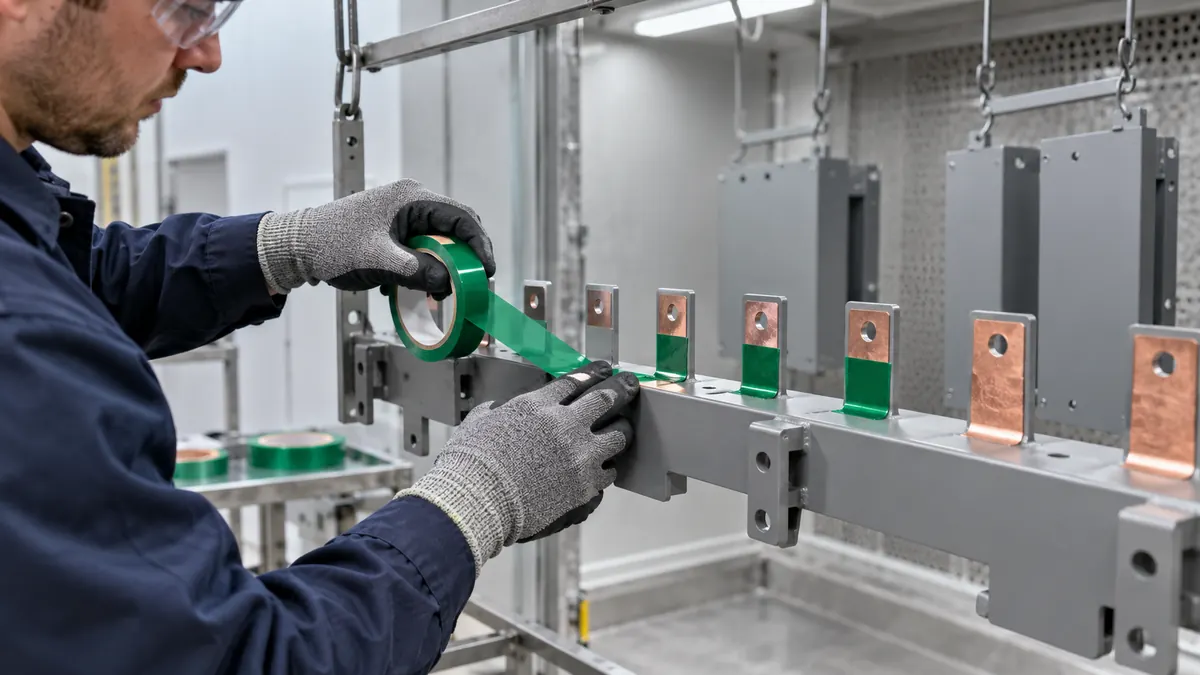
PET Silicone Tape for Busbar Contact Pad Masking
Related Article
Need help choosing the right industrial tape?
Send us your application details, including temperature, surface material, size, quantity and current problem. Our team will help recommend a suitable tape material or custom die-cut solution.

simon@jiaotaotao.com


+86-136 1277 5969


+86-136 1277 5969
