
High Temperature Tape for SMT Reflow & Wave Soldering
High Temperature Tape for SMT Reflow and Wave Soldering
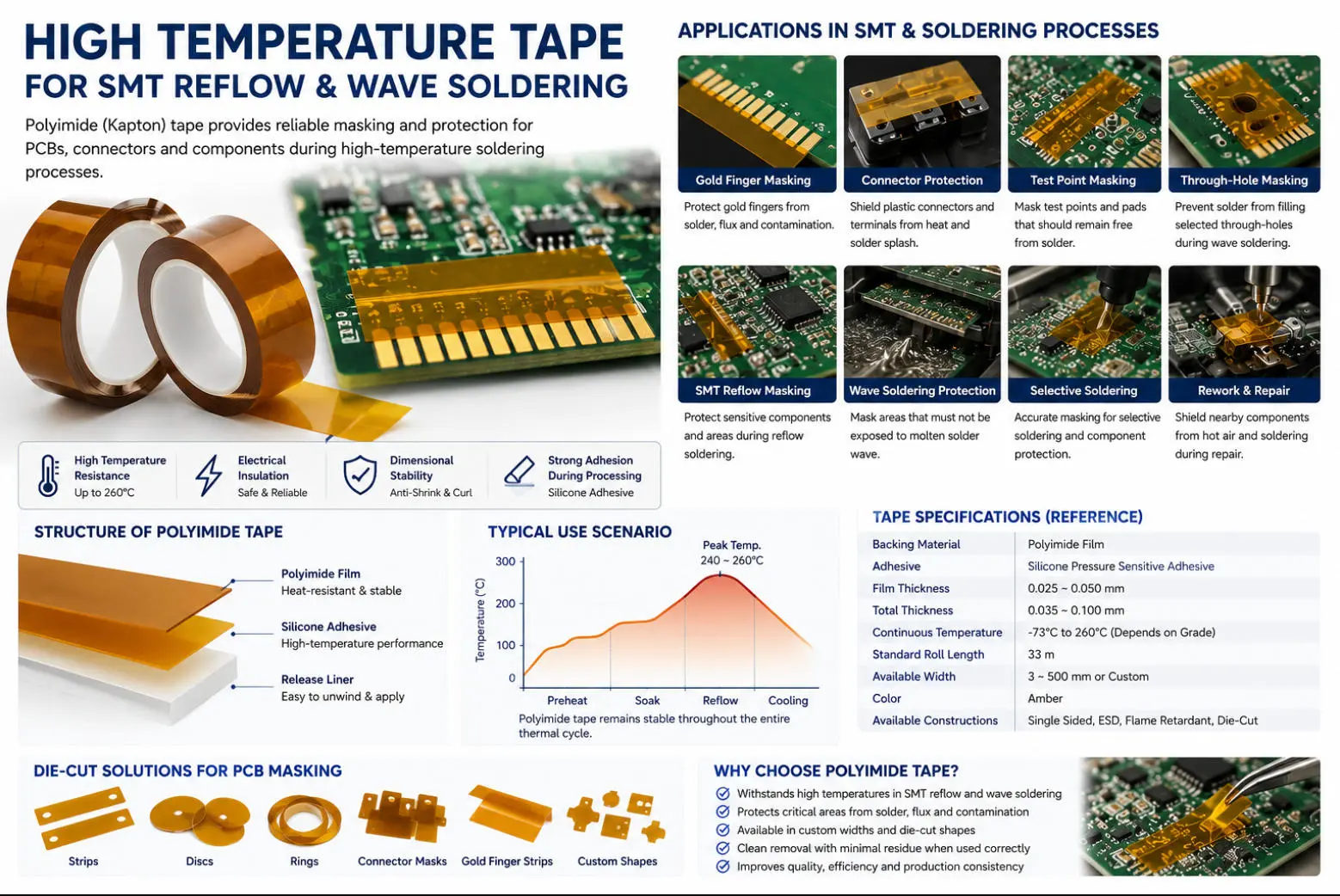
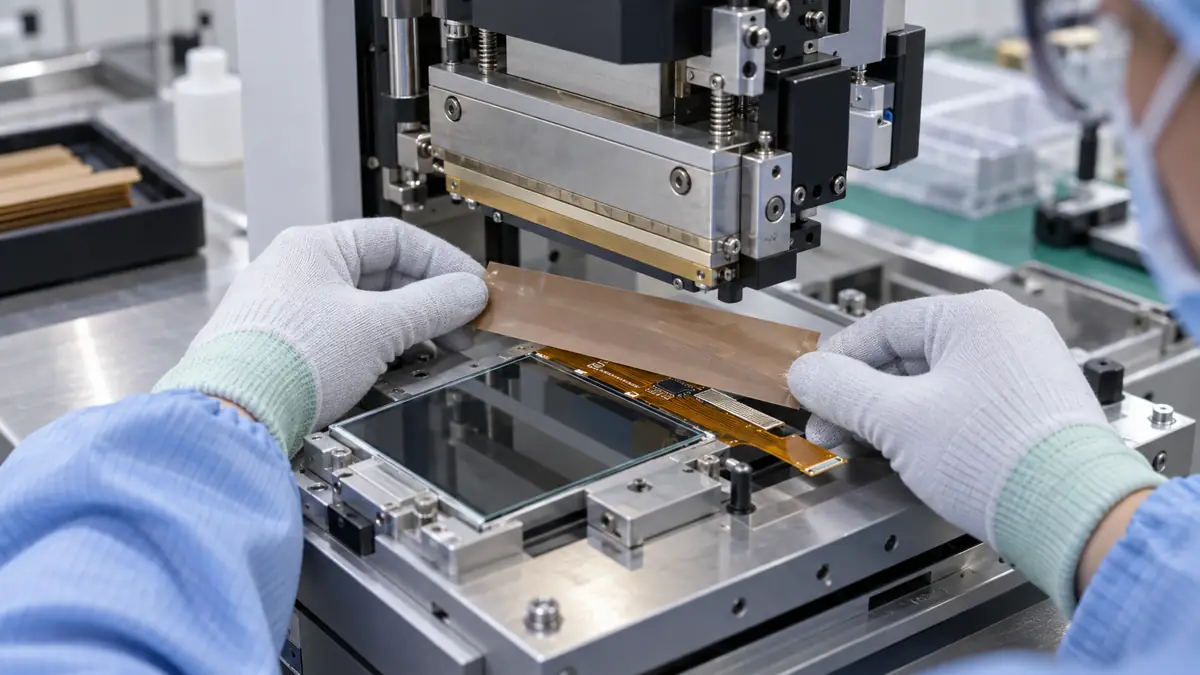
High temperature tape for SMT reflow and wave soldering is used to mask PCB contacts, gold fingers, connectors, terminals and sensitive components during high-temperature electronics manufacturing.
Polyimide tape is one of the most widely used options for these processes because it combines heat resistance, electrical insulation, dimensional stability and precise masking performance in a thin construction.
The correct tape should remain stable throughout the thermal cycle, maintain adhesion during processing and remove without damaging the PCB surface or leaving excessive adhesive residue.
Why Is High Temperature Tape Needed in SMT Manufacturing?
SMT assembly exposes printed circuit boards and electronic components to elevated temperatures during solder paste reflow, component mounting, selective soldering and post-processing.
Certain areas of the PCB must remain protected from solder, flux, coatings, heat or contamination. High-temperature masking tape creates a temporary protective barrier while allowing the rest of the board to complete the production process.
Common protected areas include:
- PCB gold fingers
- Edge connectors
- Test points
- Contact pads
- Plastic connectors
- Sensitive components
- Selected through-holes
- Areas requiring selective soldering exclusion
Main Applications in SMT Reflow and Wave Soldering
SMT Reflow Masking
During reflow soldering, a PCB passes through a controlled temperature profile that melts solder paste and forms electrical connections between components and pads.
High-temperature tape can protect selected connectors, contacts and sensitive regions that should not be exposed to solder or process contamination.
Wave Soldering Protection
Wave soldering exposes the underside of a PCB to molten solder. Areas that must remain free from solder can be covered using a suitable polyimide masking tape.
The tape must maintain edge adhesion during the process. Wrinkles, bubbles or poorly sealed edges can allow solder or flux to penetrate beneath the masking area.
Gold Finger Masking
Gold fingers must remain clean and conductive after PCB assembly. Polyimide tape can cover these contacts during soldering, coating or cleaning processes.
Precise alignment is important because the masking edge should protect the contact area without covering nearby components or test points.
Connector Protection
Plastic connectors, sockets and terminals located near high-temperature processing areas may require temporary masking. Tape can help protect them from solder splash, flux and thermal exposure.
Selective Soldering
Selective soldering processes may require temporary masking around specific pads, holes or connectors. Narrow slit tape or custom die-cut shapes can improve masking accuracy.
Electronics Repair and Rework
During hot-air rework or manual soldering, technicians may use polyimide tape to shield nearby components and circuit areas from direct heat.
Why Polyimide Tape Is Commonly Used for SMT Reflow
| Property | Benefit in SMT and Soldering |
|---|---|
| High temperature resistance | Suitable for elevated-temperature electronics processing |
| Thin polyimide backing | Allows precise masking around small PCB features |
| Dimensional stability | Helps reduce shrinking and curling during heating |
| Electrical insulation | Provides additional isolation around electronic components |
| Silicone adhesive | Maintains adhesion during elevated-temperature processing |
| Custom converting | Can be slit or die-cut for precise PCB masking |
Typical Tape Specifications for SMT Reflow Applications
The following values are general reference ranges for industrial polyimide adhesive tape. Actual specifications vary by product grade.
| Property | Typical Range |
|---|---|
| Backing | Polyimide film |
| Adhesive | Silicone pressure-sensitive adhesive |
| Film thickness | Approximately 0.025–0.050 mm |
| Total thickness | Approximately 0.035–0.100 mm |
| Typical continuous temperature capability | Up to approximately 260°C, depending on grade |
| Standard roll length | Commonly 33 m |
| Available widths | Approximately 3–500 mm or custom slit widths |
| Common color | Amber |
| Optional constructions | ESD, flame-retardant, double-sided and custom die-cut |
A tape should not be selected based only on its maximum temperature rating. Peak temperature, heating duration, substrate, adhesion, cleanliness and removal conditions must all be considered.
How to Choose Tape for SMT Reflow and Wave Soldering
1. Check the Complete Temperature Profile
Review the preheating, soaking, peak temperature and cooling stages of the soldering process.
The tape must withstand the complete thermal cycle, not only the maximum temperature shown on the production equipment.
2. Confirm the Exposure Time
Short exposure to a high temperature is different from prolonged exposure at the same temperature. Adhesive performance can change as heating time increases.
3. Identify the PCB Surface
Adhesion may vary on solder mask, gold-plated contacts, copper, aluminum, laminate and plastic connectors.
Test the tape directly on the actual production surface whenever possible.
4. Determine the Required Masking Precision
Narrow PCB features may require thin tape with accurate slitting or custom die-cut parts.
High-volume assembly may benefit from pre-cut masks that improve repeatability and reduce manual trimming.
5. Evaluate Residue Requirements
Adhesive residue can interfere with electrical contact, coating, inspection or final assembly.
Clean-removal testing should be performed using the real heating and cooling process.
6. Check ESD Requirements
Standard polyimide tape is electrically insulating. ESD polyimide tape may be required in static-sensitive manufacturing environments.
Polyimide Tape vs PET Tape for SMT Applications
| Comparison | Polyimide Tape | PET High Temperature Tape |
|---|---|---|
| Backing material | Polyimide film | Polyester film |
| Temperature capability | Generally higher | Suitable for many medium to high-temperature processes |
| Typical use | Reflow, wave soldering, PCB masking and electronics | General masking, coating and selected electronics processes |
| Electrical insulation | Suitable for demanding electronics applications | Suitable for general insulation and protection |
| Cost | Generally higher | Generally more economical |
Polyimide tape is normally preferred when the process involves higher temperatures or demanding PCB masking requirements.
PET tape can be considered when the process temperature is lower and a more economical masking solution is suitable.
Common Problems During SMT Masking
| Problem | Possible Cause | Recommended Action |
|---|---|---|
| Tape lifts during reflow | Surface contamination or insufficient adhesion | Clean the surface and test a suitable adhesive grade |
| Tape curls or shrinks | Backing cannot tolerate the thermal cycle | Use a more dimensionally stable high-temperature film |
| Solder penetrates masking area | Wrinkles, bubbles or poor edge sealing | Improve tape application and inspect masking edges |
| Adhesive residue remains | Excessive temperature or prolonged exposure | Review the temperature profile and removal conditions |
| PCB contact is damaged | Excessive adhesion or aggressive removal | Use controlled peel speed and validate adhesive strength |
| Masking dimensions vary between boards | Manual cutting and placement inconsistency | Use standardized slit widths or custom die-cut parts |
Why Does High Temperature Tape Leave Residue After Reflow?
Adhesive residue may occur when the tape construction does not match the actual process.
Common causes include:
- Peak temperature exceeds the tape recommendation
- Heating time is longer than expected
- The PCB surface contains flux, oil or chemicals
- Excessive application pressure causes adhesive flow
- The tape remains on the PCB too long after processing
- The removal temperature or angle is unsuitable
The most reliable method is to test the tape throughout the complete SMT process rather than relying only on laboratory temperature ratings.
How to Apply High Temperature Tape for PCB Masking
- Clean the PCB. Remove oil, dust, moisture and process contamination.
- Select the correct tape width. Match the tape to the PCB area that requires protection.
- Align the masking edge. Position the tape precisely along the protected feature.
- Apply uniform pressure. Avoid bubbles, wrinkles and lifted edges.
- Inspect the mask. Confirm complete coverage before soldering.
- Run the SMT or soldering process. Keep the tape within the validated temperature and exposure limits.
- Allow controlled cooling. Follow the validated removal procedure.
- Remove the tape slowly. Peel at a controlled angle to reduce stress and residue.
Custom Die-Cut Tape for SMT and PCB Masking
Custom converting can improve masking accuracy and production efficiency in repetitive electronics manufacturing.
Common converting options include:
- Narrow slit polyimide tape
- Gold finger masking strips
- Connector protection shapes
- Polyimide discs
- Ring-shaped insulation parts
- Kiss-cut masking sheets
- Custom ESD polyimide parts
- Precision die-cut components
Pre-cut shapes can reduce manual cutting time, improve positioning consistency and reduce material waste.
How to Validate Tape Before SMT Mass Production
- Record the thermal profile. Confirm preheat, peak temperature, dwell time and cooling conditions.
- Prepare actual PCB samples. Use the same PCB surface and materials used in production.
- Apply the tape using the real production method. Test manual or automated application conditions.
- Run the complete soldering cycle. Use the actual SMT, reflow or wave soldering process.
- Inspect the masking result. Check for lifting, shrinkage, penetration and deformation.
- Remove the tape. Evaluate residue, surface damage and removal force.
- Repeat the test. Confirm that the result is consistent across multiple production samples.
High Temperature SMT Masking Tape Manufacturer
JIAO TAO TAO is an industrial adhesive tape manufacturer based in Dongguan, Guangdong, China. Established in 2009, the company operates a 6,000 m² manufacturing facility with coating, slitting, rewinding, cutting, online testing and custom converting capabilities.
Polyimide and high-temperature adhesive tapes can be supplied for PCB solder masking, SMT reflow, wave soldering, gold finger protection, battery insulation and electronic component manufacturing.
Available services include:
- Custom tape width and roll length
- Single-sided polyimide tape
- ESD polyimide tape
- Double-sided polyimide tape
- Custom die-cut PCB masking parts
- Sample testing and application support
- OEM packaging and private-label services
Learn more about polyimide tape properties and applications , read our guide to Kapton tape for PCB solder masking , or explore polyimide tape for lithium battery insulation .
Frequently Asked Questions
What tape is suitable for SMT reflow?
Polyimide tape with a suitable high-temperature adhesive is commonly used for SMT reflow because it provides heat resistance, dimensional stability and precise masking performance.
Can Kapton tape be used during wave soldering?
Yes. Polyimide tape is commonly used to mask PCB contacts, gold fingers, connectors and other areas during wave soldering. The exact tape grade must be validated for the process temperature and exposure time.
Does polyimide tape leave residue after SMT reflow?
A suitable tape can normally be removed cleanly when used within its validated temperature and time limits. Residue performance depends on the adhesive, PCB surface, thermal cycle and removal method.
Can PET tape be used instead of polyimide tape for SMT?
PET tape can be suitable for selected lower-temperature applications. Polyimide tape is generally preferred for higher-temperature and more demanding PCB masking processes.
What thickness of tape is suitable for PCB solder masking?
Thin constructions are commonly used for precise masking. The correct thickness depends on required insulation, mechanical protection, conformability and process conditions.
Can SMT masking tape be custom die-cut?
Yes. Polyimide tape can be converted into strips, discs, rings, masks and custom shapes matched to specific PCB designs.
What causes tape to lift during reflow?
Common causes include contaminated surfaces, insufficient adhesion, unsuitable adhesive formulation, excessive thermal stress and poor tape application.
What information should I provide when requesting SMT masking tape?
Provide the peak temperature, heating duration, PCB surface, masking area, tape dimensions, residue requirements, ESD requirements and estimated order quantity.
Best Heat Resistant Tape for Sublimation Heat Press
Polyimide Tape for Lithium Battery Insulation
Related Article
Need help choosing the right industrial tape?
Send us your application details, including temperature, surface material, size, quantity and current problem. Our team will help recommend a suitable tape material or custom die-cut solution.

simon@jiaotaotao.com


+86-136 1277 5969


+86-136 1277 5969
