
Polyimide Tape for Lithium Battery Insulation
Polyimide Tape for Lithium Battery Insulation and Protection
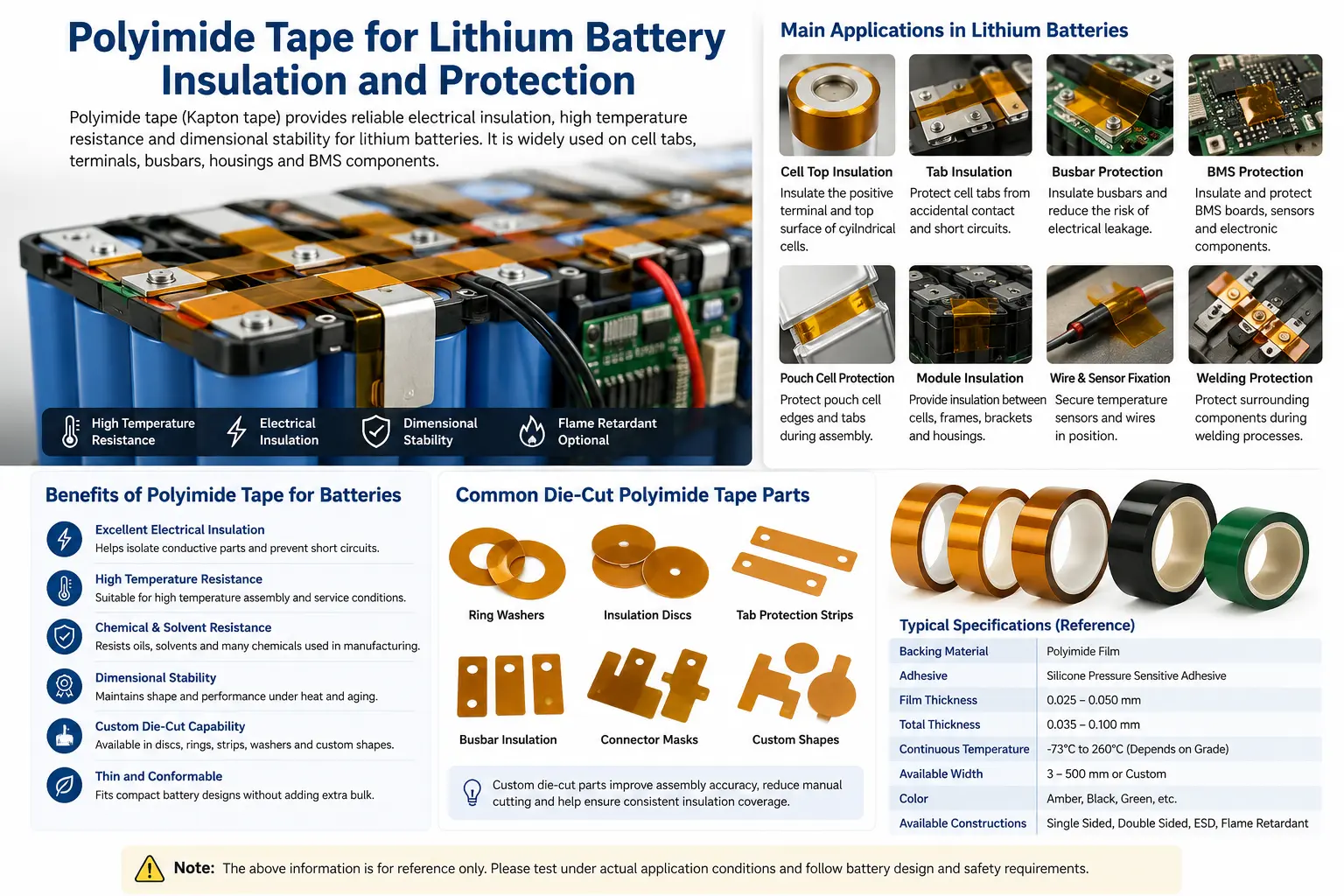
Polyimide tape for battery insulation is a thin, heat-resistant adhesive tape used to electrically isolate battery cells, tabs, terminals, busbars, metal housings, wiring and battery management system components.
Its polyimide film backing provides electrical insulation, dimensional stability and resistance to elevated temperatures. A pressure-sensitive adhesive, commonly silicone, allows the tape to bond to metals, plastics, films and electronic components during battery assembly.
In the market, polyimide tape is also frequently searched for as Kapton tape for lithium batteries. Kapton is a well-known polyimide film trade name, while polyimide tape is the general product category.
Why Is Polyimide Tape Used in Lithium Batteries?
Lithium battery assemblies contain conductive metal parts positioned close to cells, sensors, circuit boards and battery housings. If these components contact each other unintentionally, electrical leakage, short circuits or assembly failure may occur.
Polyimide tape creates a thin insulating barrier without occupying much space. This is especially valuable in compact battery packs where insulation thickness, placement accuracy and heat resistance are important.
Battery manufacturers may use polyimide tape for temporary processing, permanent electrical insulation, component fixation or custom die-cut protection. The correct construction depends on the battery design, operating environment and required service life.
Main Battery Applications of Polyimide Tape
Battery Cell Tab Insulation
Battery tabs conduct electrical current between cells and connecting components. Polyimide tape may be applied around selected tab areas to reduce accidental contact with nearby conductive surfaces.
The tape must be positioned accurately so that it protects the required area without interfering with welding, bonding or electrical connection.
Positive and Negative Terminal Protection
Battery terminals can be temporarily or permanently insulated during manufacturing, transportation and assembly. Narrow tape strips or die-cut polyimide parts can cover specific terminal areas while leaving the required connection points exposed.
Cylindrical Cell Top Insulation
Cylindrical cells may require insulation around the positive terminal, shoulder or top surface. Ring-shaped polyimide tape, washers and custom die-cut parts can help isolate conductive surfaces in a repeatable format.
Pouch Cell Edge and Tab Protection
Pouch cells have thin flexible packaging and exposed tab areas that may require additional protection during handling and assembly. Polyimide tape can help protect selected edges, tabs and contact points without adding significant thickness.
Busbar and Connector Insulation
Busbars connect multiple battery cells or modules. Polyimide tape can be applied to selected busbar surfaces, edges or adjacent components to provide an additional electrical insulation layer.
For high-volume manufacturing, custom die-cut insulation parts can provide more consistent coverage than manually cutting tape from standard rolls.
Battery Module and Pack Insulation
Polyimide tape can be used between selected cells, module components, metal brackets and housings where a thin insulating layer is needed. Application areas must be defined by the battery engineering team.
BMS Circuit Board Protection
The battery management system, or BMS, contains circuit boards, connectors, sensors and wiring. Polyimide tape may be used for electrical insulation, local masking, wire fixation and temporary component protection during assembly.
Sensor and Wire Fixation
Thin polyimide tape can temporarily or permanently secure temperature sensors, thermocouples and lightweight wires to battery components. Adhesion must be tested under the expected temperature, vibration and aging conditions.
Battery Welding and Processing Protection
During selected welding, soldering or thermal processes, polyimide tape may protect nearby surfaces from heat, sparks, metal particles and processing contamination.
Benefits of Polyimide Tape in Battery Manufacturing
| Property | Benefit for Battery Applications |
|---|---|
| Electrical insulation | Helps isolate terminals, tabs, busbars and metal components |
| Thin construction | Fits compact battery assemblies with limited installation space |
| Heat resistance | Supports selected elevated-temperature assembly processes |
| Dimensional stability | Reduces shrinking and deformation during thermal exposure |
| Die-cutting capability | Allows rings, discs, strips, washers and custom insulation shapes |
| Conformability | Can fit around tabs, edges, curves and irregular components |
| Chemical resistance | Provides resistance to many oils, solvents and process chemicals |
| Low material volume | Adds insulation without significantly increasing pack dimensions |
Typical Polyimide Tape Specifications for Battery Insulation
Battery insulation requirements vary significantly between cylindrical, prismatic and pouch-cell designs. The following values are general industrial reference ranges rather than specifications for every battery project.
| Property | Typical Option |
|---|---|
| Backing material | Polyimide film |
| Adhesive | Silicone pressure-sensitive adhesive |
| Film thickness | Approximately 0.025–0.050 mm |
| Total thickness | Approximately 0.035–0.100 mm |
| Typical continuous temperature range | Approximately −73°C to 260°C, depending on grade |
| Standard roll length | Commonly 33 m |
| Available width | Approximately 3–500 mm or custom slit widths |
| Common color | Amber, black, green or other custom colors |
| Available constructions | Single-sided, double-sided, ESD and custom die-cut parts |
Temperature resistance alone does not determine whether a tape is suitable for a battery. Adhesion, dielectric strength, flame performance, surface resistance, thickness, aging behavior and compatibility with the actual battery materials must also be evaluated.
How to Choose Polyimide Tape for Battery Insulation
1. Identify the Insulation Location
First determine whether the tape will be used on a cell tab, terminal, busbar, module frame, sensor, BMS board, cylindrical cell top or another component.
The shape and location determine the required tape width, thickness, adhesive strength and converting format.
2. Confirm the Electrical Requirements
Review the operating voltage, required dielectric strength, insulation distance and risk of contact with conductive surfaces.
Tape should be evaluated as one part of the complete insulation system, not as an isolated component.
3. Determine the Temperature Profile
Record the normal operating temperature, temporary processing temperature and maximum expected temperature. Also record the duration of each thermal exposure.
A tape that survives a short manufacturing process may not necessarily be suitable for years of continuous service at the same temperature.
4. Check the Bonding Surface
Polyimide tape may be applied to aluminum, copper, nickel-plated metal, stainless steel, plastic, PCB laminate, coated surfaces or battery pouch film.
Adhesion can vary significantly between these materials. Testing on the actual production surface is necessary.
5. Select the Correct Tape Thickness
Thin tape is suitable for applications with limited space and for precise wrapping around tabs and small components. A thicker tape may offer greater mechanical protection but can be less flexible.
6. Evaluate Adhesive Strength
The adhesive must hold the insulation in place during processing and service without lifting, sliding or excessive adhesive flow.
Excessive adhesion can also create problems if the tape must be removed or repositioned during production.
7. Confirm Flame-Retardant Requirements
Some battery applications require materials with specified flame-retardant performance. Do not assume that every polyimide tape has the same flame rating.
Request the relevant test data and certification for the exact product construction being evaluated.
8. Determine Whether ESD Performance Is Needed
Standard polyimide tape is electrically insulating. ESD polyimide tape provides controlled surface resistance for selected static-sensitive manufacturing environments.
ESD tape should only be selected when the process or product design requires controlled static behavior.
9. Choose Roll Tape or Die-Cut Parts
Standard rolls are flexible and suitable for development, repair and low-volume assembly. Custom die-cut parts are usually more efficient for repetitive high-volume production.
Standard Polyimide Tape vs ESD Polyimide Tape
| Comparison | Standard Polyimide Tape | ESD Polyimide Tape |
|---|---|---|
| Main function | Electrical insulation and heat-resistant protection | Heat-resistant protection with controlled static performance |
| Typical battery use | Cell tabs, terminals, busbars and module insulation | Static-sensitive electronics and BMS assembly processes |
| Surface resistance | Electrically insulating | Typically controlled within a specified resistance range |
| Common appearance | Often amber | Often black, but color alone does not prove ESD performance |
| Selection requirement | Confirm insulation and adhesion performance | Confirm measured surface resistance and test method |
Some ESD polyimide tapes are designed with surface resistance in the range of approximately 106 to 109 ohms. The exact value must be confirmed using the product technical data and required test method.
Polyimide Tape vs PET Tape for Battery Applications
| Feature | Polyimide Tape | PET Tape |
|---|---|---|
| Backing material | Polyimide film | Polyester film |
| Temperature capability | Generally suitable for higher-temperature requirements | Suitable for many moderate-temperature applications |
| Electrical insulation | Suitable for demanding thin insulation applications | Commonly used for general insulation and protection |
| Dimensional stability | Excellent under elevated heat | Good within its validated temperature range |
| Cost | Generally higher | Generally more economical |
| Typical selection | Compact, high-temperature or demanding electrical areas | General wrapping, holding and surface insulation |
Polyimide tape is not automatically the best choice for every battery component. PET tape may offer a more economical solution when the operating temperature and electrical requirements are lower.
Polyimide Tape vs Insulation Paper
| Comparison | Polyimide Tape | Insulation Paper |
|---|---|---|
| Adhesive | Pressure-sensitive adhesive included | May require separate adhesive or mechanical fixation |
| Thickness | Available in very thin constructions | Often used where greater barrier thickness is acceptable |
| Conformability | Suitable for wrapping tabs, edges and small components | Suitable for larger flat barriers and structural insulation |
| Die-cutting | Suitable for precision adhesive-backed parts | Suitable for larger custom insulation shapes |
| Typical role | Local insulation, fixation and precision protection | Broader electrical and mechanical barrier applications |
Many battery designs use multiple insulation materials together. Polyimide tape may provide local fixation and precision insulation, while insulation paper or molded components provide larger structural barriers.
Custom Die-Cut Polyimide Tape for Batteries
Custom die-cutting converts polyimide adhesive tape into shapes matched to specific battery components. It can improve placement accuracy and reduce manual cutting during assembly.
Common battery die-cut formats include:
- Circular cell-top insulation discs
- Ring-shaped terminal insulation washers
- Rectangular tab protection strips
- Busbar insulation covers
- Connector and terminal masks
- BMS component protection parts
- Custom sheets with positioning tabs
- Kiss-cut parts supplied on release material
- Multi-part insulation sets for battery modules
Die-cut parts can be supplied individually, on sheets or in rolls, depending on the production equipment and assembly method.
How to Validate Polyimide Tape for Battery Insulation
- Define the application. Identify the cell type, insulation location, operating voltage, temperature range and required service life.
- Choose candidate constructions. Compare tape backing, adhesive type, thickness, adhesion and available test data.
- Prepare actual production surfaces. Use real tabs, terminals, busbars, housings, films or circuit boards rather than relying only on standard laboratory panels.
- Test application and positioning. Confirm that operators or automated equipment can apply the tape accurately without wrinkles, bubbles or lifting.
- Run the complete thermal process. Expose the tape to the actual manufacturing and service temperature profile.
- Evaluate electrical insulation. Test dielectric performance according to the battery design requirements.
- Perform aging tests. Evaluate heat, humidity, vibration, chemical exposure and long-term adhesion where applicable.
- Inspect for failure. Check for lifting, shrinking, adhesive flow, cracking, displacement and insulation breakdown.
- Approve the final specification. Record tape grade, dimensions, application method and inspection requirements before mass production.
Common Battery Tape Problems and Solutions
| Problem | Possible Cause | Recommended Action |
|---|---|---|
| Tape lifts from the cell or busbar | Surface contamination or insufficient adhesion | Clean the surface and test a more suitable adhesive grade |
| Tape moves during assembly | Low initial tack or incorrect application pressure | Review adhesive, pressure and application method |
| Adhesive flows beyond the tape edge | Excessive heat, pressure or unsuitable adhesive | Reduce process stress or evaluate a different construction |
| Tape wrinkles around a tab | Tape is too thick or the shape is unsuitable | Use a thinner tape or custom die-cut part |
| Tape cracks after aging | Material is unsuitable for repeated movement or stress | Test flexibility and aging under actual conditions |
| Insulation coverage is inconsistent | Manual cutting and placement errors | Use standardized die-cut insulation parts |
| ESD performance is uncertain | Tape selected by color rather than test data | Verify surface resistance for the exact product grade |
Information to Provide When Requesting Battery Insulation Tape
To recommend a suitable polyimide tape, a supplier should understand the complete application rather than only the required width.
- Battery type: cylindrical, prismatic or pouch cell
- Insulation location and component dimensions
- Normal and peak operating temperature
- Thermal exposure time during manufacturing
- Operating voltage and insulation requirements
- Surface material and surface treatment
- Required tape or die-cut part thickness
- Permanent or temporary application
- ESD or flame-retardant requirements
- Environmental and aging test requirements
- Annual quantity and packaging method
Polyimide Battery Insulation Tape Manufacturer
JIAO TAO TAO is an industrial adhesive tape manufacturer based in Dongguan, Guangdong, China. Established in 2009, the company operates a 6,000 m² manufacturing facility with coating, slitting, rewinding, cutting, online testing and custom converting capabilities.
Polyimide tape can be supplied for battery cell tabs, terminals, busbars, BMS components, PCB assemblies, transformers and other electrical insulation applications.
Available manufacturing services include:
- Custom tape width and roll length
- Single-sided and double-sided polyimide tape
- Standard and ESD constructions
- Custom die-cut insulation discs, rings and strips
- Prototype samples and application testing support
- OEM packaging and private-label services
Learn more about polyimide tape properties and uses , review our guide to polyimide tape for PCB masking , or view our single-sided polyimide tape .
Frequently Asked Questions
Can polyimide tape be used inside lithium batteries?
Polyimide tape is commonly used to insulate selected battery tabs, terminals, busbars, sensors and module components. Suitability must be validated for the exact battery construction and operating conditions.
Is polyimide tape electrically conductive?
Standard polyimide tape is electrically insulating. ESD versions provide controlled surface resistance but should not be confused with electrically conductive tape.
What temperature can battery polyimide tape withstand?
Many industrial grades are designed for continuous temperatures up to approximately 260°C. The allowable temperature depends on the film, adhesive, exposure duration and application surface.
Can polyimide tape be used on battery terminals?
Yes, selected terminal areas can be insulated or protected using polyimide tape. The tape must not interfere with required electrical connections, welding or heat dissipation.
Can polyimide tape replace battery insulation paper?
Not always. Polyimide tape is suitable for local adhesive-backed insulation, while insulation paper may provide larger structural or mechanical barriers. Many battery designs use both materials.
Is black polyimide tape always ESD-safe?
No. Tape color does not confirm ESD performance. Surface resistance and the applicable test method must be verified for the exact tape grade.
Can battery insulation tape be custom die-cut?
Yes. Polyimide tape can be converted into discs, rings, washers, strips, sheets and custom shapes for cells, terminals, busbars and battery modules.
What thickness is suitable for battery insulation?
The correct thickness depends on the operating voltage, available space, mechanical protection, flexibility and dielectric requirements. Samples should be tested in the actual battery assembly.
What information is required for a custom battery tape quotation?
Provide the drawing, material dimensions, application surface, temperature range, electrical requirements, required thickness, annual quantity and packaging method.
High Temperature Tape for SMT Reflow & Wave Soldering
Kapton Tape for PCB Solder Masking & Gold Fingers
Related Article
Need help choosing the right industrial tape?
Send us your application details, including temperature, surface material, size, quantity and current problem. Our team will help recommend a suitable tape material or custom die-cut solution.

simon@jiaotaotao.com


+86-136 1277 5969

+86-136 1277 5969
