
How to Estimate Acetate Cloth Tape Use for Coil Wrapping
Industrial Tape Application Guide
How to Estimate Acetate Cloth Tape Use for Coil Wrapping
Estimate acetate cloth tape consumption for coil wrapping from geometry, tape width, overlap, layers, waste allowance and verified production usage.
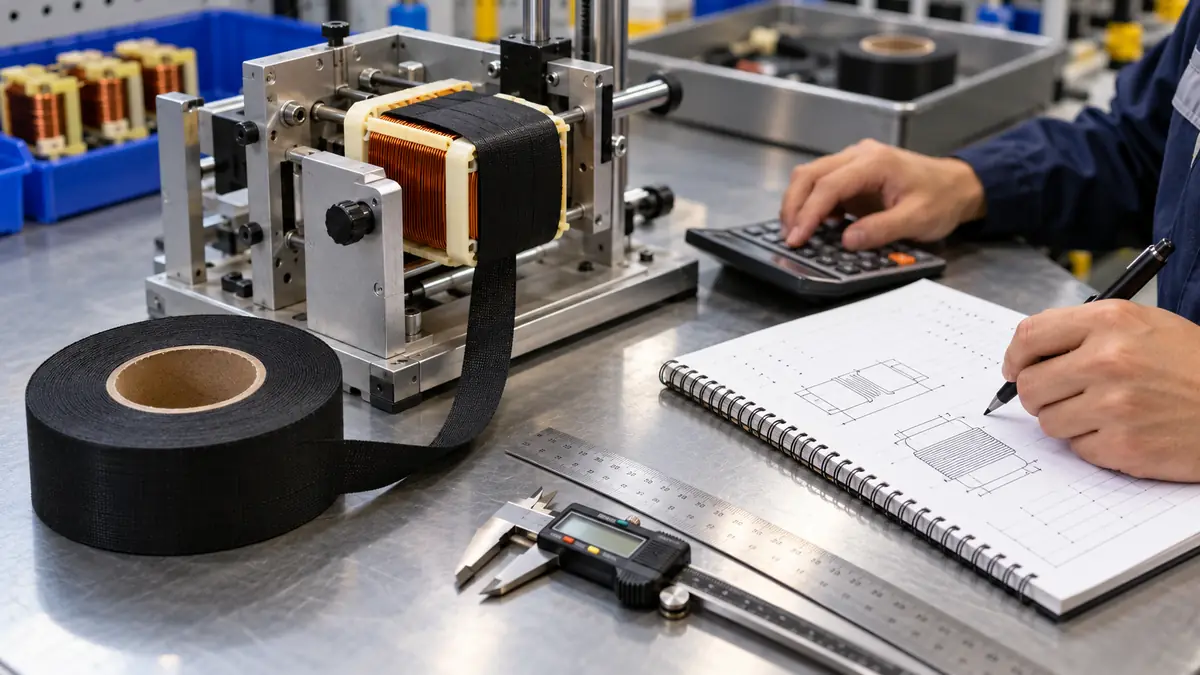
Quick Answer: Estimate, Then Measure
Acetate cloth tape consumption for a simple helical coil wrap is estimated as covered length divided by effective advance, multiplied by tape path per turn, then adjusted for required wrap passes, tails, patches and justified process losses. This guide is for electrical-component buyers, production engineers and planners who need an RFQ quantity or trial budget. The result is a planning estimate, not a released bill of material until representative parts have been wrapped and measured.
Use the same unit throughout—millimetres or metres—and define whether the tape is a helical wrap, circumferential turns, local patches or a combination. A single formula cannot describe every bobbin, toroid, end winding or irregular bundle. Technical content reviewed: .
Define the Coil and Wrap Inputs
Begin with the released wrap drawing. Record the covered length, local perimeter, tape width, overlap or pitch, number of layers, start and finish tail, local reinforcement pieces, cut losses and expected reject or setup usage. Also record the tape thickness and roll format because overlap and seam stacking can change the finished envelope even when the length estimate is accurate.
| Input | How to define it | Common mistake |
|---|---|---|
| Tape width, W | Finished slit width actually supplied | Using master-roll width or nominal width without tolerance |
| Overlap, O | Linear overlap per pass from the wrap instruction | Confusing percent overlap with millimetres |
| Effective advance, A | A = W − O for a simple helical estimate | Using full width even though passes overlap |
| Covered length, L | Axial or path distance that the wrap must advance | Ignoring end turns, shoulders or excluded zones |
| Local perimeter, P | Representative distance around the wrapped section | Using a flat width for an irregular or changing profile |
| Layers and allowances | Released layer count plus defined tails, patches and waste | Hiding every uncertainty inside one large waste percentage |
Choose an Estimating Method That Matches the Wrap
Simple circumferential turns
For a coil that receives discrete turns around a stable perimeter, estimate the number of turns and multiply by the representative perimeter. Add defined start and finish tails. This is appropriate only when the wrap instruction really uses separate or near-circumferential turns.
Simple helical coverage
For a helical wrap on a roughly constant section, estimate turns as covered length divided by effective advance, then multiply by the helical length per turn. If perimeter P is much larger than advance A, P may be a reasonable early approximation; the more complete turn length is √(P² + A²). Mark the result as geometric, because real folds and changing radii add usage.
Area-balance screen
For broad planning, tape length equals covered surface area multiplied by the effective layer count, divided by tape width. The effective layer count includes the coverage created by overlap; do not apply a second overlap multiplier to the same coverage. For example, ideal 50% overlap creates two nominal tape thicknesses over the interior of one simple wrap pass, but seams, corners and terminations still need separate allowance. Never use area balance to approve creepage, insulation thickness or finished build.
| Method | Best fit | Main limitation |
|---|---|---|
| Turn count × perimeter | Discrete turns on stable geometry | Misses helical path and changing perimeter |
| Helical path estimate | Continuous wrap along a near-constant section | Irregular shoulders and folds need measurement |
| Surface area ÷ width | Early budget and layer comparison | Does not model tails, overlaps or local patches by itself |
| Measured trial usage | Final BOM and purchasing control | Needs representative parts and disciplined measurement |
Build a Traceable Consumption Worksheet
Separate design quantity from process loss. Design quantity includes the tape intentionally present on the part. Process loss includes setup threading, cut ends, changeovers, damaged pieces, roll remnants and rejects. This separation makes improvement possible; a single “20% extra” hides the reason for variance.
Use three quantity levels
Record theoretical geometry, expected production issue and actual measured use. The difference between theory and expected production is the planned process allowance. The difference between expected and actual is variance requiring explanation.
| Worksheet field | Entry | Evidence |
|---|---|---|
| Geometry quantity | Method, dimensions, layer count and calculated length | Drawing revision and calculation |
| Part additions | Start/finish tails, local patches and reinforcement | Work instruction or cut list |
| Setup allowance | Threading, trial pieces and changeover use | Observed setup record |
| Yield allowance | Approved scrap, roll remnants and defect rate | Measured production history |
| Purchase conversion | Metres per part, parts per roll and rolls per lot | Verified usable roll length and pack quantity |
Illustrative Coil-Wrap Calculation
Assume a simplified rectangular coil section with representative perimeter P = 180 mm. The wrap must advance L = 120 mm. Tape width W = 18 mm and overlap O = 6 mm, so effective advance A = 12 mm. Estimated turns are 120 / 12 = 10. The approximate helical length per turn is √(180² + 12²) ≈ 180.4 mm.
Convert metres per part to a roll plan
If a verified usable roll length is 30 m, theoretical yield is 30 / 2.29 = 13.1 parts, so planning should not claim more than 13 complete parts before considering unusable remnants or changeover rules. Always use usable length, not the label alone, and define how partial rolls are controlled.
Measure Real Production Consumption
- Freeze the baseline. Confirm component revision, tape code, width, roll length, wrap path, overlap and layer count.
- Weigh or measure the roll. Use a calibrated, practical method before the trial; document the conversion method if mass is used.
- Run representative parts. Include normal setup, start/stop events and the approved operator or machine sequence.
- Count all outputs. Separate good parts, rejects, setup pieces, cut ends and unusable remnants.
- Measure remaining material. Use the same method and account for any roll moved to another operation.
- Calculate actual issue. Total consumed tape divided by accepted parts, with scrap reported separately.
- Compare with geometry. Explain tails, overlap drift, extra wraps, restarts, damaged rolls or wrong width.
- Repeat at boundaries. Include small/large coil variants, full/near-core roll condition and multiple lots where relevant.
- Release the planning factor. Approve metres per part and allowance only after quality results also pass.
Validate Quantity Without Sacrificing Coil Quality
A lower consumption number is not an improvement if it reduces required overlap, moves a lead, creates wrinkles or prevents varnish wetting. Verify every quantity trial against the released dimensional, visual, electrical, thermal and chemical requirements. The BOM must follow the approved wrap, not pressure the wrap to fit a target.
Audit the supplied roll format
Roll length, core, winding direction, splices, width tolerance and edge quality affect usable yield. Nitto publishes product-specific standard lengths, while Nitoms lists a 20 m retail construction; these examples show why the purchase unit cannot be assumed. Confirm the actual supplied SKU and usable-length rule.
| Validation area | Check | Release evidence |
|---|---|---|
| Coverage | Overlap, exposed areas, start/finish and local patches | Visual standard and measured sample |
| Dimensions | Finished envelope, bore, clearances and seam build | Inspection record across variants |
| Process | Tension, tracking, speed, cut length and changeover | Settings and capability evidence |
| Performance | Varnish/resin response and required electrical/mechanical tests | Released component test result |
| Consumption | Actual metres per accepted part and separated losses | Multi-run production record |
Troubleshoot Consumption Variance
| Symptom | Check first | Improvement direction | Recheck |
|---|---|---|---|
| Actual use exceeds estimate | Overlap, tails, extra turns, restarts and rejected wraps | Correct the worksheet or stabilize the process | Metres per accepted part and wrap quality |
| Yield changes near roll core | Roll length, tension, tracking and unusable remainder rule | Define usable length and near-core operating limits | Full-to-core trial |
| One operator uses more tape | Start point, overlap marks, termination and rework | Add fixtures or visual work standards | Multi-operator repeatability |
| Consumption drops but defects rise | Overlap, coverage, tension and missing reinforcement | Restore the released wrap; do not trade performance for yield | All component acceptance tests |
| Parts per roll vary by lot | Actual roll length, splices, width, damage and packaging | Clarify supply specification and incoming inspection | Lot-level usable yield |
Related Products, Articles and Technical Sources
Primary technical references
Nitto's acetate cloth electrical tape page provides product-specific thickness, standard length and electrical/mechanical typical values and explicitly marks measurements as examples, not guarantees. 3M Acetate Cloth Electrical Tape 11 describes conformability, coil wrapping and varnish/resin absorption for that construction. Nitoms No. 5 lists a specific 0.23 mm × 19 mm × 20 m format. Use the supplier's current data for the selected SKU; the formulas above remain illustrative.
Frequently Asked Questions and RFQ Checklist
Can overlap percentage alone calculate tape use?
No. You also need geometry, tape width, covered path, layers, tails, patches and measured process losses.
Should waste be a fixed percentage?
No. Use a temporary planning allowance, then replace it with measured setup, scrap, remnant and defect data.
Does a wider tape always reduce consumption?
Not necessarily. It may reduce turns but increase wrinkles, unusable width, seam build or scrap on compact geometry.
Can a calculated value be placed directly in the BOM?
Use it for trials and quotes, then release the BOM only after representative production measurement and component validation.
What belongs in an acetate tape RFQ?
Provide coil geometry, wrap drawing, tape role, width, overlap, layers, roll/core format, varnish process, annual quantity, expected issue and acceptance tests.
Turn Coil Geometry into a Supply Plan
Share the component drawing, wrap path, tape width, overlap, layers, roll format, annual volume and measured trial data. JIAO TAO TAO can prepare slit acetate cloth tape and a traceable sampling plan.
Double-Sided Tape for Metal Bonding Before Powder Coating
Related Article

Need help choosing the right industrial tape?
Send us your application details, including temperature, surface material, size, quantity and current problem. Our team will help recommend a suitable tape material or custom die-cut solution.

simon@jiaotaotao.com


+86-136 1277 5969


+86-136 1277 5969
