
Acetate Cloth Tape Unwind and Tension Control for Coil Wrapping
Product Guides · Coil-Wrapping Process
Acetate Cloth Tape Unwind and Tension Control for Coil Wrapping
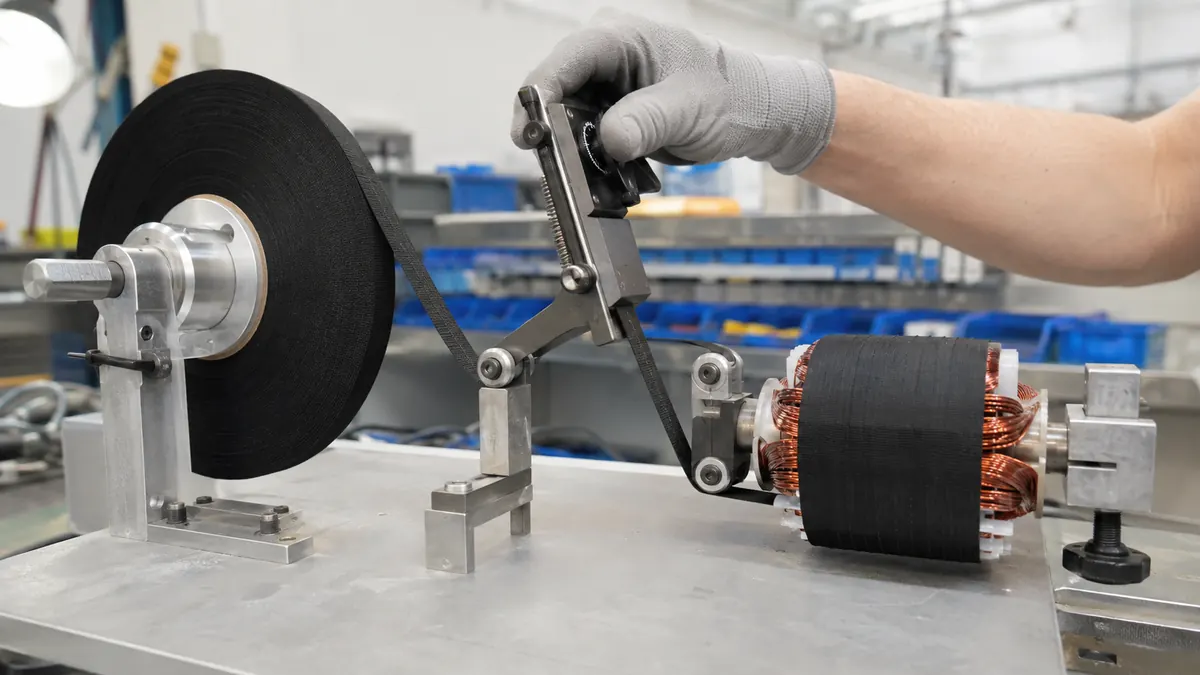
Acetate cloth tape unwind and tension control affects overlap, conformity, lead position, finished build, and operator consistency during coil wrapping. A stable process requires the tape construction, roll condition, brake setting, guide path, wrap speed, geometry, and acceptance limits to be defined together.
Quick Answer
Set acetate cloth tape unwind tension from the coil and wrap design, not from a generic machine value. The tape should track through the guides, conform to the approved winding or insulation layer, and form the specified overlap without stretching the coil, displacing lead exits, crushing insulation, wrinkling the cloth, or lifting after termination. Because roll diameter changes during use, a simple fixed brake may deliver different tension from full roll to core.
Why Unwind Tension Changes Coil Quality
Acetate cloth tape is flexible and can follow small radii, uneven winding packs, bobbin shoulders, and lead transitions. That conformity becomes a process variable when the tape arrives with changing force or side-to-side tracking. Excess tension can compress a soft winding, move a sleeve, pull a lead into a tight bend, narrow a toroidal opening, or create stored stress at the final edge. Too little tension can leave loops, wrinkles, channels, variable overlap, or poor contact.
Unwind behavior also affects handling at the tape edge. A sudden brake release or misaligned guide can pull the web sideways, fray a slit edge, or create a wrinkle that the operator then presses into the coil. The goal is not the highest stable tension; it is the lowest repeatable tension that delivers the released wrap geometry.
| Process variable | If too high | If too low or unstable |
|---|---|---|
| Unwind force | Coil compression, lead movement, adhesive transfer | Loose web, poor seating, stop-start variation |
| Guide alignment | Edge loading and side drag | Wandering overlap and roll tracking |
| Wrap speed | Dynamic spikes and missed conformity | Excess handling and inconsistent dwell |
| Termination pressure | Local deformation or adhesive squeeze | Lifted final edge and weak initial contact |
Specify the Tape and Roll Presentation
Define the exact cloth and adhesive
Backing weave, surface finish, total thickness, adhesive chemistry, tack, unwind level, hand-tear behavior, and varnish or resin response can differ between similar-looking black tapes. Approve a traceable construction and do not use color as the material identity.
Control slit edges and winding quality
Roll width must match the wrap path and permitted overlap. Inspect slit edges for loose fibers, adhesive buildup, stepped cuts, and damage. Roll telescoping, dish, core movement, splices, or crushed edges can alter tracking and create tension spikes even when the nominal tape is unchanged.
Match the core and roll diameter to the equipment
Specify core inside diameter, core width, maximum outside diameter, winding direction, splice policy, and packaging. The unwind shaft should support the core without eccentric motion. If brake torque is constant, web tension rises as roll radius decreases; use appropriate compensation or a validated operating window.
| RFQ input | What to provide | Process impact |
|---|---|---|
| Tape construction | Backing, adhesive, thickness, color, treatment, liner if any | Controls conformity, adhesion, chemistry, and traceability |
| Roll format | Width, length, core ID, OD, winding direction, splice limit | Determines machine fit and roll-change behavior |
| Coil geometry | Bobbin, winding pack, radii, leads, pins, keep-outs | Sets width, path, angle, overlap, and tension sensitivity |
| Downstream process | Varnish, resin, potting, cure, cleaning, housing assembly | Defines compatibility and finished build requirements |
| Acceptance plan | Tension method, dimensions, wrap inspection, electrical tests | Links supply quality to functional performance |
Design the Unwind and Guide Path
Keep the path short and easy to inspect. Align the roll, guides, dancer or tension arm, cut point, and coil datum so the web enters the wrap without an abrupt twist. Use smooth, clean guide surfaces with enough radius to avoid creasing or abrading the cloth. Prevent adhesive from contacting an unapproved roller face.
A brake, clutch, dancer, load cell, or torque-controlled unwind may be used depending on speed and precision. The choice should be proportional to the process: a manual fixture still needs a repeatable setting and check, while automation may need closed-loop control and alarms. Record whether tension is measured as static pull, running tension, brake torque, or a validated proxy; those values are not interchangeable.
Recommended Setup and Control Workflow
- Verify materials. Match coil, tape code, width, roll lot, core, and work instruction.
- Inspect the roll. Check edges, winding, splices, core fit, contamination, and storage condition.
- Thread the approved path. Confirm guide sequence, web face, winding direction, and cut location.
- Set the initial tension. Use the defined gauge or method at the specified roll condition.
- Run setup parts. Observe tracking, overlap, wrinkles, lead movement, and termination.
- Check at changing diameter. Confirm full, mid, and near-core behavior or validated compensation.
- Inspect completed coils. Measure wrap position, build, fibers, edges, and functional keep-outs.
- Record and react. Log settings, roll lot, results, stoppages, and authorized adjustments.
Validate the Complete Coil-Wrapping Process
Trials should include representative minimum and maximum coil geometry, tape lots, roll diameters, machine speeds, operators or equipment states, stop-start events, lead positions, downstream chemistry, and cure conditions. Do not approve the process from a visually neat wrap alone.
- Measure tension or the validated control parameter through the roll operating range.
- Inspect overlap, angle, wrinkles, bubbles, fray, lifted edges, exposed adhesive, and termination position.
- Measure finished outside dimensions, core or bore opening, lead route, pin clearance, and housing fit.
- Run the real varnish, potting, cure, cleaning, thermal, vibration, electrical, and functional checks required by the design owner.
- Requalify tape construction, slit width, core, roll length, brake, guide, speed, wrap pattern, or chemistry changes.
Troubleshooting Unwind and Wrap Defects
| Observed issue | Check first | Corrective direction |
|---|---|---|
| Tension rises near the core | Brake type, torque, radius compensation, bearing drag | Restore the validated compensation or roll window |
| Tape wanders sideways | Roll alignment, core fit, guide position, dish, side pressure | Align the web path and reject damaged rolls |
| Cloth wrinkles on the coil | Tension, width, entry angle, radius, speed, surface | Balance conformity, guidance, and approved wrap pattern |
| Loose fibers appear | Slit edge, roller abrasion, cut method, handling, debris controls | Improve edge quality and the controlled path |
| Final edge lifts after cure | Adhesive, pressure, seam location, tension, chemistry, heat | Screen the complete tape-process combination |
Related Products and Articles
Frequently Asked Questions
What is the correct unwind tension for acetate cloth tape?
There is no universal value. Set and validate tension from the tape, roll, coil geometry, wrap pattern, speed, lead sensitivity, and finished performance requirements.
Why does tension change as the roll becomes smaller?
With a constant brake torque, web tension changes with roll radius. Bearing drag, roll condition, and speed can add variation, so verify the full operating range.
Can operators judge tension by feel?
Feel may support setup, but a controlled process needs a defined measurement or validated setting plus inspection limits. Operator judgment alone is difficult to reproduce.
Does more tension improve adhesion?
Not necessarily. Excess tension may distort the coil or store stress. Initial contact depends on compatible surfaces, appropriate pressure, geometry, and dwell as well as tension.
What information belongs in an acetate tape RFQ?
Provide tape function, coil geometry, wrap pattern, width, roll and core requirements, process speed, tension method, downstream chemistry, volume, and qualification plan.
Define a Repeatable Coil-Wrapping Trial
Share the coil and lead geometry, current tape construction, roll and core format, guide path, tension method, wrap speed, overlap, varnish or potting sequence, annual usage, and acceptance tests. JIAO TAO TAO can help shortlist acetate cloth tape and converted supply formats for production evaluation.
Discuss unwind and tension controlAcetate Cloth Tape for Industrial Contactor Coil Finishing
Acetate Cloth Tape Slit-Edge Quality for Coil Wrapping
Related Article

Need help choosing the right industrial tape?
Send us your application details, including temperature, surface material, size, quantity and current problem. Our team will help recommend a suitable tape material or custom die-cut solution.

simon@jiaotaotao.com


+86-136 1277 5969


+86-136 1277 5969
