
Double-Sided Tape for Metal Bonding Before Powder Coating
Industrial Tape Application Guide
Double-Sided Tape for Metal Bonding Before Powder Coating
Select double-sided tape for metal bonding before powder coating by pretreatment, oven profile, joint geometry, application process and validation.
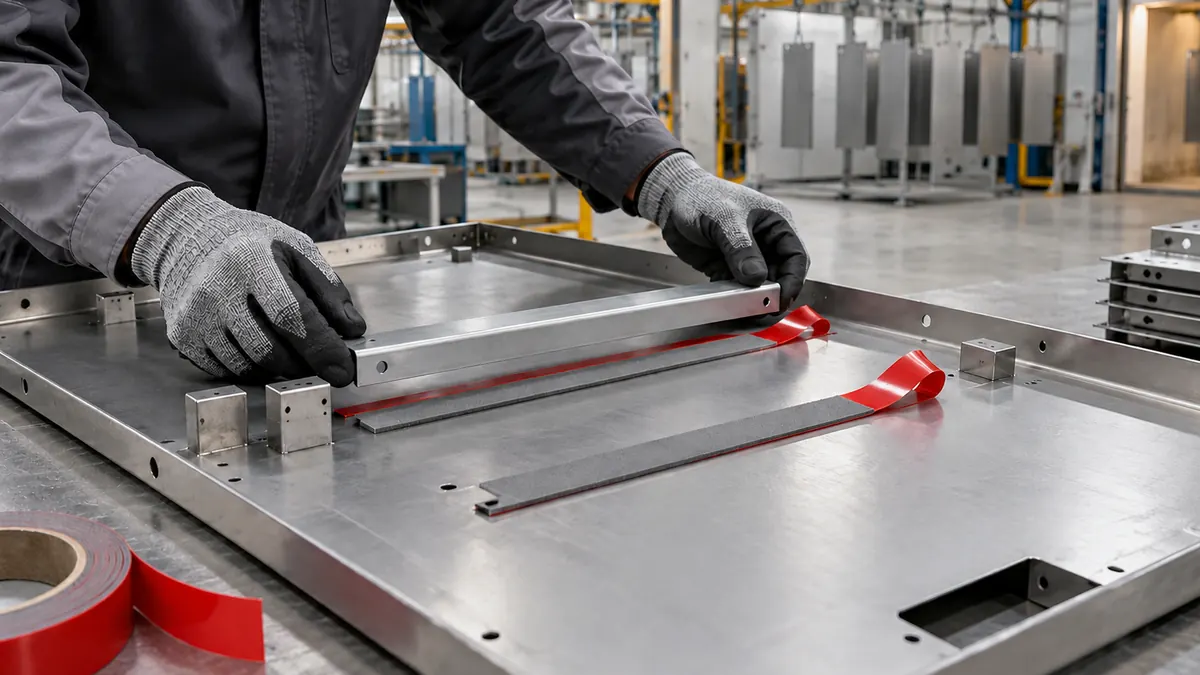
Double-sided tape used before powder coating must survive the complete pretreatment and oven-cure sequence while continuing to carry the finished joint. This guide is for sheet-metal fabricators, coating engineers, buyers and quality teams evaluating bonded stiffeners, brackets or panel reinforcements that enter the coating line as an assembly. The core decision is not whether an ordinary acrylic foam tape can tolerate one temperature headline; it is whether the specified construction, joint, metal preparation, liner removal, bath sequence and cure profile perform together.
This is distinct from bonding a part onto an already powder-coated surface. Here, tape is applied to bare or pretreated metal first; the assembled joint may then encounter cleaning, conversion coating, rinsing, drying, electrostatic powder and oven cure. Technical content reviewed: .
Define the Bond-Then-Coat Process Sequence
Map every exposure between tape application and finished-part release. Record whether the assembly is bonded before aqueous wash, after pretreatment but before powder, or at another controlled point. A construction qualified only for dry oven heat may fail when wash chemistry enters an exposed bond edge. Conversely, a tape chosen for wet pretreatment still needs thermal and mechanical validation through cure.
| Process input | What to record | Why it matters |
|---|---|---|
| Bond timing | Before wash, after conversion coating, before powder, or another released station | Determines chemical and contamination exposure |
| Pretreatment | Cleaner, rinse, conversion coat, temperature, time and spray/immersion route | Can attack an edge or become trapped in the joint |
| Cure profile | Oven air and measured part-metal temperature versus time | Tape sees the actual part profile, not only oven setpoint |
| Metal surfaces | Steel/aluminum grade, mill oil, oxide, roughness and cleaning method | Controls initial wet-out and bond strength |
| Finished duty | Load, peel risk, vibration, moisture, temperature and service life | Defines post-cure acceptance |
Select a Construction Designed for Pre-Powder-Coat Bonding
High-temperature acrylic foam tape
Acrylic foam can distribute stress and accommodate differential expansion between metal parts. A pre-powder-coat grade should have manufacturer evidence for the relevant pretreatment and oven route. Do not extend data from a post-paint mounting tape merely because both products use acrylic foam.
Heat-activated bonding film or tape
Some systems are positioned with limited initial tack and develop bond during oven heat. This can aid placement, but activation temperature, time, pressure and joint restraint become part of the process specification. A powder oven cannot be assumed to produce the same temperature history at every part mass or rack position.
Liner, edge and thickness controls
Define total bond-line thickness, liner type, slit tolerance, splices, roll winding and storage. A thicker foam can fill modest flatness variation; excessive thickness can increase movement or change panel spacing. Keep wash paths and powder access in mind when deciding whether the bond is a full-area pad, strips or a perimeter pattern.
| Construction | Potential fit | Qualification focus |
|---|---|---|
| Pre-powder-coat acrylic foam | Permanent metal-to-metal bond made before coating | Pretreatment resistance, cure profile and retained viscoelasticity |
| Heat-activated tape/film | Joint designed to develop strength during the oven cycle | Activation window, pressure, fixture and rack variation |
| General high-temperature foam tape | Screening only when supplier explicitly supports the complete route | Do not infer wet-chemistry compatibility from heat rating |
| Temporary fixture tape | Holding parts for another joining operation | Must not be confused with the permanent bond line |
Design the Joint for Shear and Minimize Peel
Pressure-sensitive tape carries distributed in-plane loads more efficiently than a concentrated peeling force. Use overlap geometry that places routine loads in shear, keeps the tape away from pry edges and supports the stiffener against rocking. Rounded tape ends can reduce a sharp stress concentration. Provide drainage or controlled edge sealing only when the coating and pretreatment design requires it.
Panel and stiffener stiffness also matter. A very flexible skin can peel away at the bond edge even when the average shear load is low. Model or fixture the joint so the complete assembly—not only a flat coupon—is represented.
Illustrative Bond-Area Screening Example
A first screening calculation divides the design shear load by nominal bonded area: average shear stress = load / bonded area. This cannot set an allowable because it omits peel, cleavage, impact, thermal expansion, creep, process degradation and safety factors.
| Worksheet field | Required entry | Decision supported |
|---|---|---|
| Joint and load | Drawing, bonded area, load direction, peak load, peel path and consequence of failure | Is tape appropriate for this joint? |
| Tape identity | Backing/core, adhesive, thickness, liner, supplier code and lot | Is the tested construction traceable? |
| Coating route | Bond station, pretreatment, rack, oven profile and powder system | Does the trial cover every exposure? |
| Process controls | Cleaning, application temperature, pressure, dwell, fixture and handling | Can production reproduce the sample? |
| Acceptance | Initial handling, post-cure strength, failure mode, appearance and aging | Are pass/fail limits set before testing? |
Controlled Bond-Then-Coat Workflow
- Confirm the released route. Match metal lots, drawing, tape, pretreatment and cure revision.
- Prepare both metals. Remove oil, particles and oxide using the qualified surface method.
- Inspect the parts. Hold warped, burred, contaminated or out-of-flatness components.
- Apply tape without stretch. Use a datum, controlled pressure and the specified overlap.
- Remove the liner cleanly. Avoid lifting the tape or transferring debris.
- Join once in a fixture. Align the stiffener or bracket without sliding after contact.
- Apply final pressure. Use the qualified platen or roller across the complete bond area.
- Respect pre-coat dwell. Protect the assembly from peel or movement before the coating line.
- Run the documented coating process. Track rack location and actual part-metal temperature.
- Inspect and test after cure. Release only after the defined mechanical and finish checks pass.
Keep exposed liner fragments, squeeze-out and loose adhesive away from the coating booth. If the tape is intended to remain hidden beneath the bonded part, confirm that the joint does not create an unacceptable liquid trap during pretreatment.
Validate Before, During and After Powder Cure
Evaluate initial handling strength so the part cannot shift on the rack. Then inspect after each major step in a controlled trial: pretreatment, drying, powder application and cure. Final testing should use the complete finished assembly and include the environmental and mechanical loads relevant to service.
| Validation stage | Observe or measure | Release evidence |
|---|---|---|
| Before coating | Alignment, edge wet-out, gap, movement and initial handling | Fixture and first-piece record |
| After pretreatment | Edge lift, trapped liquid, swelling, movement and visible ingress | Inspection by defined method |
| After oven cure | Displacement, foam collapse, squeeze-out, discoloration and joint flatness | Actual time-temperature record and photos |
| Mechanical | Shear, peel/cleavage, tensile or component test appropriate to the design | Engineering-approved method and limit |
| Environmental | Humidity, thermal cycling, vibration, corrosion or service fluids | Conditioned result and failure classification |
Pre-Powder-Coat Bond Acceptance Record
Retain: assembly drawing and revision | metal lots and surface condition | tape code, lot, width and thickness | cleaner and application pressure | pre-coat dwell | pretreatment route | oven setpoint and measured part-metal profile | powder/cure lot | post-cure dimensions | mechanical result | failure mode | photo IDs | disposition.
Troubleshoot the Process Stage That Created the Failure
| Symptom | Check first | Controlled improvement | Required recheck |
|---|---|---|---|
| Part shifts before coating | Surface condition, pressure, fixture, initial tack and dwell | Restore the approved application process or fixture support | Handling through rack loading |
| Edge lifts after pretreatment | Exposed edge, wash pressure, chemistry, overlap and adhesive evidence | Revise edge geometry or qualified construction | Full pretreatment route plus cure |
| Bond slides in the oven | Part-metal profile, load orientation, foam softening and fixture restraint | Correct the cure/fixture or evaluate an approved heat-activated system | Worst-case rack and heavy-part profile |
| Joint passes hot but fails after cooling | Differential expansion, peel geometry, metal flatness and bond thickness | Redesign stress path or compare a suitable viscoelastic construction | Thermal cycling and mechanical test |
| Powder finish defects near joint | Contamination, trapped wash, liner fragments and exposed adhesive | Contain parts and correct cleanliness or drainage before changing tape | Finish inspection and bond validation |
Related Products, Articles and Technical Sources
Technical sources and scope
3M's pre-powder-coat VHB technical bulletin treats metal cleaning, tape family, joint width and oven exposure as part of the process and explicitly notes that coating plants vary. 3M's architectural-panel guidance describes stiffener attachment before paint or powder-coat bake for identified tape families. Scapa's AS1230 data sheet identifies an acrylic foam tape for metal-to-metal bonding before powder coating. These manufacturer statements apply to their named products; they are not performance claims for JIAO TAO TAO tape. The load calculation above is an original screening example.
Frequently Asked Questions and RFQ Checklist
Can ordinary high-temperature foam tape go through powder coating?
Do not assume so. The tape must have evidence for the full pretreatment, oven profile and permanent service joint.
Is this the same as bonding onto powder-coated metal?
No. Pre-powder-coat tape is applied before the finish and may face wet chemistry and oven cure; post-coat bonding adheres to the cured paint surface.
Can the oven cure create the final bond?
Some heat-activated systems are designed for that route, but activation temperature, time, pressure and fixture conditions must be qualified.
Should testing use oven air temperature or part-metal temperature?
Record the actual part-metal time-temperature profile because heavy and light assemblies can heat differently at the same oven setting.
What belongs in a pre-powder-coat tape RFQ?
Provide metals, drawing, bond area, load direction, pretreatment route, oven and part-metal profile, powder system, tape thickness limit, annual volume and post-cure tests.
Prepare a Bond-Then-Coat Engineering Trial
Share the metal pair, joint drawing, load case, application station, pretreatment sequence, powder system, measured part-metal cure profile, tape thickness limit, annual volume and acceptance plan. JIAO TAO TAO can prepare slit or die-cut double-sided tape candidates for controlled evaluation.
Custom Die-Cut Tape for LiDAR Sensor Window Bonding
Related Article
Need help choosing the right industrial tape?
Send us your application details, including temperature, surface material, size, quantity and current problem. Our team will help recommend a suitable tape material or custom die-cut solution.

simon@jiaotaotao.com


+86-136 1277 5969


+86-136 1277 5969
