
Polyimide Tape Residue: Causes, Prevention and Clean Removal
Polyimide Tape Residue: Why It Happens
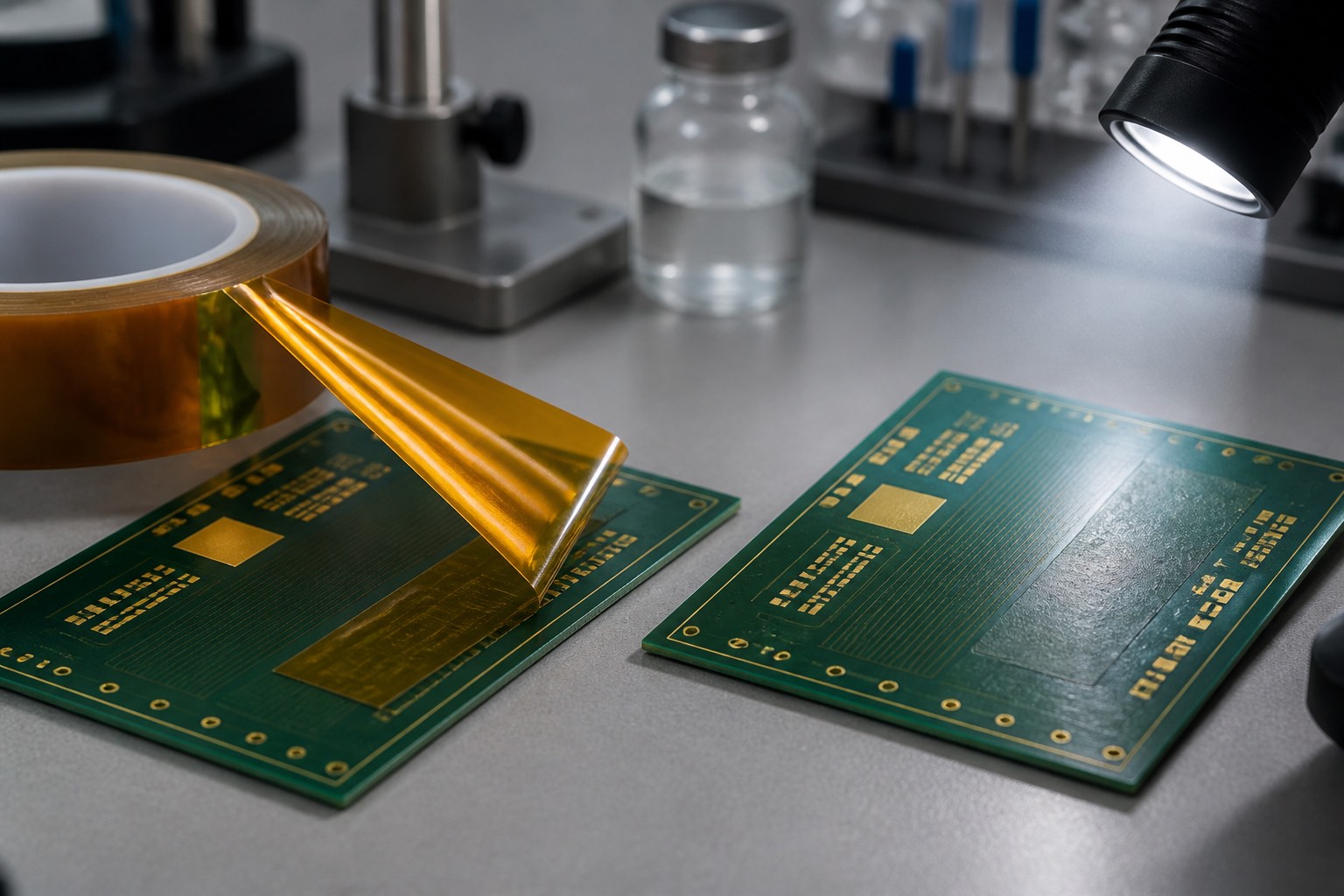
Polyimide tape residue is usually caused by a mismatch among adhesive chemistry, temperature, dwell time, substrate, pressure, aging, and removal conditions. The amber film may look intact while the adhesive has softened or chemically interacted with the surface. Clean removal therefore has to be validated across the complete production cycle.
Quick Answer
To reduce residue, use the correct tape grade, clean and dry the substrate, avoid exceeding the specified thermal exposure, apply only the pressure needed for good contact, and remove the tape at the validated temperature and angle. Test the actual board finish, paint, metal, plastic, or insulation material before production.
Main Causes of Adhesive Transfer
Excessive Temperature or Dwell Time
Short peak exposure and prolonged heating are not equivalent. Heat can increase adhesive flow and promote interaction with a coating or solder mask. A tape that removes cleanly after one brief cycle may behave differently after repeated cycles or an extended oven dwell.
Wrong Adhesive for the Surface
Silicone and acrylic adhesive systems have different adhesion, aging, and removal characteristics. Neither is universally residue-free. The correct option depends on the surface energy, roughness, contamination, thermal profile, and whether the bond is temporary or permanent.
Surface Contamination
Oil, flux, dust, release agent, moisture, oxidation, and cleaning residues can create uneven contact. During heating, contamination may mix with softened adhesive and appear as tape residue. Use a cleaning method approved for the substrate and allow the surface to dry fully.
Excess Application Pressure
Pressure-sensitive adhesive needs firm contact, but excessive rolling pressure or stretching can force adhesive into texture and gaps. This increases removal force and can contribute to transfer, especially after heat exposure.
Delayed or Incorrect Removal
Removal angle, speed, and temperature affect the stress placed on the adhesive layer. Pulling sharply upward can increase local stress. A controlled low-angle peel is often easier, but the correct procedure must be established through testing.
Residue-Prevention Checklist
- Record peak temperature, dwell time, heating rate, cooling time, and cycle count.
- Use the exact production substrate, coating, solder mask, or plastic.
- Clean with an approved process and confirm the surface is dry.
- Apply tape without excessive stretch, wrinkles, or trapped air.
- Control pressure with the same roller or application method.
- Remove at the specified temperature, angle, and speed.
- Inspect under angled light and define an objective acceptance limit.
How to Run a Practical Clean-Removal Test
Prepare at least three representative samples from the same substrate batch. Apply the tape consistently, allow the planned dwell before heating, run the complete thermal profile, and remove the tape at the chosen process point. Inspect for visible transfer, edge staining, surface damage, and changes in adhesion. Repeat the test after the maximum expected storage time.
For PCB processing, review our high-temperature tape guide for SMT reflow and wave soldering. For available constructions, see the JIAO TAO TAO polyimide tape range.
What to Do If Residue Appears
Stop and preserve the failed sample before cleaning it. Record the lot number, substrate, thermal profile, application method, removal conditions, and time between processing and inspection. Determine whether the material is adhesive transfer, contamination, coating change, or discoloration. Any cleaning solvent must first be checked for compatibility with the component and workplace requirements.
Frequently Asked Questions
Does all polyimide tape leave residue?
No. Clean removal depends on the specific tape and process. Even a suitable tape can transfer adhesive if it is overheated, left too long, applied to a contaminated surface, or removed incorrectly.
Should polyimide tape be removed hot or cold?
There is no universal rule. Some processes favor warm removal, while others require cooling. The supplier recommendation and an application-specific test should define the removal window.
Can residue be predicted from peel adhesion?
Peel adhesion is useful, but it does not by itself predict residue after heat. Thermal aging, substrate interaction, dwell time, and removal technique also matter.
Conclusion
Preventing polyimide tape residue requires control of the entire process, not simply choosing an amber high-temperature tape. Share your substrate, heat cycle, removal requirement, dimensions, and cleanliness standard with JIAO TAO TAO to select and test an appropriate construction.
Polyimide Tape Dielectric Strength: What Engineers Should Check
Polyimide Tape Thickness: How to Choose the Right Construction
Related Article

Need help choosing the right industrial tape?
Send us your application details, including temperature, surface material, size, quantity and current problem. Our team will help recommend a suitable tape material or custom die-cut solution.

simon@jiaotaotao.com


+86-136 1277 5969

+86-136 1277 5969
