
PTFE Tape for Textile Fusing Press Platen Protection
PTFE Tape for Textile Fusing Press Platen Protection
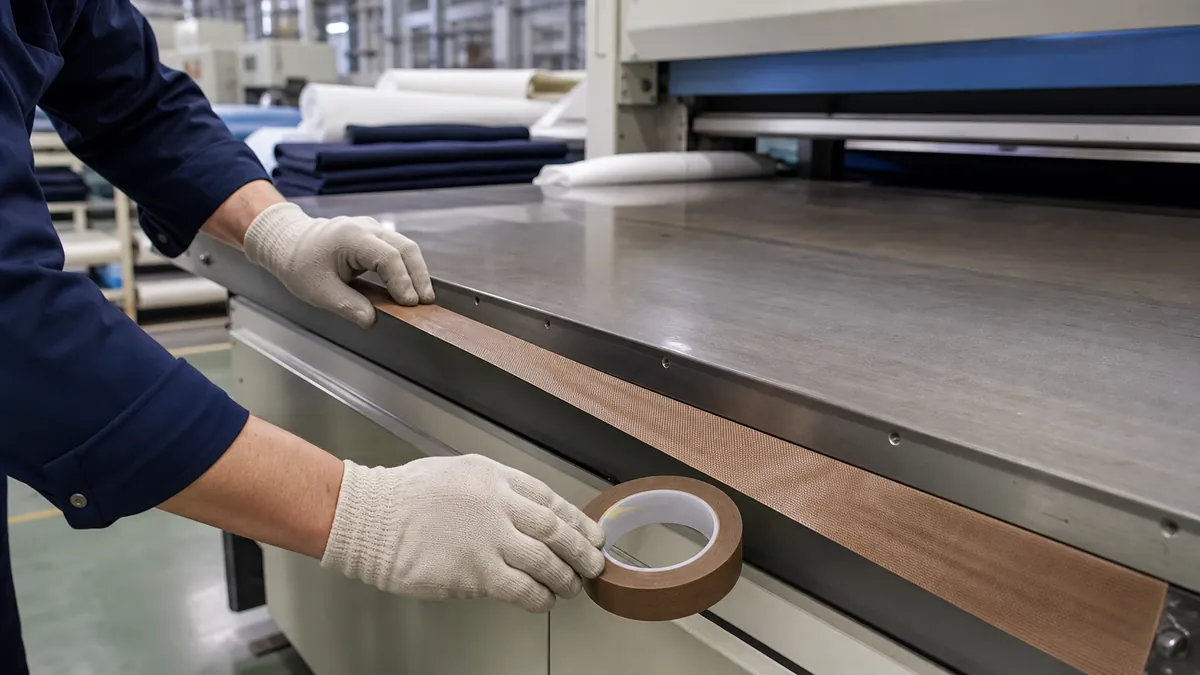
PTFE tape for textile fusing press platen protection creates a smooth, non-stick barrier where fusible adhesive, resin, or fabric contamination can collect on hot machine surfaces. Correct selection and installation can simplify cleaning and support consistent material flow, but the tape must be matched to the press design, operating cycle, surface condition, and maintenance method.
What the PTFE Surface Does in a Fusing Process
Fusing presses combine heat, pressure, and dwell time to bond interlining to fabric. Adhesive can migrate beyond the intended area, especially when components are misaligned or process settings are unstable. Deposits on a platen, guide, or transition edge may transfer to later garments, create drag, or require frequent mechanical cleaning.
PTFE-coated tape provides a low-surface-energy contact layer over a suitable machine surface. The tape is a replaceable maintenance component, not a correction for excessive adhesive flow or an incorrectly set press. Operators should first control material alignment, adhesive quantity, temperature, pressure, and dwell time.
Common Locations for PTFE Tape on Fusing Equipment
- Platen edges and transition zones where fabric enters or leaves the heated area.
- Small guide surfaces that contact adhesive-bearing material.
- Localized repair areas on an approved non-stick cover system.
- Release surfaces near cleaning or scraping points specified by the equipment owner.
Do not place tape over sensors, ventilation paths, moving joints, pressure-control components, or areas where the equipment manufacturer prohibits added material. Disconnect and cool the machine before maintenance.
PTFE Tape Construction and Selection Parameters
| Parameter | Why it matters | What to verify |
|---|---|---|
| Backing construction | Influences dimensional stability, durability, and conformity | PTFE-coated fiberglass fabric or another approved PTFE construction |
| Overall thickness | Changes edge height and flexibility | Clearance, seam profile, and whether fabric can catch the edge |
| Surface texture | Affects material glide and imprint risk | Suitability for the fabric and adhesive system |
| Adhesive system | Controls holding power on the platen or guide | Compatibility with the cleaned metal and operating cycle |
| Width and edge layout | Determines coverage and number of seams | A width that protects the zone without obstructing machine functions |
| Removal and replacement behavior | Affects maintenance time and surface cleanup | Removal method after realistic service exposure |
PTFE Tape, PTFE Sheet, or OEM Belt Cover?
| Option | Best suited to | Limitations to consider |
|---|---|---|
| Pressure-sensitive PTFE tape | Localized protection, defined edges, and maintenance replacement | Seams, edge wear, and adhesive compatibility |
| PTFE sheet or fabric cover | Larger continuous areas where the machine design accepts a cover | Fastening, tension, wrinkles, and thermal expansion |
| OEM belt or platen component | Primary machine surfaces designed by the equipment manufacturer | Lead time, cost, and replacement procedure |
| Temporary release paper | Short production trials or material-specific protection | Handling, waste, movement, and limited durability |
Installation Procedure
- Lock out and cool the press. Follow the equipment manufacturer's maintenance and energy-isolation instructions.
- Remove the old protective layer. Use approved tools and cleaners that will not scratch or distort the platen.
- Inspect the substrate. Tape cannot compensate for dents, sharp burrs, loose hardware, or damaged machine components.
- Clean and dry the surface. Remove adhesive, oil, lint, release agents, and cleaner residue.
- Measure and pre-cut. Use a strip width and length that reduce unnecessary seams and avoid functional openings.
- Apply from one end. Peel the liner gradually while smoothing the tape without tension, trapped air, or wrinkles.
- Seal the edge. Press the full bonded area with a suitable roller or firm hand pressure.
- Run an approved trial. Inspect tape position, fabric movement, surface marks, temperature recovery, and adhesive transfer before normal production.
Preventing Early Edge Lift and Wrinkling
Edge lift often begins with contamination, a tape seam facing material flow, insufficient pressure during installation, or a strip that was stretched around a corner. A sharp step between the tape and the platen can also catch fabric. Use rounded corners where practical, orient seams away from the direction of travel, and avoid layering tape unless the maintenance standard specifically allows it.
Wrinkles can create pressure variation or marks on sensitive textiles. Apply the tape to a flat, cool surface and smooth it progressively. If the area has compound curves or moving geometry, ask whether a formed cover or different construction is more appropriate than pressure-sensitive tape.
Maintenance and Replacement Checklist
- Inspect the PTFE surface at the start of a shift or at the interval defined by the plant.
- Look for cuts, burnishing, exposed fiberglass, lifted edges, wrinkles, contamination, and adhesive seepage.
- Clean only with methods approved for both the PTFE surface and the press.
- Replace a damaged strip instead of covering a failing edge with another unapproved layer.
- Record the tape construction, installation date, machine location, and reason for replacement.
Related Tape Resources
- Review available PTFE tape constructions for industrial non-stick surfaces.
- See a related guide to PTFE tape for blister packaging heat-seal plates.
- Send your machine and application details to discuss roll width, length, and converted pieces.
Frequently Asked Questions
Is PTFE plumbing thread-seal tape suitable for a fusing press?
No. Textile equipment protection normally uses an engineered PTFE-coated tape or cover with a backing and adhesive designed for surface application. Thread-seal tape is a different product.
Can PTFE tape repair a damaged fusing belt?
Only use a repair method approved by the equipment or belt manufacturer. A local tape patch can change thickness, tracking, pressure, or fabric contact and may not be appropriate.
Why does a PTFE tape edge collect lint?
The edge may be lifted, damaged, oriented against material travel, or exposed to adhesive contamination. Inspect surface preparation, seam direction, installation pressure, and the condition of the tape.
How often should PTFE tape be replaced?
Use a condition-based interval supported by machine inspections. Service life depends on contact, heat cycle, cleaning, fabric, adhesive contamination, and installation quality.
Should the platen be hot during installation?
Maintenance should follow the equipment manufacturer's safe procedure. In most cases, the surface must be powered down, cool, clean, and dry so the tape can be installed accurately and safely.
Specify PTFE Tape for Your Fusing Press
Provide the machine type, protected location, strip dimensions, operating cycle, surface material, and current failure mode. The JIAO TAO TAO team can help compare PTFE tape constructions and prepare samples for an on-machine validation.
Custom Die-Cut Tape for LCD Backlight Light-Leak Control
Acetate Cloth Tape for Transformer Lead Exit Reinforcement
Related Article
Need help choosing the right industrial tape?
Send us your application details, including temperature, surface material, size, quantity and current problem. Our team will help recommend a suitable tape material or custom die-cut solution.

simon@jiaotaotao.com


+86-136 1277 5969


+86-136 1277 5969
