
Polyimide Tape for Motor Slot Wedge Retention Before VPI
Technical Insights · Motor Manufacturing
Polyimide Tape for Motor Slot Wedge Retention Before VPI
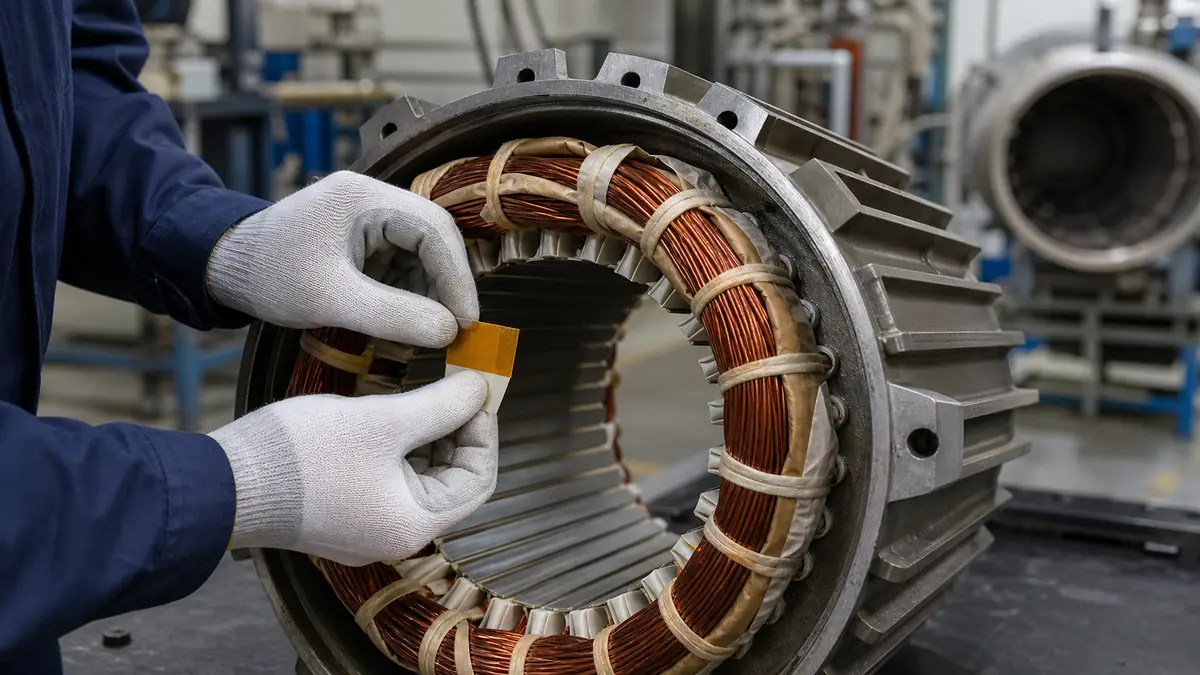
Polyimide tape for motor slot wedge retention can provide temporary, localized holding while a wound stator moves from wedge insertion to vacuum pressure impregnation. It must support the released insulation process without replacing the slot wedge, lacing, bracing, varnish, or mechanical retention designed into the motor.
Quick Answer
Use a polyimide tape patch at a motor slot wedge only when the winding drawing or approved work instruction defines its exact temporary function. The patch may help keep a wedge end or adjacent insulation component in position during handling, transfer, preheat, and VPI loading. It should never conceal an incorrectly sized wedge, damaged slot liner, displaced conductor, burr, or missing structural retention.
Define What the Patch Must Retain
Slot wedges close the slot opening and help maintain conductor and insulation position within the stator. Their shape, material, interference, insertion depth, and end condition belong to the motor design. A localized tape patch may be considered where handling or winding spring-back could move an otherwise correct wedge before varnish is cured.
Map the complete route from wedge insertion through inspection, transport, preheat, VPI, draining, curing, and final test. The tape must remain controlled through every stage or be removed at a specified point.
| Location | Possible temporary role | Do not use it to |
|---|---|---|
| Wedge end | Limit local lift during stator transfer | Compensate for incorrect wedge interference |
| Slot-mouth transition | Hold an approved insulation flap or edge | Cover a sharp lamination burr |
| End-winding side | Stabilize a short transition until lacing or impregnation | Carry electromagnetic or vibration loads |
| Inspection witness area | Provide a defined temporary reference | Hide conductor, liner, or wedge defects |
Select the Polyimide Tape Construction
Film and adhesive are one system
Polyimide film provides a thin, heat-resistant backing, but the adhesive determines initial hold, varnish interaction, cure response, edge lift, and residue. Specify a traceable tape code with current supplier data. Color alone cannot identify film thickness, adhesive chemistry, or thermal capability.
Check every contacted surface
The patch may touch a wedge, slot liner, enamel wire, insulating paper, lacing, existing tape, or varnished steel. Screen adhesion and removal on the exact materials and conditioning state. An aggressive adhesive can disturb a delicate liner; a low-tack construction may release during preheat or vacuum.
Review VPI and cure exposure
Vacuum, pressure, resin chemistry, temperature, dwell, drainage, and cure can change adhesive flow and film position. The patch must not create a resin shadow, trap air, release particles, or migrate toward the air gap. Representative impregnation trials are essential.
| Selection input | What to record | Why it matters |
|---|---|---|
| Polyimide film | Grade, thickness, color, width, and tensile behavior | Controls build, stiffness, and handling |
| Adhesive | Chemistry, coating side, tack, and approved temperature sequence | Controls retention and process interaction |
| Stator materials | Wedge, liner, wire enamel, varnish, and existing insulation | Defines the compatibility set |
| VPI cycle | Vacuum, resin, pressure, drain, preheat, and cure | Represents the actual chemical and thermal exposure |
| Final motor duty | Voltage, temperature, vibration, speed, and environment | Sets system-level validation requirements |
Design Patch Geometry and Placement
Use the smallest repeatable patch that meets the approved retention need. Define width, length, overlap, start and finish faces, orientation, and maximum distance from the lamination stack or bore. Keep tape clear of rotor clearance, air-gap surfaces, cooling features, sensors, terminals, and varnish paths identified by the motor designer.
A die-cut patch can improve length and edge consistency when a hand-cut strip varies too much. Rounded corners may reduce lifting, while a liner tab can help operators place the adhesive without touching it. Any converted format still requires drawing tolerances and lot traceability.
Recommended Application Workflow
- Verify revisions. Match stator, wedge, insulation, tape, varnish, and work instruction.
- Inspect the slot. Confirm wedge depth, liner condition, conductor position, and absence of burrs.
- Prepare approved patches. Use the released width and cut method; control loose backing or liner debris.
- Locate the datum. Place the patch from the specified wedge end, slot, or fixture reference.
- Apply light controlled pressure. Seat the patch without moving the wedge or compressing insulation.
- Check the bore. Confirm that no film, adhesive, or liner enters the rotor envelope.
- Account for liners. Remove and count every release liner before VPI loading.
- Inspect before impregnation. Record wedge position, tape edge, wrinkles, lift, and traceability.
Validate Through VPI, Cure, and Motor Tests
Qualification should compare representative stators with and without the proposed process aid when the motor owner considers that comparison meaningful. Include normal and worst-case wedge position, tape age, application pressure, VPI loading delay, resin batch, drain orientation, and cure profile.
- Inspect tape position before VPI, after impregnation, after cure, and after machining or assembly steps.
- Section development samples where practical to look for resin shadows, voids, lifted edges, or adhesive migration.
- Measure wedge position and bore clearance using the released inspection method.
- Run required winding resistance, surge, hipot, insulation resistance, partial-discharge, vibration, thermal, and functional tests defined by the motor owner.
- Requalify changes to wedge, liner, tape, resin, cure, patch geometry, or application method.
Troubleshooting Common Defects
| Observed problem | Check first | Corrective direction |
|---|---|---|
| Patch lifts before VPI | Surface condition, adhesive, pressure, dwell, and preheat | Correct the approved surface and application window |
| Wedge still moves | Wedge dimensions, insertion, slot condition, handling, and patch location | Fix the mechanical retention cause before changing tape |
| Resin void appears near patch | Patch area, overlap, edge seal, vacuum, pressure, and drainage | Reduce obstruction and revalidate impregnation |
| Adhesive migrates after cure | Adhesive chemistry, resin, temperature, pressure, and dwell | Select a compatible construction with supplier support |
| Film enters the bore | Patch length, datum, wedge movement, and inspection access | Stop production and tighten geometry and poka-yoke controls |
Related Products and Articles
Frequently Asked Questions
Can polyimide tape replace a motor slot wedge?
No. The wedge and its mechanical retention belong to the motor design. A tape patch may only perform the defined, qualified temporary role in the released process.
Should the tape remain after VPI?
That depends on the approved design and process. Define whether it remains, is integrated by varnish, or is removed before a specific stage, then validate that sequence.
Does amber color prove VPI compatibility?
No. Color does not identify film thickness, adhesive chemistry, resin compatibility, or cure performance. Approve the exact tape code.
How much overlap should a wedge-retention patch use?
There is no universal value. Specify geometry from the wedge, slot mouth, insulation stack, bore clearance, retention need, and VPI flow path.
What belongs in an RFQ?
Provide the stator and slot geometry, wedge and liner materials, tape function, VPI resin and cycle, cure, patch drawing, motor duty, quantity, and validation requirements.
Define a Controlled Slot-Wedge Retention Trial
Share the stator slot and wedge drawing, insulation materials, current retention method, VPI resin and cycle, cure profile, patch envelope, bore clearance, production volume, and acceptance tests. JIAO TAO TAO can help prepare polyimide tape samples or converted patches for motor-process qualification.
Discuss motor slot-wedge retentionPTFE Tape for Shrink-Wrap L-Sealer Release Surfaces
PTFE Tape for Textile Seam-Sealing Machine Guide Surfaces
Related Article

Need help choosing the right industrial tape?
Send us your application details, including temperature, surface material, size, quantity and current problem. Our team will help recommend a suitable tape material or custom die-cut solution.

simon@jiaotaotao.com


+86-136 1277 5969


+86-136 1277 5969
