
Acetate Cloth Tape Storage and Handling Before Coil Wrapping
Technical Insights · Material Control
Acetate Cloth Tape Storage and Handling Before Coil Wrapping
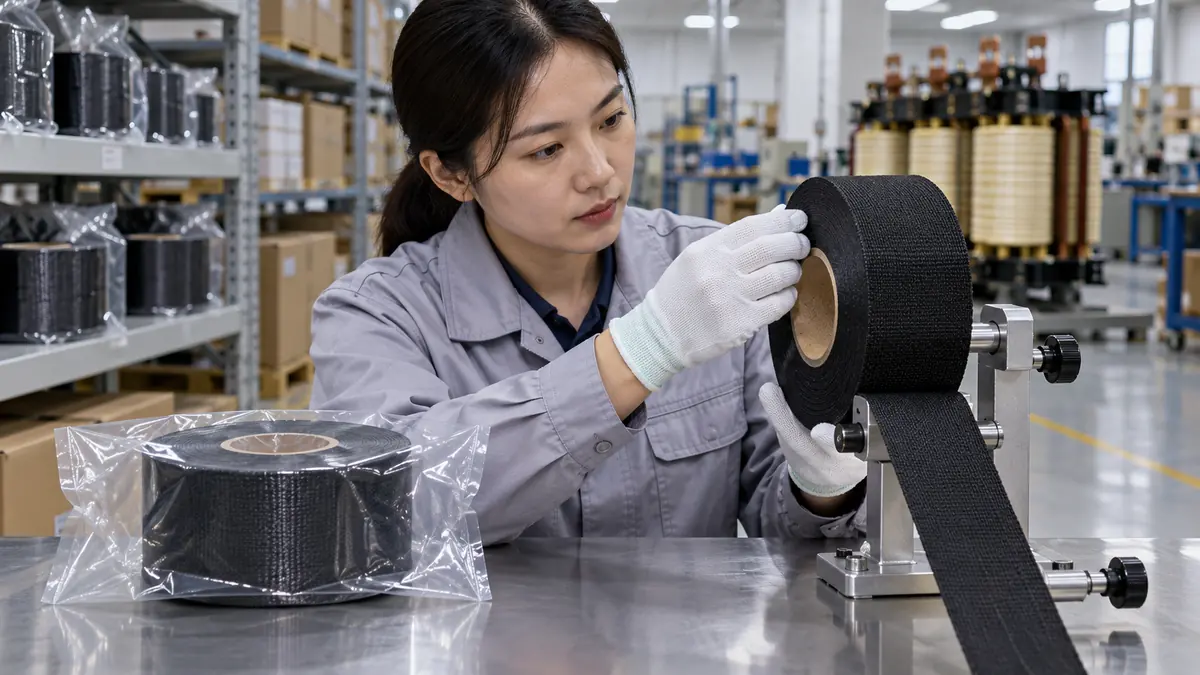
Acetate cloth tape storage and handling can influence unwind, edge condition, adhesion and wrapping consistency before a roll ever reaches a coil. Keep the exact product in its supplier packaging under the conditions defined by its technical data, rotate inventory by documented shelf life, and inspect conditioned rolls before releasing them to production.
Quick Answer
Store acetate cloth tape according to the current instructions for the exact grade, not a generic rule for all black electrical tapes. Keep rolls clean, dry, protected from direct heat and sunlight, supported so edges and cores are not crushed, and traceable to their lot and receipt date. Before use, allow conditioned material to reach the approved production environment, inspect the roll and run a representative unwind or wrap check.
Why Storage Affects Coil-Wrapping Performance
Acetate cloth tape combines a woven backing, adhesive and converted roll geometry. Temperature, pressure and time can influence adhesive flow, roll blocking and edge transfer. Moisture or contamination can affect surfaces and handling. Poor stacking can deform cores, telescope the web or damage slit edges. None of these conditions is guaranteed to cause failure, but each can change how a roll tracks, releases and conforms on a winding.
The production symptom may appear far from the storeroom. An operator can see unstable unwind, frayed edges, a hard roll, variable tack or seams that do not remain seated. If the investigation begins only at the wrapping machine, earlier packaging, transport and storage evidence may already be lost.
| Observed condition | Possible storage or handling factor | Production concern |
|---|---|---|
| Telescoped roll | Side load, poor stacking, temperature or winding condition | Tracking drift and damaged edges |
| Blocking or heavy unwind | Heat, pressure, age or adhesive movement | Stretch, torn cloth or unstable application tension |
| Loose fibers at the edge | Contact damage, open packaging or poor handling | Debris near windings, gaps or varnish surfaces |
| Condensation or damp packaging | Environmental transfer without conditioning | Surface contamination and inconsistent adhesion |
| Unknown lot or date | Label loss, mixed cartons or uncontrolled partial rolls | No defensible shelf-life or change-control decision |
Build a Product-Specific Storage Specification
Use the supplier's current data
Record the exact tape code, backing, adhesive, width, length, core and packaging configuration. Shelf life and recommended storage conditions belong to that construction and packaging. Do not transfer a date or temperature range from a visually similar acetate cloth tape.
Define the storage environment
The controlled specification should address acceptable temperature and humidity, sunlight and heat sources, dust, chemicals, ozone-producing equipment where relevant, and distance from floors or exterior walls. Use monitored facility data and documented excursions rather than assuming that a closed cabinet is automatically suitable.
Protect roll geometry
Store cartons and rolls in the orientation and stacking condition intended by the supplier. Avoid concentrated loads on roll faces, unsupported cores and shelves that allow material to lean. Keep original separators, bags and edge protection in place until the material is issued.
| Control item | What to document | Acceptance basis |
|---|---|---|
| Identity | Product code, lot, width, length, core and revision | Purchase specification and supplier label |
| Time | Manufacture or receipt date, shelf life and issue order | Current product-specific documentation |
| Environment | Temperature, humidity, monitoring and excursion response | Approved storage work instruction |
| Packaging | Sealed bag, carton, separators and partial-roll closure | Defined clean and damage-free condition |
| Orientation | Carton stacking, roll support and maximum load | Supplier guidance and internal material-handling plan |
Control Issue, Conditioning and Partial Rolls
Move only the quantity needed for the planned job and keep it identified through staging. When material comes from a different environment, use the approved conditioning time before opening the bag so cold rolls do not collect moisture from warmer air. The appropriate time depends on package size, temperature difference and the facility procedure; it should not be improvised by operators.
Handle roll faces and edges with clean gloves where the assembly cleanliness plan requires them. Do not set a roll directly on a dirty bench, push it across a shelf or use a damaged core as a handhold. After a partial roll is removed from a dispenser, protect the free end, restore identification, close it in the approved packaging and record the remaining status.
Recommended Incoming-to-Line Workflow
- Receive and identify. Match purchase order, product code, width, quantity and lot.
- Inspect shipping condition. Record wet cartons, crushing, punctures or disturbed seals.
- Log shelf-life data. Enter the applicable date basis without inventing a new expiry.
- Store correctly. Place cartons in the released environment and orientation.
- Rotate inventory. Issue material by the approved first-expiring or first-in rule.
- Condition before opening. Follow the facility procedure after temperature transfer.
- Inspect the roll. Check label, core, faces, edges, telescoping and contamination.
- Run an unwind check. Observe release, noise, blocking, tracking and adhesive transfer.
- Complete a wrap trial. Use the real dispenser, tension and representative coil geometry.
- Protect the remainder. Reseal and relabel partial rolls or segregate them.
Release Material with Evidence
A visual check through a bag is not enough for every risk. Define which lots need dimensional sampling, edge inspection, controlled unwind or a first-piece wrap. Use the same lighting, length and handling method when comparing results. A tape that looks acceptable on the roll can still track poorly or produce an unstable overlap on the actual machine.
| Inspection point | What to check | Disposition evidence |
|---|---|---|
| Packaging | Seal, moisture, dust, crushing and identification | Receipt record and photographs for damage |
| Roll build | Faces, telescoping, core fit and edge protection | Released limit sample or measurement |
| Unwind | Release force trend, blocking, noise and transfer | Defined bench or machine method |
| Converted quality | Width, slit edge, fibers, joins and winding direction | Drawing and incoming-inspection plan |
| Wrap performance | Conformity, overlap, wrinkles, lift and finished build | Approved first-piece or trial coil |
Troubleshoot Without Hiding the History
If a roll blocks, telescopes, transfers adhesive or produces fibers, quarantine the roll, packaging and nearby lots before trimming away evidence. Compare storage records, shelf time, transport condition, dispenser settings, slit quality and operator method. A single symptom can have more than one cause: heavy unwind may be related to storage heat, winding pressure, adhesive chemistry or dispenser geometry.
Do not warm, chill, rewind, solvent-clean or repackage suspect tape unless an approved disposition specifically allows it. Such actions can change the evidence and create a material state that was never qualified. The quality and product owners should decide whether the lot is returned, tested, reworked under control or rejected.
Related Products and Articles
Frequently Asked Questions
What is the shelf life of acetate cloth tape?
Use the current shelf-life statement for the exact product code and packaging. There is no defensible universal period for every acetate cloth tape, adhesive system or supplier.
Should tape rolls be refrigerated?
Not unless the product-specific documentation requires it. Unapproved cold storage can create condensation and handling problems when material is moved to a warmer production area.
Can an expired roll be released after a visual check?
Only through the organization's approved material-review and requalification process. Appearance alone does not establish unwind, adhesion, electrical or finished-assembly performance.
How should a partial roll be stored?
Keep it identified, protect the edges and adhesive, return it to approved packaging, and record its remaining shelf-life and handling status according to the site procedure.
What information should be included in a supplier complaint?
Include tape code, lot, width, packaging, receipt and opening dates, storage history, photographs, roll condition, unwind observations, process settings and representative failed parts.
Specify Storage with the Tape, Not After It
Share the acetate cloth tape construction, finished width, roll and core format, packaging route, expected storage time, facility conditions, wrapping equipment, coil geometry and incoming-inspection needs. JIAO TAO TAO can help align converted-roll packaging and handling details with your production qualification.
Discuss acetate cloth tape storage and supply
How to Remove PET Silicone Tape After Powder Coating
Related Article

Need help choosing the right industrial tape?
Send us your application details, including temperature, surface material, size, quantity and current problem. Our team will help recommend a suitable tape material or custom die-cut solution.

simon@jiaotaotao.com


+86-136 1277 5969


+86-136 1277 5969
