
Polyimide Tape for Motor Stator Slot Exit Insulation
Polyimide Tape for Motor Stator Slot Exit Insulation
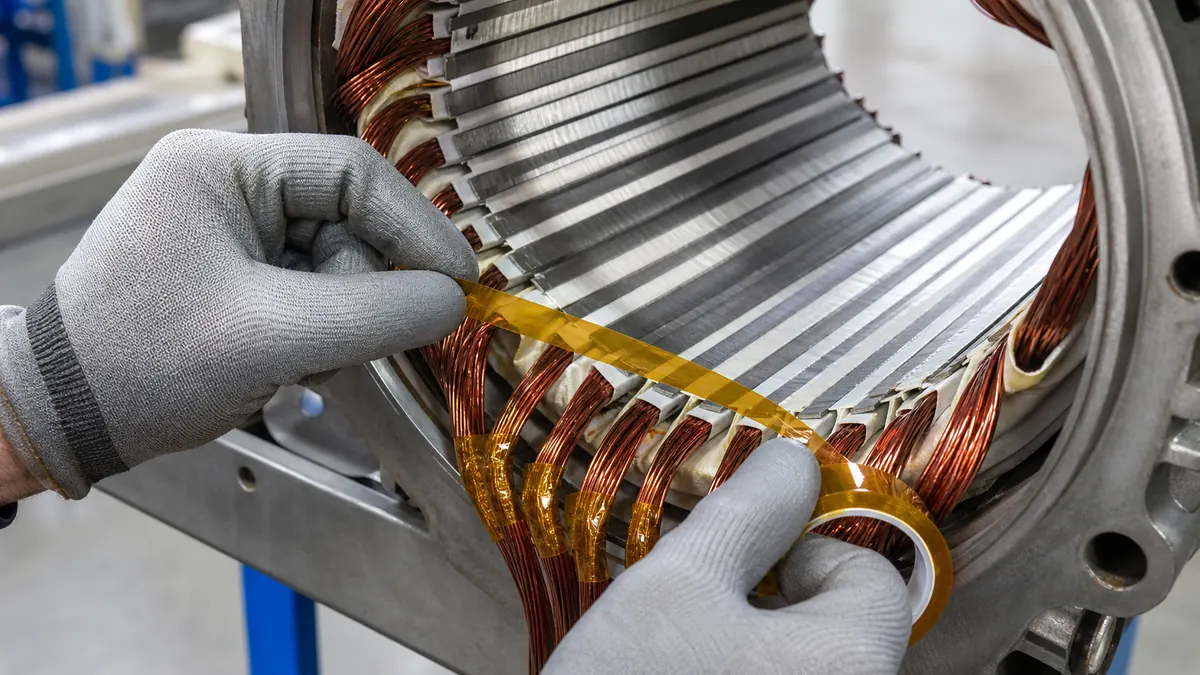
Polyimide tape for motor stator slot exit insulation can provide a thin, heat-resistant protective layer where magnet wire leaves the laminated core and changes direction. This location combines tight bend radii, steel edges, lead movement and later varnish or curing exposure. The correct tape is therefore selected from the complete winding process—not from film color or a single maximum-temperature number.
Why the Slot Exit Is a Critical Insulation Zone
A straight section of winding is supported by the slot liner and surrounding conductors. At the exit, the bundle bends toward the end winding, may cross a core edge and can move during lacing, forming, impregnation and final assembly. Excessive tape build can distort the designed route, while insufficient coverage can leave a vulnerable transition.
Polyimide film is attractive because it can combine low thickness, electrical insulation and thermal stability. Adhesive behavior still matters: the tape must wet the actual contact surfaces, stay positioned during handling and tolerate the validated process without flagging or undesirable transfer.
Process Inputs to Define Before Sampling
| Input | What to record | Selection impact |
|---|---|---|
| Slot geometry | Core-edge radius, slot-liner extension, available wrap length and nearby supports | Controls conformability and coverage shape |
| Winding bundle | Wire size, bundle diameter, enamel system and lead movement | Affects pressure, abrasion risk and tape width |
| Thermal profile | Preheat, peak temperature, dwell, cooling and number of cycles | Must be matched to the completed tape construction |
| Varnish or resin | Chemistry, application route and cure stage | Can change adhesion, wetting and removal behavior |
| End use | Permanent insulation or temporary process holding | Changes durability and compatibility requirements |
| Application | Hand wrap, dispenser, pre-cut strip or die-cut part | Determines liner and converting needs |
Compare Tape Construction, Not Just “Kapton Tape”
| Construction factor | Potential benefit | Trade-off to check |
|---|---|---|
| Thinner polyimide film | Lower build and easier fit in compact exits | Less mechanical body during manual placement |
| Thicker film or total construction | More handling stiffness and physical separation | May resist tight bends or crowd the lead path |
| Silicone pressure-sensitive adhesive | Common direction for elevated-temperature processing | Adhesion and residue depend on substrate and cycle |
| Release-liner construction | Supports pre-cut strips and precision placement | Liner release must match operator handling |
Polyimide tape is often searched as Kapton tape, but purchase approval should reference the supplier’s exact backing, adhesive, thickness and product data. Similar-looking amber tapes can behave differently after pressure, varnish contact and heat.
Application Guidelines for the Slot Exit
Prepare a smooth, controlled transition
Confirm that slot liner, wedges and formed windings are in the intended position before taping. Tape should not be used to hide a sharp edge, damaged enamel wire or an out-of-position component. Correct the underlying assembly condition first.
Avoid excessive tension
High wrap tension can pull the lead bundle against the core edge or deform soft insulation. Use enough tension to conform the tape without narrowing it, cutting into the bundle or creating spring-back at the end.
Control overlap and end placement
A defined overlap helps keep build repeatable. Place the final edge where later forming or lacing will not peel it back. If the slot exit shape repeats, a pre-cut strip with a defined length can reduce operator variation.
Document pressure and dwell
Pressure-sensitive adhesive needs contact with the real surface. A small roller, fixture or documented hand method can provide more consistent pressure than an unspecified finger press. Define the time between application and the next process step.
Qualification Through the Real Motor Process
- Apply each candidate to production-representative stators using the intended operator method.
- Inspect conformity at the steel edge, slot liner and curved bundle; reject wrinkles and bridges.
- Run forming, lacing and handling steps that can move the leads.
- Expose samples to the actual varnish or resin process and full thermal profile.
- After cooling, inspect edge lift, tape shift, adhesive transfer, embrittlement and changes to the lead route.
- Complete the motor design’s electrical, mechanical and environmental validation before releasing the material.
Common Selection Errors
- Using a catalog peak temperature without checking dwell time and the full cure cycle.
- Approving tape on a flat metal coupon instead of the real slot exit.
- Ignoring contact with enamel wire, slot liner, varnish and adjacent insulating materials.
- Increasing thickness to solve an edge problem that should be corrected mechanically.
- Changing slit width without confirming wrap coverage and finished bundle build.
FAQ
Can polyimide tape replace a motor slot liner?
Not as a general rule. Slot liners and localized tape can serve different functions. Any substitution must be made by the motor insulation-system designer and validated for the complete construction.
What width should be used at a stator slot exit?
The width should cover the defined transition while fitting the bend and avoiding excess build. Determine it from the actual geometry and placement method rather than a universal value.
Will polyimide tape resist varnish curing?
A suitable construction may tolerate a defined varnish and cure cycle, but compatibility depends on the adhesive, chemistry, temperature, dwell and contact surfaces. Test the complete process.
Are pre-cut polyimide strips better than roll tape?
Pre-cut strips can improve length and overlap consistency in repetitive production. Roll tape may remain practical for development, repair or variable geometries.
Related Products and Articles
- Polyimide tape product range
- Single-sided polyimide insulation tape
- Kapton insulation tape selection guide
- Polyimide tape for converted insulation parts
Request a Slot-Exit Tape Screen
Provide the stator drawing or photo, wire bundle dimensions, contact materials, target coverage, application method, varnish chemistry and complete thermal profile. JIAO TAO TAO can help shortlist polyimide constructions and converting formats for a controlled winding trial. Share your motor insulation process.
PET Silicone Tape for E-Coat Masking
PET Silicone Tape for Chemical Etching Masking
Related Article
Need help choosing the right industrial tape?
Send us your application details, including temperature, surface material, size, quantity and current problem. Our team will help recommend a suitable tape material or custom die-cut solution.

simon@jiaotaotao.com


+86-136 1277 5969


+86-136 1277 5969
