
PET Silicone Tape for Threaded Insert Masking During Powder Coating
Application Solutions · Powder Coating
PET Silicone Tape for Threaded Insert Masking During Powder Coating
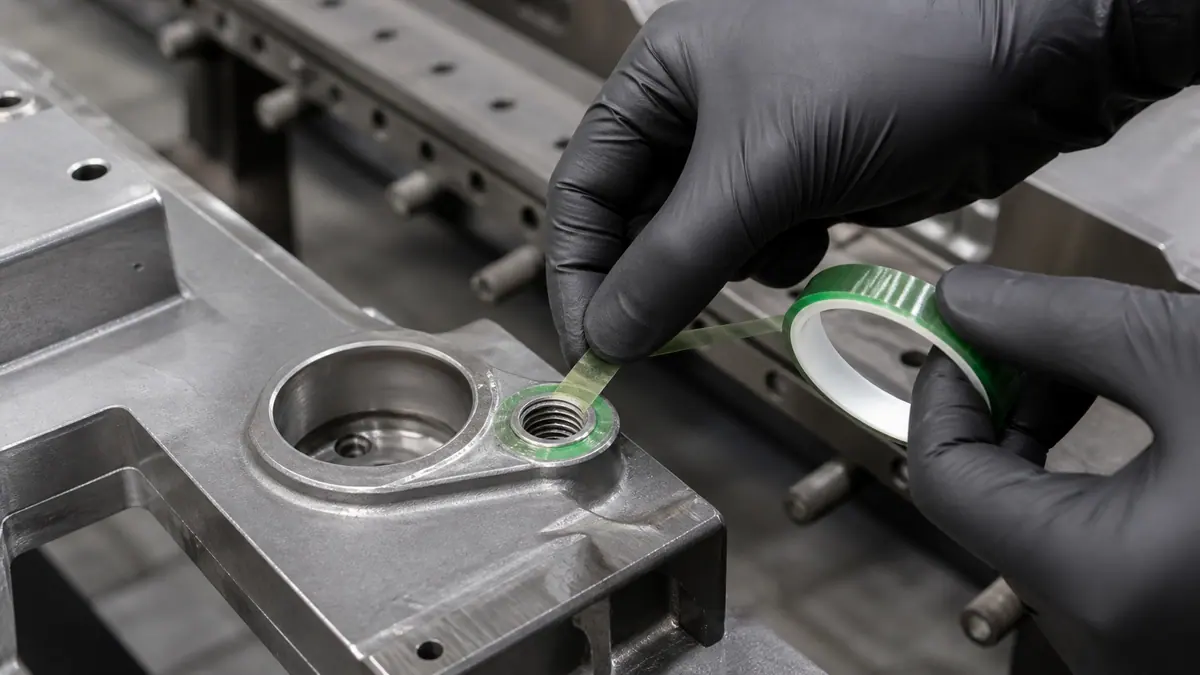
PET silicone tape for threaded insert masking protects a defined fastener land, conductive contact, or assembly interface while the surrounding metal receives powder coating. The reliable result comes from controlled geometry, measured heat exposure, clean application, and a validated peel method—not from choosing tape by color alone.
Quick Answer
PET silicone masking tape can keep a specified ring or face around a threaded insert free of powder during a qualified coating cycle. It does not automatically protect the full thread depth, establish electrical continuity, or prove that the finished joint will meet torque and corrosion requirements. The drawing and released process plan must identify the exact surface to protect and the acceptance method.
Define the No-Coat Zone Before Selecting Tape
A threaded insert may serve as a fastening point, a locating feature, a grounding path, or a sealing interface. Each function creates a different masking boundary. A ring around the insert face can preserve a washer seat or contact land, while a plug or cap may be needed when the internal thread must remain free of powder. Combining methods is often more repeatable than asking a strip of tape to bridge an unsupported opening.
| Feature | Possible masking purpose | Drawing or process check |
|---|---|---|
| Insert face or flange | Preserve a controlled assembly or contact land | Outside diameter, edge tolerance, and permitted finish |
| Internal thread | Keep the engagement path clear | Thread depth, plug method, removal access, and gauge |
| Adjacent panel | Allow coating up to a defined circular boundary | Coating overlap and corrosion strategy |
| Ground path | Maintain a specified conductive interface | Electrical design and released continuity test |
| Sealing land | Control coating build below a seal or washer | Compression stack and surface-finish requirement |
How to Select PET Silicone Tape
Backing and adhesive as one construction
PET film can provide a thin, dimensionally stable mask edge for many industrial coating cycles. Silicone pressure-sensitive adhesive is commonly screened where elevated-temperature removal is required. Film thickness affects handling, conformability, tear resistance, and the coating step at the edge. Adhesive formulation affects initial hold, heat response, and residue. Specify an exact product code and approved lot controls rather than a generic “green high-temperature tape.”
Actual part temperature
Record pretreatment drying, oven setpoint, measured metal temperature, dwell, repeated passes, and time before removal. A heavy insert or reinforced boss can heat and cool differently from a flat coupon. A supplier limit is a screening input; it is not a substitute for a production-part trial.
Surface condition and storage
Oil, blasting dust, rinse residue, oxidation, and fingerprints can create edge channels or unstable adhesion. Define when masking occurs relative to cleaning and pretreatment. Include tape storage, conditioning, and shelf-life controls from the supplier documentation in the released work instruction.
| Selection input | What to record | Why it matters |
|---|---|---|
| Substrate and insert | Metals, coatings, plating, texture, and cleanliness | Changes adhesion and residue risk |
| Thermal exposure | Measured part temperature, dwell, passes, and cooling | Screens film and adhesive together |
| Geometry | Insert OD, flange, recess, thread opening, and tolerance | Defines strip, ring, disc, plug, or combined mask |
| Removal | Part temperature, peel angle, speed, and access | Affects tearing and coating-edge fracture |
| Inspection | Gauge, visual standard, residue limit, and fit test | Turns “clean removal” into measurable acceptance |
Choose a Repeatable Mask Geometry
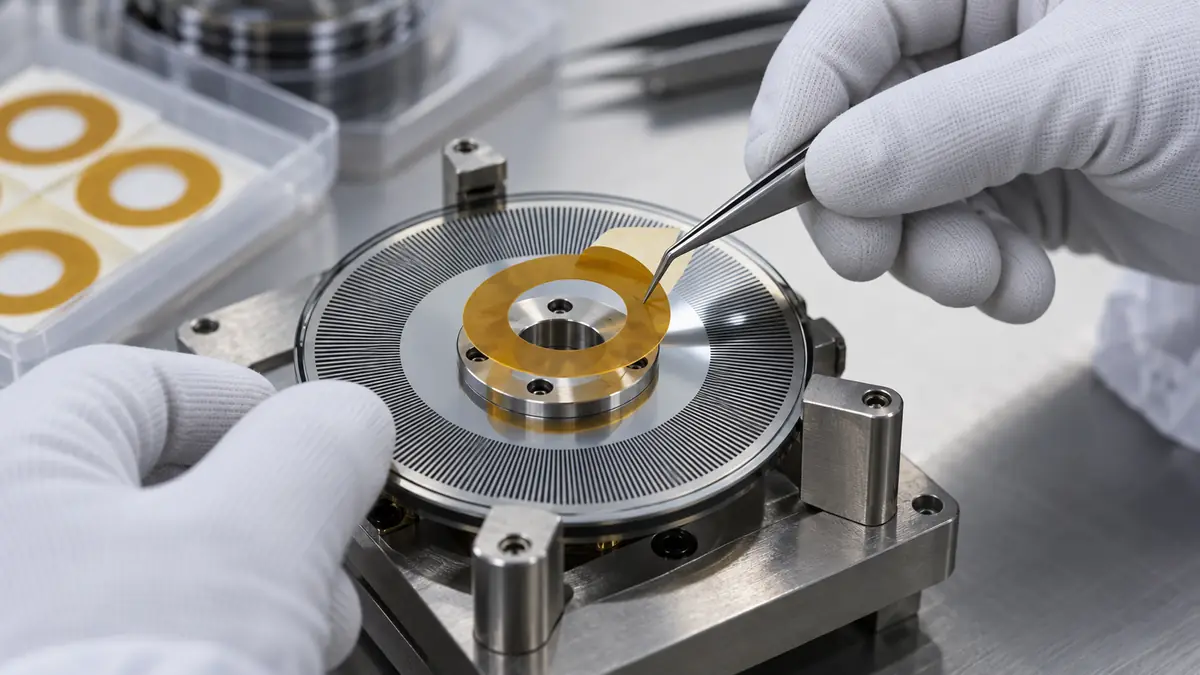
Narrow slit tape can suit prototypes or changing diameters, but hand-wrapping a small circular land may create overlap steps and variable edge position. A kiss-cut ring on a liner can control inner and outer diameters and add a finger lift. If the thread opening also needs protection, define a compatible plug or cap and verify that the two masks do not leave a gap.
Use a machined edge, fixture stop, or vision feature as the placement datum. Do not locate the ring from powder color or an operator estimate. Rounded pull tabs and split liners can improve handling without requiring a tool near the finished metal.
Recommended Application Workflow
- Confirm the drawing. Mark the flange, thread, and surrounding surface requirements.
- Verify released materials. Match insert revision, tape code, mask drawing, and powder system.
- Inspect the part. Reject oil, burrs, moisture, chips, or loose pretreatment residue.
- Apply the thread protection. Install the specified plug or cap when required.
- Place the PET mask. Align from the approved datum without stretching the film.
- Burnish the perimeter. Apply uniform pressure around the complete circular edge.
- Inspect before spraying. Check gaps, wrinkles, overlap, and clearance from coated areas.
- Run the validated cycle. Keep handling and thermal exposure within the released window.
- Remove as specified. Use the approved sequence, temperature, angle, and speed.
- Inspect and record. Check edge quality, residue, thread access, gauge fit, and lot traceability.
Qualification and Production Validation
Test the smallest and largest insert geometry, the roughest approved finish, the hottest credible rack position, maximum dwell, and longest approved delay before removal. Include realistic masking variation and multiple operators. A flat coupon can screen adhesion, but it cannot reproduce the circular edge, recess, thermal mass, or unmasking access of the production part.
- Measure the no-coat boundary against the drawing.
- Check the internal thread with the released gauge or assembly method.
- Inspect for adhesive transfer, film fragments, powder bridge, and edge chipping.
- Run required torque, continuity, sealing, or fit checks defined by the product owner.
- Review any change to tape grade, insert supplier, cleaning, powder, oven, or removal stage.
Troubleshooting Common Defects
| Observed defect | Check first | Corrective direction |
|---|---|---|
| Powder enters the thread | Plug fit, ring-to-plug gap, edge lift, and spray direction | Revise the combined mask geometry |
| Uneven circular coating edge | Hand overlap, stretch, datum, and insert recess | Use a die-cut ring or placement fixture |
| Residue on the insert land | Heat history, finish, contamination, pressure, and peel stage | Requalify the construction and removal window |
| Tape tears during removal | Burrs, powder bridge, backing thickness, and pull access | Remove the damage source and add a finger lift |
| Coating chips beside the mask | Edge build, cure state, and peel direction | Validate removal timing with the coating process owner |
Related Products and Articles
Frequently Asked Questions
Can PET silicone tape protect the full internal thread?
A face ring mainly protects the insert land. Use a separately qualified plug, cap, or combined mask when the full thread depth must remain coating-free.
Is every green PET tape suitable for powder coating?
No. Color is only a visual cue. Confirm the exact PET backing, silicone adhesive, thickness, heat exposure, substrate, and removal requirement.
When is a die-cut ring better than narrow roll tape?
A die-cut ring is useful when diameter, edge position, pull-tab design, and placement time must be consistent across repeated parts.
When should the mask be removed?
Removal timing must be established on the actual coating cycle and part. Define part temperature, sequence, peel angle, direction, and speed.
What belongs in an RFQ?
Provide the insert drawing, protected surfaces, substrate and pretreatment, powder and cure profile, tape format, quantity, removal condition, and acceptance tests.
Turn the Insert Boundary into a Controlled Process
Share the insert dimensions, no-coat zone, metal finish, measured cure profile, masking sequence, removal stage, and expected volume. JIAO TAO TAO can help shortlist a PET silicone roll or die-cut ring for production evaluation.
Discuss threaded-insert maskingCustom Die-Cut Tape for Power Electronics Thermal Pad Positioning
Custom Die-Cut Tape for Automotive Rain-Light Sensor Pad Bonding
Related Article
Need help choosing the right industrial tape?
Send us your application details, including temperature, surface material, size, quantity and current problem. Our team will help recommend a suitable tape material or custom die-cut solution.

simon@jiaotaotao.com


+86-136 1277 5969


+86-136 1277 5969
