
PET Silicone Tape for High-Temperature Release Liner Splicing
PET Silicone Tape for High-Temperature Release Liner Splicing
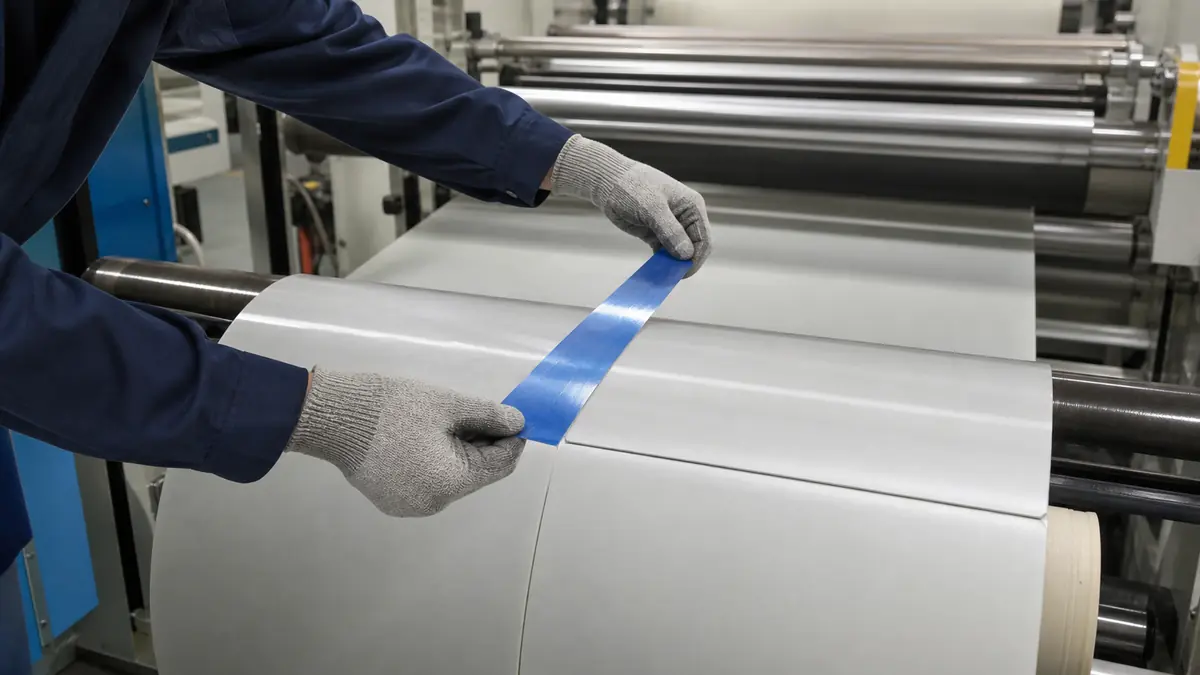
PET silicone tape for release liner splicing joins silicone-treated papers, films, and process liners that are difficult for many conventional pressure-sensitive adhesives to grip. The right construction must hold through the real web tension, line speed, temperature, and downstream contact conditions without creating a raised splice, contaminating the coated surface, or separating in the converting line.
Key Takeaways
- Silicone adhesive is considered because silicone-treated liners can be difficult bonding surfaces.
- Backing strength, tape thickness, splice direction, and adhesive compatibility must be evaluated together.
- Approval should use the real coated web, line speed, tension, thermal exposure, and downstream rollers.
- A tape that adheres at room temperature is not automatically qualified for continuous converting.
Why Silicone-Coated Liners Need a Compatible Splicing Tape
Release liners are intentionally engineered so adhesives and coated materials separate from them in a controlled way. That low-release surface can also make liner splicing difficult. A general-purpose rubber or acrylic tape may initially appear attached but lift when the splice bends around a small roller, warms in a coating or curing zone, or carries steady web tension.
PET film provides a thin, strong, dimensionally stable backing. A silicone pressure-sensitive adhesive can improve contact to silicone-treated papers and films when the exact tape and liner chemistry are compatible. Official polyester/silicone tape literature from 3M lists splicing of silicone liners, papers, and films among intended applications, but the published values for one branded grade must not be treated as specifications for another product.
PET Silicone Tape Splice Designs Compared
| Splice design | Potential advantage | Qualification concern |
|---|---|---|
| Overlap splice | Simple web joining with continuous material support | Creates a thickness step that may mark a coated web or disturb a close-tolerance nip |
| Butt splice with tape on one side | Lower web-thickness change than a full overlap | Requires accurate edge alignment and enough tape strength for the intended tension |
| Butt splice with tape on both sides | Can reinforce the joint from both faces | May interfere with release behavior or contact surfaces on one side of the web |
| Angled splice | Introduces the joint progressively across the web | Needs controlled angle, cut quality, and tracking through rollers |
| Tabbed splice | Supports prepared-roll change procedures | Tab geometry and exposed adhesive must not catch guides or contaminate the web |
Information to Include in a PET Silicone Tape RFQ
| Parameter | Record it as | Why it affects selection |
|---|---|---|
| Release liner construction | Paper or film type, coating side, silicone system, and surface treatment | Defines the actual difficult-to-bond surface |
| Web dimensions | Width and thickness in mm | Influences splice area, flexibility, and thickness transition |
| Line conditions | Speed in m/min and web tension in N | Controls the dynamic load on the splice |
| Thermal exposure | Measured web temperature in °C and dwell in seconds or minutes | Must stay within the approved backing and adhesive window |
| Roller path | Smallest roller diameter in mm, wrap angle, and coated-face contact | Shows how sharply the splice will bend and which face touches equipment |
| Downstream process | Coating, laminating, printing, curing, die cutting, or slitting sequence | Identifies contamination, marking, and registration risks |
| Acceptance criteria | Maximum step, residue, edge lift, splice visibility, and break requirement | Turns a material trial into a measurable approval |
How to Select the Tape Construction
Match the adhesive to the treated surface
Confirm which side of the liner carries the silicone release coating and whether the tape must bond to that side. Ask for adhesion data or samples on the exact liner lot. Do not assume that every silicone adhesive bonds equally to every release coating.
Control total thickness and edge profile
A thicker tape may add handling strength but creates a larger step through nips, rollers, and coating heads. A thinner tape reduces the step but still needs enough tensile and tear performance for the web path. Compare total construction thickness, not only PET film thickness.
Decide whether a linered tape is needed
A release liner on the tape can support pre-cut splice strips, protect adhesive before use, and make repeatable placement easier. It also adds a removal step. The liner release should allow operators or automatic splicing equipment to expose the adhesive without stretching the strip or touching the bond area.
Specify visibility without relying on color
Blue, green, clear, and other colors can support splice detection or visual removal checks. Color is not a performance grade. The approved tape still needs a controlled material code, adhesive system, thickness, width, and supplier specification.
Recommended Splicing Workflow
- Stop and secure the web. Follow the line owner’s lockout and roll-change procedure before entering the web path.
- Identify the coated face. Confirm the silicone-treated side and the direction in which the splice will travel.
- Cut clean, square web edges. Remove torn, telescoped, dusty, or wrinkled material from the joint.
- Clean only with an approved method. Keep dust, oil, fingerprints, and release-agent contamination away from the bonding zone.
- Align the splice without a gap or buckle. Use a fixture or marked work surface when repeatability matters.
- Apply the tape without stretching. Press from the center outward with a clean roller or squeegee.
- Trim exposed edges and adhesive. Prevent loose corners from catching machine guides or transferring adhesive.
- Restart at the validated condition. Observe the splice through critical rollers, nips, heat zones, and the first downstream operation.
Qualification and Troubleshooting
| Observed issue | Tape and splice checks | Process checks |
|---|---|---|
| Edge lift before the first roller | Surface compatibility, application pressure, contamination, tape age | Web preparation and time between splicing and restart |
| Splice opens in a heated zone | Adhesive grade, backing shrinkage, joint area, temperature compatibility | Measured web temperature, dwell, tension, and roller geometry |
| Raised line marks the product | Tape and overlap thickness, trapped air, folded edge | Nip clearance, pressure, coating thickness, and splice orientation |
| Adhesive contaminates a roller | Exposed adhesive, squeeze-out, excessive width, damaged tape edge | Web tracking and roller contact path |
| Splice tears during slitting | Backing strength, cut direction, tab geometry, tape width | Blade condition, slit layout, web tension, and acceleration |
Run qualification with production-representative rolls and record whether the splice passes every critical station. A useful approval log includes the liner lot, tape lot, splice design, application tool, measured conditions, number of successful passes, failure location, and retained sample. Do not convert a supplier’s typical data into a company guarantee.
Related Products and Articles
- Review the polyester silicone tape product range for PET film and silicone adhesive constructions.
- Compare process limits in this guide to high-temperature PET and polyimide masking tape selection.
- Send your liner, web path, and splice requirements for sample review.
Technical References
- 3M Polyester Tape 8911 application information identifies high-temperature splicing of silicone liners, papers, and films as an intended use.
- 3M Polyester Tape 8991L technical data describes PET backing, silicone adhesive, and silicone-treated liner splicing applications.
Frequently Asked Questions
Why use PET silicone tape for release liner splicing?
PET film offers a thin, strong backing, while silicone adhesive can bond to selected silicone-treated surfaces that are difficult for many conventional adhesives. Compatibility still has to be confirmed on the exact liner and process.
Can the same tape splice both paper and film release liners?
Possibly, but not automatically. Paper and film liners differ in stiffness, tear behavior, surface treatment, thickness, and thermal response. Qualify each construction and coating system separately.
Is an overlap splice always stronger than a butt splice?
An overlap provides more material continuity, but it also creates a larger thickness step. Strength alone does not determine suitability; the splice must also pass rollers, nips, coating heads, and downstream inspection without marking or contamination.
How wide should the splicing tape be?
The width should be set by the web tension, joint design, tape construction, roller path, and available clearance. Use a controlled trial instead of copying a generic width from another converting line.
What should be checked after a trial splice?
Inspect edge lift, joint opening, backing stretch, adhesive transfer, thickness marks, roller contamination, tracking, and the finished material. Record the exact conditions and failure location.
Request a PET Silicone Splicing Tape Trial
Share the release liner material and coating side, web width and thickness, line speed, tension, temperature profile, roller path, splice design, and acceptance criteria. JIAO TAO TAO can help shortlist a PET silicone tape format for your own line qualification.
Contact the technical team with your converting-line details.
Acetate Cloth Tape for Motor End-Winding Binding
Polyimide Tape for Conformal Coating Connector Masking
Related Article
Need help choosing the right industrial tape?
Send us your application details, including temperature, surface material, size, quantity and current problem. Our team will help recommend a suitable tape material or custom die-cut solution.

simon@jiaotaotao.com


+86-136 1277 5969


+86-136 1277 5969
