
PET Silicone Tape for Heat-Sink Mounting Face Masking
Application Solutions · Powder Coating
PET Silicone Tape for Heat-Sink Mounting Face Masking
PET silicone tape for heat-sink mounting face masking protects a defined metal-to-metal interface while fins and exterior surfaces receive powder coating. A reliable process depends on the actual aluminum finish, pretreatment, cure profile, tape geometry, edge pressure, removal stage, and flatness requirement—not on tape color alone.

Quick Answer
PET silicone masking tape can create a precise temporary boundary on the flat base or mounting pad of an aluminum heat sink during powder coating. The protected face may later contact a chassis, thermal interface material, gasket, grounding feature, or other assembly surface. The tape is only a process aid: the drawing, flatness specification, coating system, thermal design, and released assembly method determine what must remain uncoated.
Why the Heat-Sink Mounting Face Is Masked
Powder coating can improve appearance and environmental protection on exposed aluminum surfaces, but a coating layer on a functional interface may change contact, fit, heat transfer, or grounding behavior. A machined base often has a different requirement from the fins and sidewalls. Masking keeps the defined face available for the next controlled operation without requiring broad post-coating removal.
The decision to leave a surface bare must come from the product design. Tape should not be used to invent an uncoated zone that is missing from the released drawing. If the interface requires conversion coating, selective plating, a thermal pad, or another specified treatment, the masking plan must preserve that requirement.
| Interface | Reason it may be masked | Engineering check |
|---|---|---|
| Thermal mounting face | Preserve the specified surface for a thermal interface material | Flatness, roughness, cleanliness, and thermal-stack approval |
| Chassis contact pad | Maintain metal contact or controlled fit | Grounding and corrosion design, not tape assumption |
| Gasket land | Avoid coating build where compression height is controlled | Seal design, compression range, and edge location |
| Fastener seat | Control stack height below a washer or bracket | Torque, coating specification, and galvanic considerations |
| Identification datum | Keep a defined area available for a later operation | Downstream marking or machining requirement |
How to Select the PET Silicone Tape
Film thickness and silicone adhesive
PET film provides a stable, clean-edged backing for many industrial masking cycles. Film thickness influences handling, conformability, tear behavior, and the step created at the coating boundary. Silicone pressure-sensitive adhesive is often screened for elevated-temperature removal, but performance varies by formulation. Specify the exact product code, not simply “green PET tape.”
Part temperature and dwell
Record pretreatment exposure, drying, powder cure, repeated passes, and cooling before removal. A heavy aluminum heat sink can lag the oven atmosphere while later retaining heat longer than a thin test panel. Measure representative parts at the tape location and include the hottest credible production condition.
Aluminum surface condition
As-machined aluminum, blasted surfaces, conversion-coated areas, oily stock, and cleaned parts can show different adhesion. The process plan should define when masking occurs relative to washing or pretreatment and which cleaning method is approved. Tape should be applied only to a dry surface that passes the plant's inspection criteria.
| Selection input | What to record | Why it matters |
|---|---|---|
| Heat-sink material | Alloy, temper, surface finish, and pretreatment | Controls adhesion and residue risk |
| Thermal cycle | Measured part temperature, dwell, passes, and cooling | Screens backing and adhesive as a system |
| Mask dimensions | Length, width, corner radius, holes, and tolerance | Defines coverage and coating edge |
| Tape construction | PET thickness, total thickness, adhesive, color, and liner | Prevents purchasing by appearance |
| Removal requirement | Part temperature, peel angle, speed, and disposal | Affects tearing, residue, and coating bridge |
Mask Geometry, Datum, and Edge Design
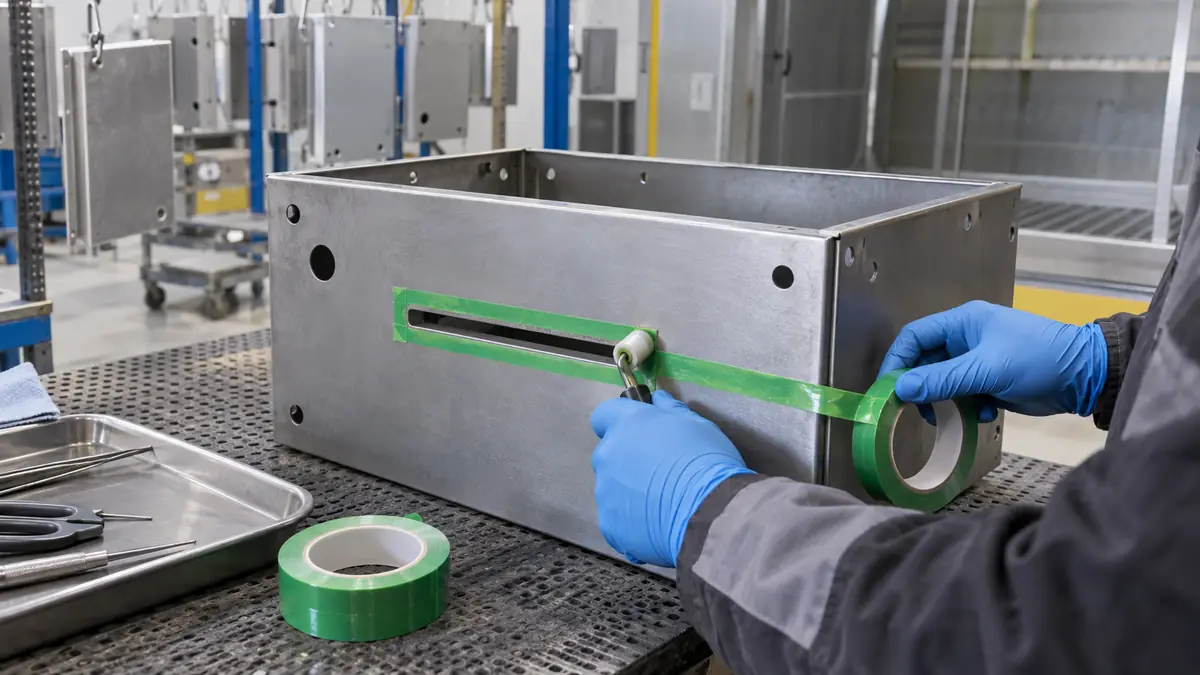
A narrow roll can suit a simple rectangular pad, but large heat sinks often benefit from a pre-cut mask. A die-cut piece can control corner radii, bolt-hole openings, pull tabs, and orientation. The converting drawing should state whether the tape edge aligns to the final uncoated boundary or includes an allowance for the coating process.
Where the tape crosses holes or steps, decide whether plugs, caps, or separate masks are more reliable. Avoid unsupported spans that can sag or collect powder. Rounded internal corners reduce stress concentration during removal, while a non-bonded pull tab can give the operator a controlled starting point without scraping the aluminum.
Recommended Masking Workflow
- Confirm the drawing. Identify the exact face, holes, and boundary that must remain free of powder.
- Verify released materials. Check heat-sink revision, tape code, mask drawing, powder system, and work instruction.
- Inspect the surface. Reject oil, moisture, burrs, loose particles, or pretreatment defects using the approved criteria.
- Locate from a datum. Place the roll strip or die-cut mask without stretching the PET backing.
- Apply uniform pressure. Smooth from the center toward the edge and inspect corners, holes, and transitions.
- Inspect before spraying. Confirm full coverage and keep the tape off surfaces that must receive coating.
- Run the validated cycle. Control pretreatment, spray, cure, and repeated exposure within the released window.
- Remove at the approved stage. Peel at the defined part temperature, angle, direction, and speed.
- Inspect the interface. Check residue, powder creep, edge fracture, scratches, dimensions, and assembly cleanliness.
- Record the result. Trace tape lot, heat-sink lot, cycle, operator, and acceptance outcome.
Qualification and Production Validation
Qualification should include representative minimum and maximum mask sizes, heat-sink mass, aluminum finishes, oven loading, and time before removal. Test both nominal and credible edge-placement variation. A coupon can screen adhesion, but it cannot reveal the full thermal lag, fin geometry, handling, and coating bridge behavior of the actual component.
- Measure the uncoated boundary against the released drawing.
- Inspect adhesive transfer under the plant's defined lighting or cleanliness method.
- Check coating edge integrity after removal and normal handling.
- Verify flatness, surface condition, and assembly fit using the product's approved gauges.
- Confirm that mask removal does not scratch or contaminate the mounting face.
- Run downstream thermal, grounding, sealing, or torque tests required by the product design.
Troubleshooting Common Masking Defects
| Observed defect | Check first | Corrective direction |
|---|---|---|
| Powder creeps below the edge | Surface cleanliness, edge pressure, wrinkles, and corner geometry | Improve preparation and standardize mask placement |
| Tape shrinks or exposes the face | Measured part temperature, dwell, PET grade, and tension during application | Remove stretch and screen a more suitable construction |
| Adhesive residue remains | Exposure, aluminum finish, application pressure, storage, and peel stage | Revise the removal window or evaluate another adhesive system |
| Coating edge chips during peel | Coating bridge, cure state, peel direction, and edge thickness | Validate timing and geometry with the coating supplier |
| Mask position varies | Datum quality, roll handling, part presentation, and operator access | Use a keyed die cut, fixture, or visual placement aid |
| Face is scratched after removal | Tools, glove contamination, peel start, and part stacking | Add a finger lift and protected handling step |
Related Products and Articles
Frequently Asked Questions
Is every green PET tape suitable for powder coating?
No. Green is a visibility choice. Confirm the PET backing, silicone adhesive, total thickness, supplier grade, measured part temperature, dwell, surface, and removal requirement.
Why keep powder coating off a heat-sink mounting face?
The product drawing may require a controlled metal interface for heat transfer, fit, grounding, sealing, or another downstream operation. The engineering specification—not a general rule—defines the uncoated area.
Should the mask be roll tape or a die-cut part?
Roll tape is flexible for simple rectangles and trials. A die cut can improve corner, hole, pull-tab, orientation, and tolerance control in repetitive production.
When should the tape be removed?
Removal timing must be validated with the actual powder, part temperature, coating thickness, and tape construction. Define the stage, peel angle, direction, and speed in the work instruction.
What information belongs in an RFQ?
Provide the heat-sink drawing, alloy and finish, masked dimensions and tolerances, pretreatment, measured cure profile, tape function, desired roll or die-cut format, removal criteria, annual quantity, and acceptance tests.
Turn the Mounting Face into a Controlled Mask
Share the heat-sink drawing, aluminum finish, powder system, measured cure profile, mask boundary, flatness requirement, removal stage, and expected volume. JIAO TAO TAO can help shortlist a PET silicone roll width or die-cut mask for production evaluation.
Discuss heat-sink maskingCustom Die-Cut Tape for Automotive Rain-Light Sensor Pad Bonding
Custom Die-Cut Tape for Automotive Shark-Fin Antenna Bonding
Related Article

Need help choosing the right industrial tape?
Send us your application details, including temperature, surface material, size, quantity and current problem. Our team will help recommend a suitable tape material or custom die-cut solution.

simon@jiaotaotao.com


+86-136 1277 5969


+86-136 1277 5969
