
PET Silicone Tape for E-Coat Masking
PET Silicone Tape for E-Coat Masking
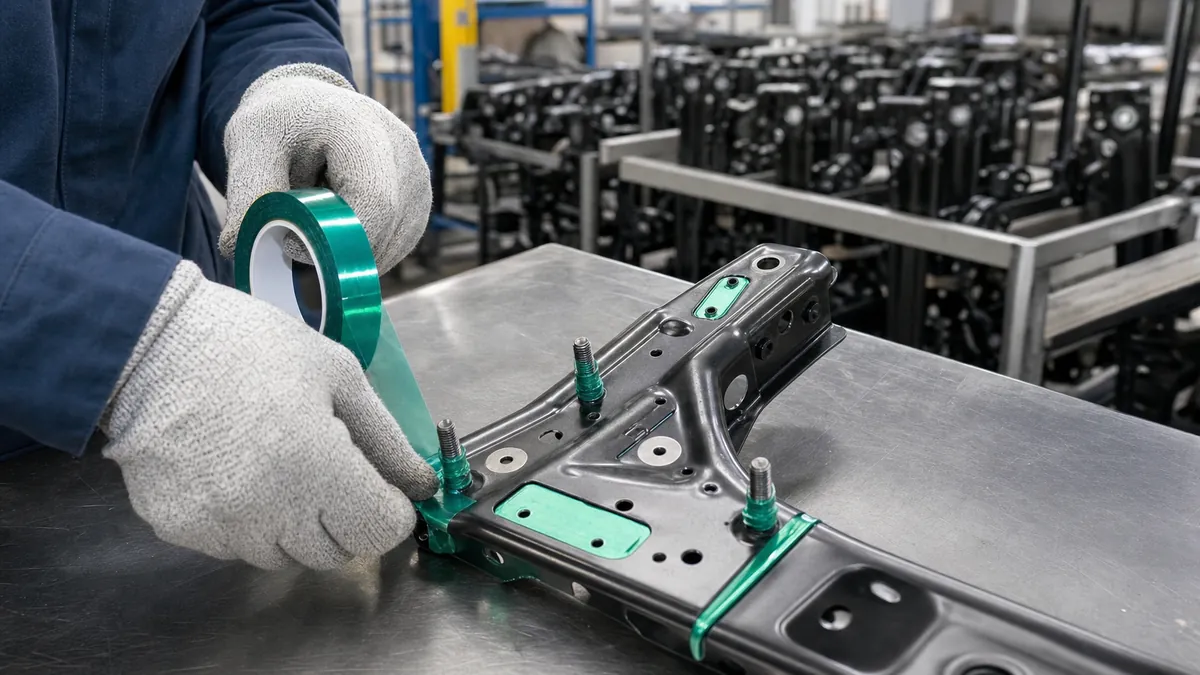
PET silicone tape for e-coat masking protects threads, grounding points, weld zones, and selected metal surfaces that must remain free of electrophoretic coating. The right tape is not chosen by color alone: film stability, adhesive compatibility, edge sealing, removal behavior, and the complete pretreatment-to-cure cycle all affect the result.
Why E-Coat Masking Needs a Process-Specific Tape
Electrophoretic coating is a multi-stage process rather than a single paint step. Parts may pass through cleaning, rinsing, pretreatment, an electrically charged coating bath, further rinsing, and thermal curing. A masking material therefore has to stay positioned through wet handling and later heat exposure while keeping coating away from the protected area.
Common mask locations include threaded studs, threaded holes, electrical contact pads, bonding points, weld interfaces, dimensional reference surfaces, and areas reserved for a later assembly operation. If the tape lifts or the edge is not pressed down evenly, liquid can enter beneath the mask. If the adhesive is too aggressive or poorly matched to the substrate, removal can add cleaning work or damage the finished edge.
PET Film and Silicone Adhesive: What Each Layer Does
PET backing
Polyester film provides a thin, smooth, and dimensionally stable backing. It can form a defined masking edge and is easier to inspect than a soft, highly extensible tape. For buyers comparing constructions, film thickness, tensile behavior, and conformity around bends should be reviewed together rather than as isolated specifications.
Silicone adhesive
A silicone adhesive is commonly selected when a process includes elevated temperature and clean-removal requirements. Actual performance still depends on the metal surface, pretreatment chemistry, immersion time, cure profile, and removal timing. Production approval should always follow trials on representative parts.
E-Coat Masking Selection Checklist
| Parameter to verify | Why it matters in e-coat | Question for the trial |
|---|---|---|
| Backing thickness and stiffness | Affects edge definition and conformity around radii | Can operators apply it without wrinkles or bridging? |
| Adhesion to the actual substrate | Controls edge lift during pretreatment and rinsing | Does it remain sealed on stamped, cast, or plated metal? |
| Chemical exposure compatibility | The tape encounters cleaners, rinses, and bath chemistry | Does the construction swell, soften, or lose position? |
| Cure-cycle suitability | Heat and dwell time can change adhesive behavior | Does it stay stable through the complete oven profile? |
| Removal behavior | Influences cleanup, edge quality, and takt time | Can it be removed in one piece at the chosen stage? |
| Slit or die-cut tolerance | Controls repeatability on small contact zones | Would a pre-cut mask reduce placement variation? |
PET Silicone Tape Compared with Other Masking Formats
| Masking format | Useful characteristics | Points to validate |
|---|---|---|
| PET silicone tape | Thin profile, clean visual edge, available in slit widths | Conformity on compound curves and complete chemical cycle |
| Polyimide tape | Useful when a process demands a different high-temperature film construction | Cost, stiffness, and whether the extra thermal capability is necessary |
| Custom die-cut film mask | Repeatable geometry and faster placement on high-volume parts | Tooling, liner design, registration, and change control |
| Caps or plugs | Three-dimensional coverage for holes, studs, and ports | Fit, reuse policy, handling, and compatibility with part geometry |
Application Method for a Reliable Masking Edge
- Define the protected boundary. Use the drawing or approved work instruction to identify every surface that must remain coating-free.
- Prepare the surface. Apply tape only to a clean, dry surface that is ready for the specified pretreatment sequence.
- Use the correct width or shape. Avoid excessive overlap, stretched tape, and narrow strips that cannot be pressed down consistently.
- Apply without tension. Lay the film onto the surface and form it around edges instead of pulling it tight and allowing it to recover later.
- Press the full perimeter. Use controlled finger pressure or a suitable roller, especially at corners, holes, and stamped transitions.
- Inspect before racking. Check for bubbles, wrinkles, lifted edges, contamination, and masks that cover unintended areas.
- Remove at the approved stage. Establish a removal window during the production trial and train operators to pull at a consistent angle.
When Custom Die-Cut Masks Improve the Process
Roll tape is flexible for prototypes, repairs, and changing part families. A custom die-cut mask can be more repeatable when the same contact pad, flange, or mounting area is protected on every part. Registration holes, split liners, pull tabs, and kiss-cut layouts can simplify placement and help operators avoid touching the adhesive.
Before converting to a die-cut format, confirm the approved tape construction on production-representative parts. Geometry should be designed around the real coating boundary, part tolerances, accessible press-down area, and the way the mask will be removed.
Trial and Approval Plan
A useful trial includes the actual substrate, surface condition, pretreatment sequence, bath exposure, rack orientation, cure profile, and removal method. Inspect edge definition, coating intrusion, tape movement, adhesive residue, film tearing, and the condition of the protected surface. Record the approved tape construction and application method so purchasing and production use the same specification.
Related Tape Resources
- Compare available polyester silicone tape formats.
- Review a related process guide on PET silicone tape for chemical etching masking.
- For slit widths or converted shapes, send your application details for material-selection support.
Frequently Asked Questions
Can PET silicone tape go through every e-coat line?
No tape should be approved for every line without testing. Pretreatment chemistry, bath conditions, part geometry, cure time, cure temperature, and removal timing vary. Test the complete construction on representative parts.
Should tape be applied before or after pretreatment?
The correct stage depends on which surface must be protected and which process steps the mask must survive. Follow the coating engineer's approved sequence and validate adhesion on the surface condition present at application.
Why does e-coat creep under a tape edge?
Possible causes include contamination, insufficient edge pressure, bridging over a radius, wrinkles, tape tension, an unsuitable adhesive, or movement during wet processing. Examine the failure location before changing materials.
Is green color proof of e-coat suitability?
No. Color helps operators see the mask, but it does not establish chemical or thermal performance. Review the backing, adhesive, supplier data, and application test results.
When should a die-cut mask replace slit roll tape?
Consider die-cut masks when geometry repeats, placement time is significant, quality depends on consistent boundaries, or operators need registration features and pull tabs.
Request an E-Coat Masking Tape Review
Share the substrate, masked geometry, pretreatment stages, cure profile, preferred removal point, and required roll or die-cut dimensions. The JIAO TAO TAO team can help you compare PET silicone tape constructions and prepare samples for your own process validation.
Contact us for tape selection and custom converting support.
Polyimide Tape for Conformal Coating Connector Masking
Polyimide Tape for Motor Stator Slot Exit Insulation
Related Article
Need help choosing the right industrial tape?
Send us your application details, including temperature, surface material, size, quantity and current problem. Our team will help recommend a suitable tape material or custom die-cut solution.

simon@jiaotaotao.com


+86-136 1277 5969


+86-136 1277 5969
