
PET Silicone Tape for Chemical Etching Masking
PET Silicone Tape for Chemical Etching Masking
PET silicone tape for chemical etching masking protects selected areas of a metal part while exposed areas are processed. The polyester film provides a thin, dimensionally stable mask, while the silicone pressure-sensitive adhesive is selected for temporary holding and controlled removal. A successful mask depends on the actual bath chemistry, temperature, dwell time, part geometry and edge-sealing method. This guide helps process engineers and buyers prepare a screening plan without assuming that every polyester masking tape is compatible with every etchant.
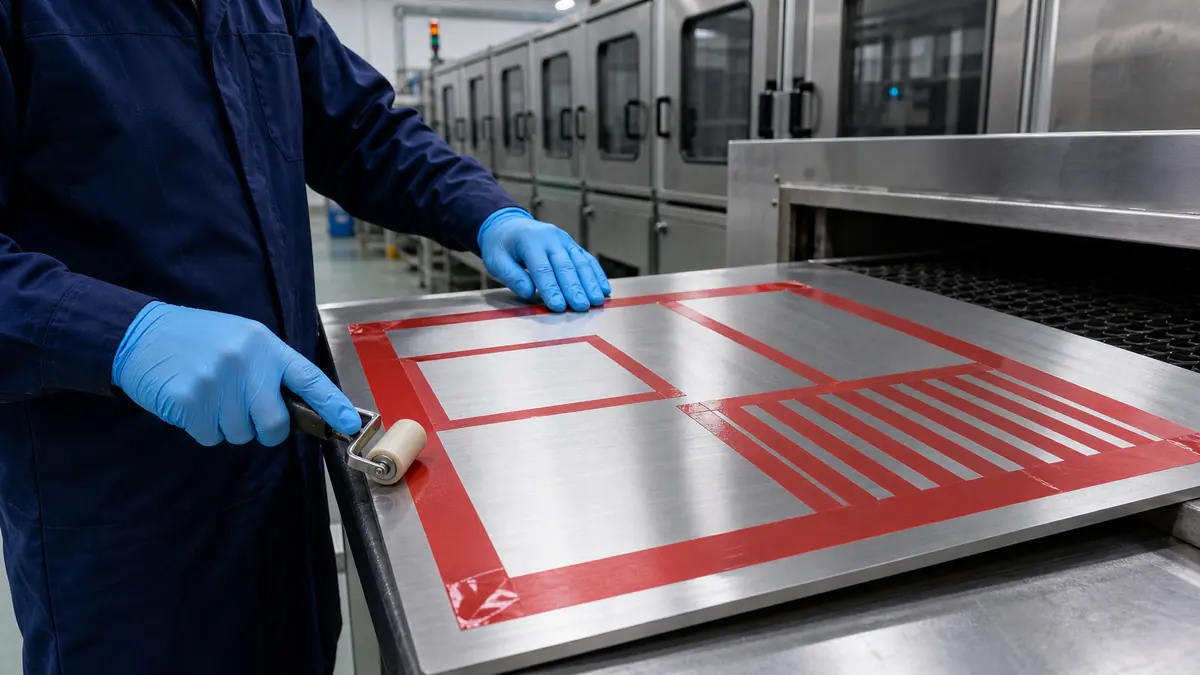
Where PET Silicone Masking Fits in an Etching Process
Temporary tape masks can be useful for prototypes, short runs, local protection, secondary finishing and parts that do not justify a permanent resist pattern. Typical protected zones include identification areas, electrical contact lands, fixture surfaces, edges and regions reserved for later joining or coating. Tape is not a universal substitute for photoresist, lacquer or a purpose-designed plating stop-off. The choice depends on required edge definition, exposure severity and production volume.
The main selection question is not simply whether the backing is PET. The completed construction includes film, adhesive, colorant and any liner, and each layer can respond differently to acids, alkalis, solvents, surfactants and heat. Request construction-specific data and validate the exact production bath.
Process Information to Put in the RFQ
| Parameter | Information to Provide | Why It Matters |
|---|---|---|
| Substrate | Metal grade, surface finish, roughness and prior treatment | Controls wet-out, edge sealing and removal behavior |
| Bath chemistry | Chemical family, concentration and additives | Film and adhesive compatibility must be screened together |
| Exposure profile | Bath temperature, dwell time and number of cycles | Short contact and repeated immersion create different risks |
| Mask geometry | Minimum line width, corners, holes and protected area | Determines whether slit tape or die-cut pieces are practical |
| Edge quality | Allowed undercut, bleed and cosmetic tolerance | Defines the required seal and inspection method |
| Removal point | Before rinse, after rinse, wet or fully dry | Changes peel force, residue risk and handling sequence |
PET Silicone Tape Compared With Other Masking Routes
| Masking Route | Useful Strength | Main Limitation to Check |
|---|---|---|
| PET silicone tape | Thin, visible, easy to slit and suitable for repeatable shapes | Bath compatibility and edge seal are construction-specific |
| Polyimide tape | Useful where higher thermal margin or electrical insulation is central | May add cost without solving chemical compatibility |
| Liquid stop-off | Can follow complex three-dimensional geometry | Application, cure and removal add process steps |
| Photoresist | Supports fine patterns and controlled imaging | Requires dedicated coating, exposure and development control |
| Custom plugs or caps | Repeatable for holes, threads and defined features | Geometry and tooling must match the part closely |
How to Improve Mask Edge Reliability
Prepare the surface consistently
Oil, polishing compound, oxide, rinse residue and fingerprints reduce adhesive contact. Use the approved cleaning method for the metal and allow the surface to reach the specified dry condition before applying the mask. Record elapsed time between cleaning and masking when oxide growth or airborne contamination may matter.
Use the thinnest practical bondline
A thin film helps define an edge, but the adhesive must still contact the real surface. Rough, brushed or curved metal can leave microchannels under an overly stiff mask. Do not increase application pressure or film thickness blindly; compare candidate constructions on the actual finish.
Design corners and overlaps deliberately
Sharp internal corners, wrinkles and hand-cut joints are common entry paths. Rounded die-cut corners and a controlled overlap can improve repeatability. When two pieces meet, specify which piece is applied first and keep the overlap away from the most critical edge where possible.
Control application pressure and dwell
Use a roller, fixture or documented manual method so the tape receives consistent pressure. A defined dwell before immersion allows the adhesive to wet the surface. The appropriate dwell must be determined with the chosen tape rather than copied from an unrelated product.
Qualification Plan Before Production
- Run a coupon screen using the production metal finish and approved cleaning sequence.
- Apply candidate tapes with the intended pressure, overlap and pre-process dwell.
- Expose coupons to the real bath chemistry, temperature, agitation and cycle time.
- Inspect lifting, swelling, wrinkling, edge penetration and film discoloration.
- Remove the mask at the planned process stage and inspect for residue or surface change.
- Measure the protected boundary using the part drawing’s acceptance method.
- Repeat on representative production geometry before approving a material code.
Common Failure Modes
- Etchant creeps under the edge: check cleanliness, surface texture, application pressure, overlap and tape conformability.
- Tape lifts during immersion: review bath compatibility, trapped air, sharp corners and tension created during application.
- Adhesive remains after removal: compare exposure duration, removal temperature, peel angle and adhesive construction.
- Film tears on removal: inspect nicks, chemical embrittlement, narrow tabs and the selected removal sequence.
- Protected metal changes appearance: rule out cleaning variation, trapped solution and reactions at the tape edge.
FAQ
Is PET silicone tape resistant to every etching chemical?
No. Compatibility depends on the complete tape construction and the actual chemical, concentration, temperature, dwell and agitation. Test production chemistry before approval.
Can PET masking tape replace photoresist?
It can be practical for selected protected zones, prototypes and less intricate patterns, but photoresist is normally better suited to fine, imaged features. Choose by tolerance and process volume.
Should the tape be removed wet or dry?
The correct point depends on the process and adhesive. Compare safe removal stages during qualification and include rinse control, peel angle and worker handling in the instruction.
Are die-cut PET masks better than hand-cut tape?
Die-cut pieces can improve geometry and placement repeatability when the part design is stable. Hand application may remain suitable for trials, repair or very low volumes.
Related Products and Articles
- Red polyester silicone tape for industrial masking
- Polyester tape product range
- Heat-resistant PET tape selection guide
Request a Process-Specific Tape Screen
To evaluate PET silicone tape for chemical etching masking, send JIAO TAO TAO the substrate, bath chemistry, concentration, temperature, dwell time, protected geometry, required edge quality and removal stage. The technical team can help shortlist constructions for a controlled coupon trial. Share your masking process.
Polyimide Tape for Motor Stator Slot Exit Insulation
Polyimide Tape for Thermocouple Attachment in Thermal Testing
Related Article
Need help choosing the right industrial tape?
Send us your application details, including temperature, surface material, size, quantity and current problem. Our team will help recommend a suitable tape material or custom die-cut solution.

simon@jiaotaotao.com


+86-136 1277 5969


+86-136 1277 5969
