
Industrial Double-Sided Tape for Polycarbonate Machine Guard Windows
Buying Guides · Machine Enclosures
Industrial Double-Sided Tape for Polycarbonate Machine Guard Windows
Industrial double-sided tape for machine guard windows can bond a transparent polycarbonate panel to a metal door or enclosure while creating a continuous spacing and sealing layer. The bond must be engineered around the guard's safety function, window grade, powder-coated frame, loads, edge geometry, thermal movement, cleaners, and any required mechanical retention.
Bond and space a polycarbonate window in a machine-door frame
Peel, creep, cleaner attack, stress cracking, or unsafe retention
Substrates, tape construction, frame geometry, liner, and load path
Bond, impact strategy, sealing, aging, visibility, and service
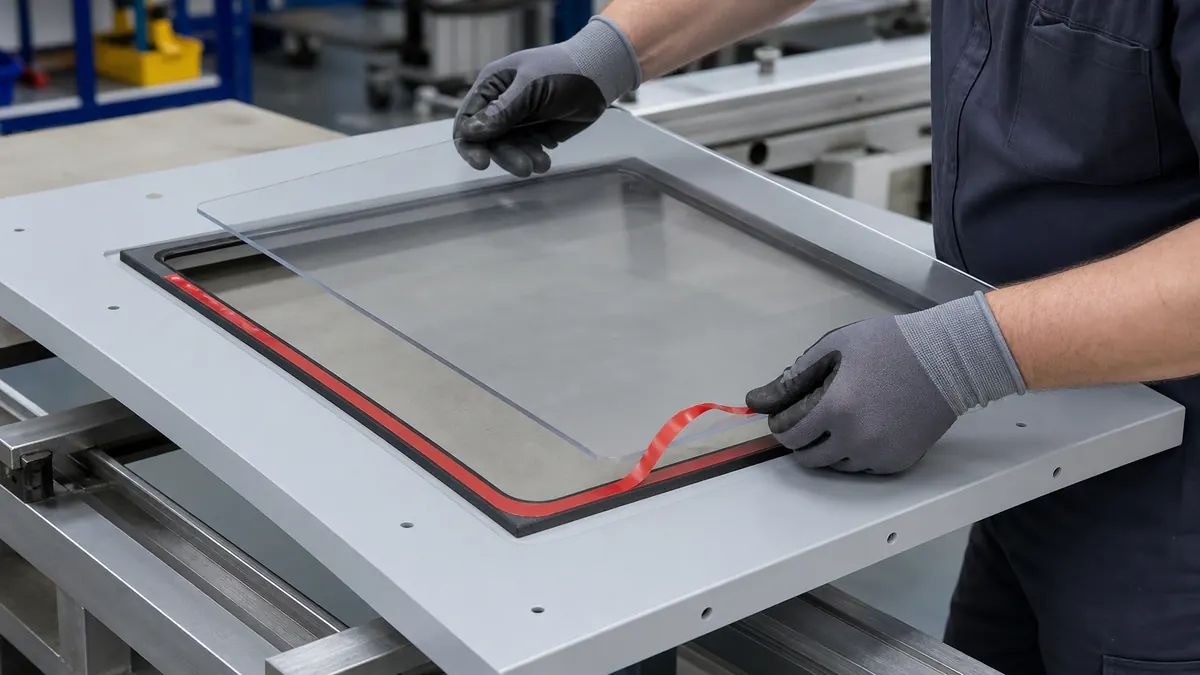
Quick Answer
Choose double-sided tape for a polycarbonate machine guard window by working from the complete assembly, not from a generic adhesion value. Define the window material and coating, metal-frame finish, bond width, unsupported span, door orientation, vibration, temperature, cleaning chemistry, expected service life, and the guard's required mechanical or impact performance. Then compare foam, film-carrier, transfer, or converted adhesive-frame constructions on production-representative substrates.
Define What the Window Bond Must Do
A viewing window may only close a light-duty dust opening, or it may form part of a safety guard around moving equipment. Those are different engineering problems. Document whether the tape provides permanent structural retention, secondary sealing, assembly positioning before fasteners, vibration isolation, cosmetic gap control, or a combination of functions.
Polycarbonate expands differently from a steel or aluminum door. A rigid, thin bondline can concentrate stress when the panel changes temperature or the door flexes. A conformable foam tape may accommodate texture and movement, but thickness also changes the window position and can increase peel leverage. The drawing should define the supported perimeter, corners, gaps, and any drainage or pressure-relief features.
| Requirement | Questions to answer | Design consequence |
|---|---|---|
| Guard function | Viewing panel, dust cover, splash shield, or safety barrier? | Determines retention and validation severity |
| Load path | Panel weight, pressure, vibration, impact, door slam, and service loads? | Defines bond area and need for hardware |
| Environment | Temperature, humidity, oil mist, coolant, UV, and cleaners? | Screens adhesive and foam compatibility |
| Appearance | Visible bondline, color, squeeze-out, bubbles, and edge alignment? | Controls tape color, thickness, and conversion |
| Service | Permanent assembly or replaceable window? | Changes edge access, removal, and residue requirements |
Compare Industrial Double-Sided Tape Constructions
Foam-core tape
Acrylic or polyethylene foam constructions can bridge small coating texture and provide a controlled spacing layer. Compare foam density, compression, thickness, edge exposure, and compatibility with the exact powder coat and polycarbonate surface. A soft foam can improve contact but may allow excessive movement; a firmer foam may transfer more stress to the panel edge.
Film-carrier or transfer adhesive
Thinner constructions minimize the visible gap and can suit smooth, flat mating surfaces. They offer less ability to absorb texture, door distortion, or differential movement. A transfer adhesive can be converted into a clean frame, but handling and liner design become critical because the unsupported adhesive can stretch or fold.
Converted adhesive frame
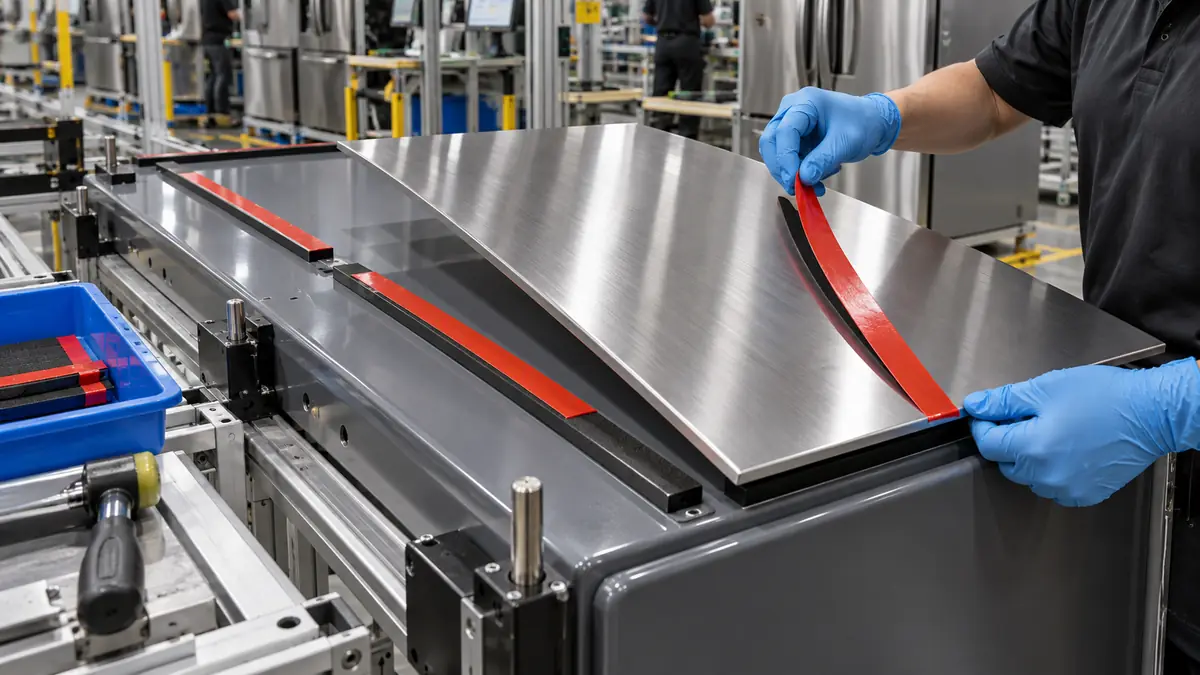
A kiss-cut frame on a stable release liner can control window opening, corner radius, vent paths, pull tabs, and placement datums. It also reduces hand-spliced corners where leaks and peel can start. The drawing should specify which liner is removed first and how the frame is registered to the door.
| Selection input | What to provide | Why it matters |
|---|---|---|
| Polycarbonate | Grade, thickness, hard coat, texture, protective film, and edge finish | Defines adhesion and stress-cracking checks |
| Metal frame | Metal, powder code, gloss, texture, cure, and flatness | Controls wet-out and durability |
| Bondline | Width, corner radius, thickness, joints, gaps, and visibility | Sets area, peel geometry, and appearance |
| Assembly | Fixture, placement tolerance, roller pressure, dwell, and liner sequence | Controls repeatable contact |
| Service | Loads, environment, cleaning, life, and replacement method | Defines qualification and maintenance |
Design the Adhesive Frame and Edges
Use generous internal corner radii where the design permits. Sharp inside corners concentrate stress in the adhesive and can be difficult to place without stretching. Keep the tape fully supported inside the frame; an exposed foam edge can collect coolant, dust, or cleaning fluid. If a sealed perimeter is required, do not leave unplanned gaps between hand-applied strips.
Allow space between the window edge and the metal cutout so the panel does not hard-contact a burr or sharp corner. Deburr and finish the door opening before bonding. If the window needs ventilation, drainage, or pressure equalization, put those features on the drawing instead of cutting the adhesive frame informally during assembly.
Decide whether the clear panel overlaps the frame from the inside or outside. The direction changes peel exposure, contaminant access, and service removal. Protective films on polycarbonate should remain only as long as the assembly process allows; never bond to a temporary film unless that is the intended released interface.
Recommended Window-Bonding Workflow
- Confirm the released design. Verify the window, door, tape frame, retention strategy, and safety requirements.
- Inspect substrates. Check polycarbonate coating, edges, protective films, powder finish, flatness, burrs, and damage.
- Condition materials. Follow supplier storage and workplace conditioning requirements.
- Clean by the approved method. Use chemicals compatible with both polycarbonate and the powder coat.
- Place the tape frame. Align from defined datums without stretching, touching, or contaminating adhesive.
- Apply controlled pressure. Roll or press the complete perimeter using the qualified tool and support.
- Stage liner removal. Peel in the released sequence so the frame and window remain aligned.
- Place the window once. Use stops or a fixture; avoid lifting and repositioning after contact begins.
- Consolidate the bondline. Apply uniform pressure around edges and corners without cracking or bowing the panel.
- Condition and inspect. Hold for the qualified dwell, then check position, contact, gaps, appearance, and retention.
Qualify the Complete Guard Assembly
Test the smallest bond width, largest unsupported panel, roughest approved powder texture, realistic window and door tolerances, and the most demanding service orientation. Use production parts because flat test strips cannot reproduce door flex, corner peel, panel bow, cutout edges, or assembly pressure. Include both initial build quality and aged performance.
- Inspect continuous wet-out, corner contact, edge gaps, foam squeeze, and visible bondline quality.
- Run temperature, humidity, cleaner, coolant, vibration, and door-cycle exposures defined by the machine owner.
- Evaluate polycarbonate for haze, cracking, crazing, coating damage, or chemical attack.
- Perform required retention, pressure, impact, and guarding tests using the applicable released methods.
- Review any change to window grade, hard coat, powder coat, tape, frame geometry, cleaner, fixture, or assembly pressure.
Troubleshooting Guard-Window Bonds
| Observed problem | Check first | Corrective direction |
|---|---|---|
| Corner lifts from the door | Powder texture, corner radius, contamination, stress, and applied pressure | Improve geometry, preparation, contact, or tape construction |
| Window bows or pulls away | Differential movement, foam stiffness, gap, door flex, and unsupported span | Rework the mechanical and bondline design |
| Polycarbonate develops cracks | Cleaner, adhesive chemistry, edge stress, fastener load, and panel grade | Stop use and requalify compatible materials and geometry |
| Fluid enters at a corner | Hand splice, gap, edge exposure, drainage, and pressure path | Use a controlled continuous frame or released seal detail |
| Bondline is visible or uneven | Panel flatness, tape thickness, placement, squeeze, and trapped air | Tighten the fixture, datum, pressure, and appearance standard |
Frequently Asked Questions
Can double-sided tape replace screws on a machine guard window?
Only when the machine design, risk assessment, and validation explicitly permit adhesive retention. Do not remove required fasteners, retainers, interlocks, or other safety provisions based on initial tack.
What tape works on powder-coated metal and polycarbonate?
A conformable foam tape is often screened for textured powder coat, while thinner film or transfer constructions may suit smooth frames. Test the exact powder finish, polycarbonate grade, cleaners, and loads together.
Can adhesive cause polycarbonate stress cracking?
Material incompatibility, cleaners, residual forming stress, sharp edges, and assembly load can contribute to cracking or crazing. Qualify the complete material and chemical system on production-representative panels.
Is a die-cut adhesive frame better than four tape strips?
A converted frame can control corner continuity, opening geometry, liner sequence, and placement. Separate strips remain practical for prototypes if joints and gaps are documented and validated.
What information belongs in an RFQ?
Provide the guard drawing, window grade and coating, metal and powder finish, bond width, load and safety role, environment, cleaner, liner preference, annual quantity, assembly method, and required tests.
Specify a Production-Ready Guard-Window Bond
Share the window and door drawings, substrates, powder finish, bondline geometry, safety role, loads, environment, cleaner, liner sequence, assembly fixture, and validation plan. JIAO TAO TAO can help shortlist a foam, film-carrier, transfer, or die-cut frame construction for evaluation.
Industrial Double-Sided Tape for Machine-Vision Light Diffuser Bonding
Industrial Double-Sided Tape for Wiring Duct Mounting
Related Article
Need help choosing the right industrial tape?
Send us your application details, including temperature, surface material, size, quantity and current problem. Our team will help recommend a suitable tape material or custom die-cut solution.

simon@jiaotaotao.com


+86-136 1277 5969


+86-136 1277 5969
