
Custom Die-Cut Tape for Battery Vent Membrane Bonding
Custom Die-Cut Tape for Battery Vent Membrane Bonding
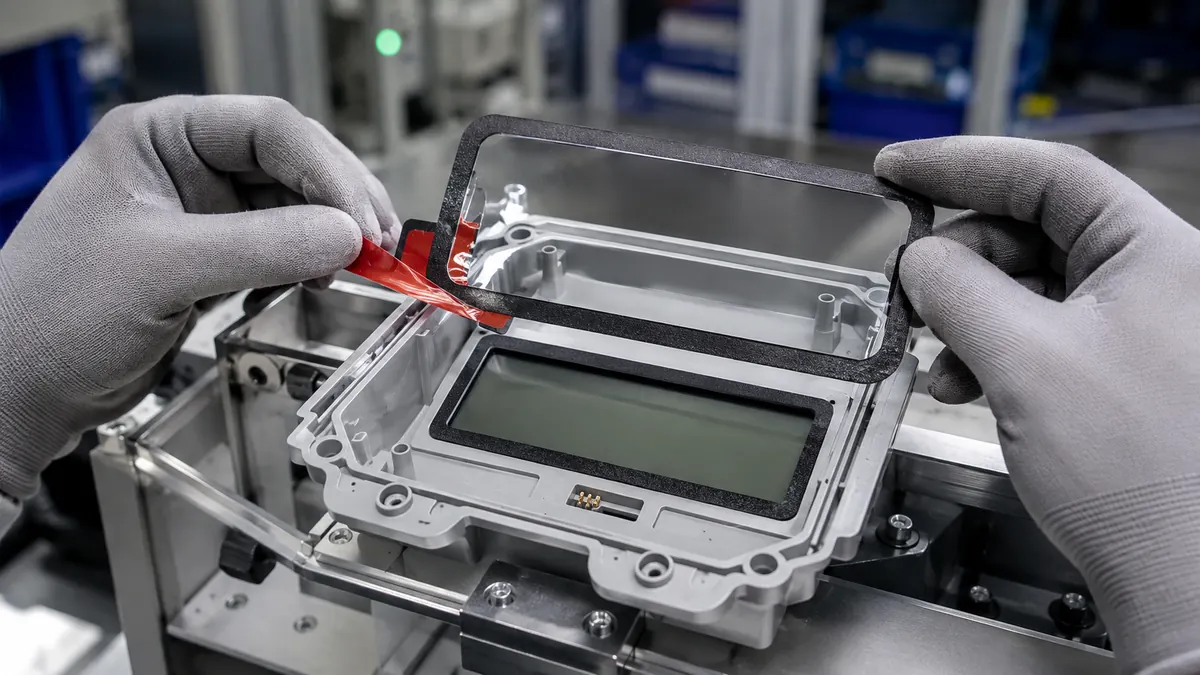
Custom die-cut tape for battery vent membrane bonding creates a repeatable adhesive border around a pressure-relief or breathable opening without covering the active vent area. The finished part must match the housing, membrane, vent geometry, liner format, and assembly method. It should be treated as one element of the enclosure design—not as proof of vent performance, sealing, or battery safety by itself.

Key Takeaways
- Keep the membrane's active vent zone separate from the adhesive land and all cut tolerances.
- Screen the adhesive on the actual membrane edge, housing resin or coating, and surface condition.
- Design the liner, pull tab, orientation, and carrier for the intended manual or automated placement process.
- Validate the complete vent assembly to the battery manufacturer's own mechanical, environmental, and safety requirements.
What the Battery Vent Membrane Bond Must Accomplish
Battery modules, packs, power electronics enclosures, and energy-storage housings may use a vent membrane to manage pressure, exchange air, or protect an opening from selected contaminants. The membrane and vent hardware define the functional airflow or relief path. A die-cut adhesive ring provides a controlled attachment land between that membrane assembly and a plastic, coated metal, or composite housing.
The adhesive part has several practical jobs: keep the membrane centered, maintain a continuous perimeter where the design requires one, avoid squeeze-in toward the vent, and survive handling before the housing is closed. It may also need to support robotic pick-and-place or a manual fixture. These functions depend on geometry and process control as much as on adhesive chemistry.
Common Die-Cut Constructions Compared
| Construction | Potential fit | Critical checks |
|---|---|---|
| Transfer adhesive ring | Thin bondline where both surfaces are flat and well supported | Handling stability, edge flow, liner release, and membrane distortion |
| Double-coated PET carrier | Precise geometry and repeatable placement of a thin membrane | Total thickness, carrier stiffness, adhesion to both substrates, and aging |
| Thin foam adhesive ring | A controlled gap or surface variation must be accommodated | Compression, recovery, closed- or open-cell structure, and vent intrusion |
| High-temperature film construction | Assembly or service includes elevated thermal exposure | Real temperature profile, adhesive compatibility, shrinkage, and residue |
| Removable process mask | The opening needs temporary protection before the permanent membrane is installed | Removal force, residue, detection, and damage to the housing surface |
RFQ Inputs for a Vent-Membrane Adhesive Ring
| Design input | Information to provide | Why it matters |
|---|---|---|
| Membrane | Material, surface treatment, thickness, active area, edge construction, and supplied format | Controls adhesion, handling, and keep-out requirements |
| Housing | Resin or metal grade, coating, texture, curvature, molding condition, and cleaning method | Defines wet-out and surface compatibility |
| Vent geometry | Opening outline, adhesive land, radii, ribs, holes, and all keep-out zones | Sets the usable bond area and cut tolerance |
| Stack condition | Nominal gap, flatness, clamp load, membrane tension, and housing deflection | Determines whether a film or foam construction is suitable |
| Environment | Temperature cycling, humidity, fluids, dust, vibration, pressure events, and service life | Defines the finished-assembly qualification sequence |
| Placement | Manual or automated, datum scheme, pick point, sheet or roll, pitch, orientation, and liner tab | Controls line speed and placement repeatability |
| Inspection | Position tolerance, bond continuity, wrinkles, edge lift, cleanliness, and functional test | Turns the drawing into measurable acceptance criteria |
How to Design the Die-Cut Geometry
Protect the active vent area
Start with the released vent and membrane drawings. Create an adhesive-free keep-out zone that includes cut tolerance, placement tolerance, adhesive flow, membrane movement, and housing variation. The inner edge of the tape should not be located only from a nominal CAD line.
Use a stable registration feature
A carrier outline, asymmetric corner, datum hole, or fixture edge can prevent rotation and reversed placement. For thin rings, a split liner or extended pull tab may let an operator register one section before exposing the rest of the adhesive.
Review narrow lands and internal waste
Narrow bridges and sharp internal corners can make waste removal and dispensing unstable. The converter should review minimum web width, corner radii, liner stiffness, internal-slug removal, part spacing, and roll direction. Prototype tooling should represent the intended production format whenever possible.
Do not infer an enclosure rating from the tape
A continuous adhesive perimeter can support a seal design, but it does not establish an ingress, pressure, or safety rating. The membrane, housing joint, vent hardware, fasteners, welds, gaskets, and every other path remain part of the complete enclosure validation.
Recommended Converting and Assembly Process
- Freeze the functional inputs. Record the membrane code, housing material, vent opening, active area, bond land, and required test sequence.
- Screen adhesive families. Compare only constructions that fit the gap, surface energy, temperature profile, and permanent or temporary function.
- Prototype the finished geometry. Include the production liner, pull tab, internal opening, orientation, pitch, and packaging.
- Condition production-representative parts. Use the approved cleaning method and the actual molding or coating state.
- Apply with controlled pressure. Record placement datum, fixture, roller or press condition, dwell, and any membrane tension.
- Inspect before enclosure closure. Check centering, wrinkles, trapped particles, exposed adhesive, lift, and intrusion into the active area.
- Validate the assembly. Run the required airflow, pressure, leak, thermal, humidity, vibration, fluid, and aging tests defined by the device owner.
- Release the full specification. Control tape construction, drawing revision, liner, delivery format, packaging, inspection, and change notification.
Failure-Mode Review
| Observed issue | Adhesive-part checks | Assembly checks |
|---|---|---|
| Vent area is partly covered | Inner-cut tolerance, ring stability, adhesive flow, and liner release | Datum, fixture, membrane shift, and vision threshold |
| Perimeter edge lifts | Adhesive compatibility, land width, thickness, and conditioning | Contamination, pressure, dwell, curvature, and housing stress |
| Ring stretches during placement | Carrier choice, liner release force, bridges, and pull-tab design | Peel direction, gripper path, fixture support, and operator motion |
| Particles appear near the membrane | Cut-edge debris, internal-slug removal, liner cleanliness, and packaging | Workstation control, gloves, handling tools, and inspection timing |
| Functional result varies | Opening size, bond continuity, compression, and material variation | Membrane lot, housing flatness, vent hardware, closure, and test method |
Datasheets and simple peel checks are useful for screening, but they cannot approve a battery vent assembly. Qualification should use released parts, production fixtures, representative conditioning, and the manufacturer's documented safety and functional test plan.
Related Products and Articles
- Explore custom die-cutting services for industrial tapes and insulation materials.
- Compare double-sided tape carrier, foam, and adhesive families.
- Review another converting workflow in custom die-cut tape for LED lighting assembly.
- Send the vent drawing and assembly requirements for a material and liner review.
Frequently Asked Questions
What tape is used to bond a battery vent membrane?
Transfer adhesive, double-coated film tape, or a thin foam adhesive may be considered. Selection depends on the membrane edge, housing surface, gap, temperature, fluids, placement method, and the device qualification plan.
Can the adhesive ring cover part of the active membrane?
It should remain outside the released active-area keep-out zone unless the membrane supplier and device design explicitly specify otherwise. Include cut, placement, and adhesive-flow tolerances in the boundary.
Is foam tape always better for sealing?
No. Foam may accommodate a controlled gap, but compression, recovery, cell structure, thickness, and long-term load must fit the joint. A thin film carrier may be more stable where the surfaces are flat.
Can vent-membrane adhesive parts be supplied on a roll?
Selected geometries can be delivered in roll format for automated or semi-automated placement. Pitch, orientation, liner stiffness, release force, winding direction, and pick location must be defined.
What should be included in a quotation request?
Provide the dimensioned drawing, membrane and housing materials, vent keep-out zone, gap, temperature and fluid exposure, delivery format, placement process, quantity, packaging, and acceptance tests.
Prepare a Battery Vent Membrane Trial
Share the vent and housing drawings, membrane construction, adhesive land, gap, environment, placement method, annual quantity, and validation requirements. JIAO TAO TAO can help shortlist a tape construction and production-friendly die-cut format for your own qualification.
Contact the technical team about a battery vent membrane bonding project.
PET Silicone Tape for Automotive Connector Masking During Paint Bake
PET Silicone Tape for Powder-Coat Grounding Point Masking
Related Article


Need help choosing the right industrial tape?
Send us your application details, including temperature, surface material, size, quantity and current problem. Our team will help recommend a suitable tape material or custom die-cut solution.

simon@jiaotaotao.com


+86-136 1277 5969


+86-136 1277 5969
