
Acetate Cloth Tape for Current Transformer Secondary Lead Protection
Product Guides · Instrument Transformer Assembly
Acetate Cloth Tape for Current Transformer Secondary Lead Protection
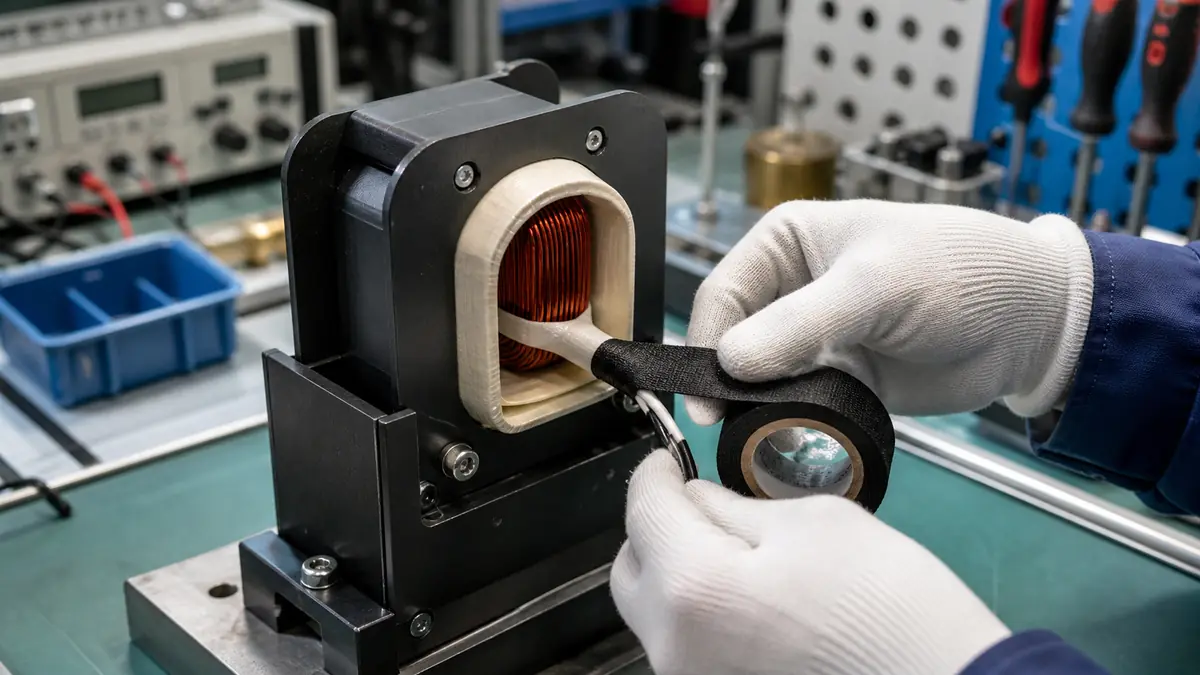
Acetate cloth tape for current transformer secondary lead protection can provide a conformable local wrap where insulated secondary conductors leave a coil, pass a core edge, or transition toward terminals. The tape must support the released transformer insulation and mechanical design without replacing sleeving, barriers, strain relief, terminal hardware, or required electrical spacing.
Quick Answer
Choose acetate cloth tape only after defining the exact secondary lead route, insulation already on the conductor, contact surfaces, bend radius, terminal direction, varnish or resin exposure, operating temperature, and available enclosure space. A narrow cloth wrap may hold an approved sleeve, soften a localized transition, or protect a selected contact point, but it should not hide a damaged wire or carry an undefined pulling load.
Define the Secondary Lead-Exit Function
A current transformer secondary may use enamel wire, flexible insulated leads, pins, terminals, or a small connector. The transition from the wound coil to the termination can experience forming, soldering, handling, potting, clamping, and final installation. Tape is useful only where the released drawing identifies a controlled function.
| Lead-exit location | Possible tape function | Engineering boundary |
|---|---|---|
| Coil-to-lead transition | Hold an approved sleeve or local bundle | Lead insulation and bend radius remain primary |
| Core-edge crossing | Add a conformable abrasion barrier over a smooth, approved surface | Sharp edges must be corrected before wrapping |
| Terminal approach | Maintain routing during assembly | Tape must not carry terminal torque or pull load |
| Outer coil finish | Secure a short transition before impregnation | Coverage must not block required varnish or inspection |
| Housing contact point | Reduce rubbing at a defined interface | Clearance, temperature, and vibration still require validation |
How to Select an Acetate Cloth Tape
Start with the insulation system
The transformer design owner should identify the required electrical, thermal, mechanical, flammability, and regulatory framework. Do not infer suitability from a generic product family. Request current data and traceability for the exact tape construction.
Match the adhesive to the process
Initial tack should hold on the approved wire insulation, sleeving, paper, film, or underlying wrap. Later the adhesive may encounter varnish, resin, solvent, heat, humidity, and pressure. Evaluate edge lift, softening, hardening, migration, residue, and interaction with impregnation chemistry.
Balance width, conformity, and build
A narrow tape follows a small lead bundle and short radius more easily, while a wider tape covers faster but can wrinkle or bridge. Every overlap adds thickness near the terminal or housing. Select width together with overlap, route, and the finished dimensional envelope.
| RFQ input | Information to provide | Why it matters |
|---|---|---|
| Transformer geometry | Core, coil, lead exit, terminal, housing, and clearances | Defines the available wrap envelope |
| Lead construction | Wire or cable insulation, sleeve, conductor size, and bend radius | Controls adhesion and flexing |
| Tape function | Holding, abrasion protection, finishing, or qualified insulation role | Prevents undefined material substitution |
| Process exposure | Soldering, cleaning, varnish, potting, cure, and storage | Guides chemical and thermal screening |
| Service duty | Voltage, frequency, load, temperature, vibration, and environment | Sets complete-assembly tests |
Design the Wrap and Termination
Document the wrap start, direction, number of turns, overlap window, tension, finished edge, and distance from the terminal or core. Keep the cloth edge away from a solder joint that must remain visible and from a bend where a hard tape step could concentrate flexing. Maintain creepage, clearance, connector access, and enclosure fit.
Use controlled cutting when a clean termination is important. Hand tearing may create loose fibers or variable length unless the tape grade and work instruction specifically allow it. A die-cut patch or pre-cut strip can improve repeatability on small assemblies.
Recommended Production Workflow
- Verify the build. Match core, coil, lead, sleeve, tape, terminal, and drawing revision.
- Inspect before covering. Check enamel, cable insulation, solder joint, sleeve, burrs, and contamination.
- Prepare the strip. Use the approved width, length, cut method, and clean workstation.
- Set the lead route. Hold the specified bend radius and terminal direction in a fixture.
- Anchor the wrap. Start at the released datum without pulling the lead.
- Control tension and overlap. Conform the cloth without compressing or displacing insulation.
- Finish cleanly. Press the final edge away from inspection and motion zones.
- Measure and inspect. Verify coverage, fibers, edge lift, clearance, and finished dimensions.
Qualification and Production Validation
Run representative samples through the actual soldering, cleaning, impregnation or potting, cure, and assembly sequence. Include minimum and maximum lead bend, material lots, wrap tension, overlap, and storage age. The current transformer owner should define electrical and functional tests for the complete unit.
- Inspect the wrap before and after each major process exposure.
- Check varnish wetting, voids, fiber release, adhesive migration, and lifted terminations.
- Measure lead position, clearance, terminal access, and housing fit.
- Run required ratio, phase, excitation, resistance, insulation, dielectric, thermal, vibration, and environmental tests.
- Use pull, flex, or abrasion tests only with loads and methods defined by the product owner.
- Requalify changes to cloth grade, adhesive, width, route, varnish, cure, lead, or terminal.
Troubleshooting Common Lead-Wrap Problems
| Observed problem | Check first | Corrective direction |
|---|---|---|
| Tape end lifts | Surface, overlap, pressure, contamination, adhesive, and storage | Correct the approved preparation and termination |
| Lead insulation is marked | Wrap tension, edge placement, bend radius, and underlying damage | Reduce concentrated stress and re-inspect the lead |
| Loose fibers appear | Cut method, cloth finish, handling, and workstation control | Use a cleaner approved cutting and packaging method |
| Varnish leaves a dry zone | Coverage, overlap, cloth wetting, resin viscosity, and process | Adjust the qualified wrap and impregnation plan |
| Assembly no longer fits | Tape thickness, overlap stack, route, and housing clearance | Rebuild the dimensional stack and wrap drawing |
Related Products and Articles
Frequently Asked Questions
Can acetate cloth tape replace lead sleeving?
Not automatically. Sleeving, cloth tape, film barriers, and strain relief serve different functions. Any substitution requires design approval and representative electrical and mechanical validation.
Can the tape wrap directly over an enamel-wire joint?
Only when the released construction defines the joint, primary insulation, smoothness, spacing, and wrap. Tape should never conceal damaged enamel or an unapproved splice.
Should the cloth absorb varnish?
Only if the selected insulation system and process require it. Test wetting, cure, voids, adhesion, dimensions, and electrical performance with the exact tape and varnish.
What tape width is best for a secondary lead exit?
Width depends on lead diameter, sleeve, bend radius, available access, overlap, finished build, and application method. Trial practical widths on the real geometry.
What information belongs in an RFQ?
Provide the transformer geometry, lead and sleeve materials, tape function, electrical and thermal requirements, varnish or resin cycle, wrap drawing, quantity, and validation plan.
Prepare a Current Transformer Lead-Wrap Trial
Share the core and coil geometry, secondary lead route, terminal style, sleeve and insulation materials, varnish or potting sequence, service duty, desired tape width, finished envelope, and acceptance tests. JIAO TAO TAO can help shortlist acetate cloth tape constructions for controlled production trials.
Discuss current transformer lead protectionAcetate Cloth Tape Slit-Edge Quality for Coil Wrapping
PET Silicone Tape Slitting Tolerances for Automated Masking
Related Article
Need help choosing the right industrial tape?
Send us your application details, including temperature, surface material, size, quantity and current problem. Our team will help recommend a suitable tape material or custom die-cut solution.

simon@jiaotaotao.com


+86-136 1277 5969


+86-136 1277 5969
