
Acetate Cloth Tape for Motor End-Winding Binding
Acetate Cloth Tape for Motor End-Winding Binding
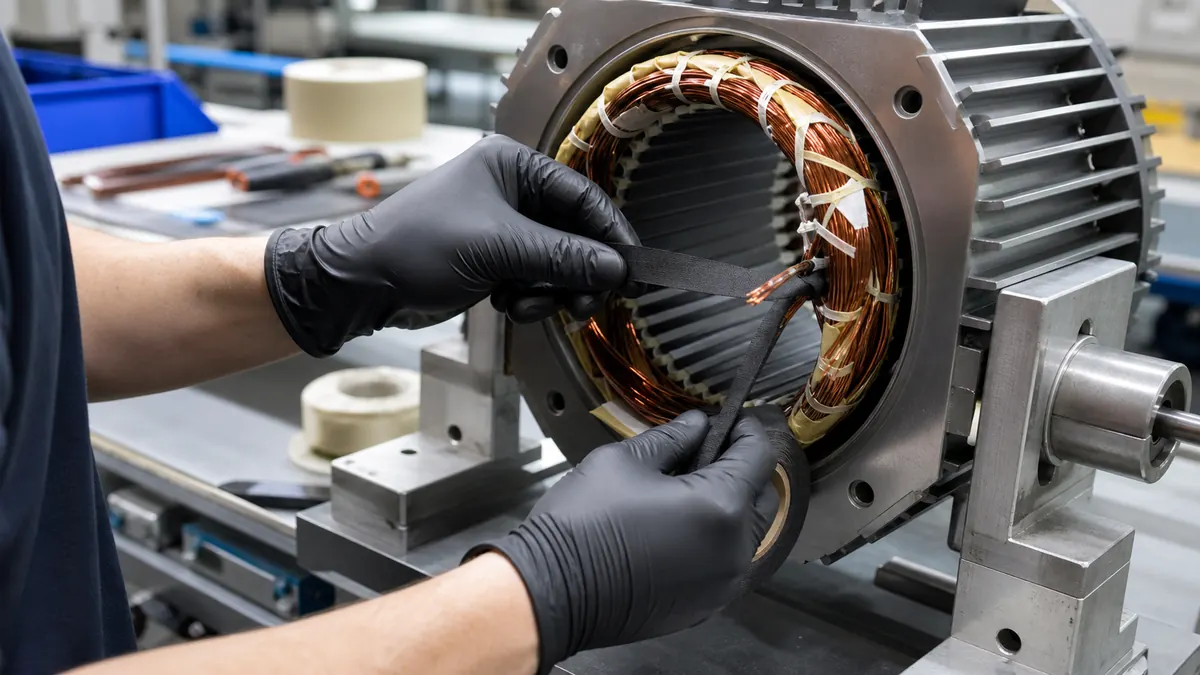
Acetate cloth tape for motor end-winding binding can hold, protect, and locally insulate copper end turns and lead exits during stator assembly and selected varnish processes. Its woven backing is conformable and can absorb insulating varnish, but the tape must be chosen as part of the motor’s approved insulation system. Thermal class, adhesive chemistry, dielectric requirements, wrap geometry, varnish compatibility, and mechanical loading all need application-specific validation.
Key Takeaways
- Acetate cloth tape is commonly used for coil wrapping because it is conformable, hand-tearable in many grades, and receptive to insulating varnishes.
- The tape should not be treated as a stand-alone motor insulation system or a replacement for lacing, sleeving, wedges, or structural bracing without engineering approval.
- Wrap width, overlap, tension, edge placement, and lead-exit protection must be standardized to avoid loose ends or concentrated stress.
- Qualification should include the real varnish, cure cycle, electrical checks, vibration, thermal aging, and inspection after sectioning or teardown where required.
What Acetate Cloth Tape Does at a Motor End Winding
Motor stator windings emerge from the slot region and form end turns before the conductors connect to leads or adjacent coils. These areas experience handling during winding, forming, lead connection, lacing, varnish treatment, and final assembly. Depending on the design, tape may provide local holding, abrasion protection, separation between conductors, identification, or a protective wrap around a lead exit.
Acetate cloth backing conforms around rounded windings and irregular bundles. Commercial electrical grades may use rubber-resin or acrylic pressure-sensitive adhesive and can absorb varnish or resin. That absorption can help the wrap become integrated with a varnished coil, but it also means the exact tape and varnish must be evaluated together. The adhesive should hold during assembly without creating contamination or preventing the intended impregnation.
| End-winding function | How tape may be used | Engineering limit |
|---|---|---|
| Temporary bundle holding | Maintains local conductor position before lacing or varnish | Must not be assumed to carry final electromagnetic or vibration loads |
| Lead-exit protection | Wraps a transition where a lead leaves the coil bundle | Bend radius and abrasion source still require design control |
| Local electrical separation | Adds a conformable layer between approved regions | Dielectric performance must be verified in the complete insulation system |
| Abrasion barrier | Covers an exposed winding edge or contact point | Sharp metal edges should be corrected, not merely hidden by tape |
| Varnish-receptive outer wrap | Absorbs selected insulating varnish around a local coil area | Wetting, cure, voids, and chemical compatibility need qualification |
How to Select an Acetate Cloth Tape Grade
Start with the approved insulation system and thermal requirement
The motor design owner should identify the required electrical insulation system, thermal class, and any recognized material combinations. Acetate cloth products vary in backing weight, adhesive, flame performance, temperature rating, and electrical properties. Do not transfer a temperature or certification claim from one branded grade to an unverified alternative. Request the current technical data and compliance documentation for the exact tape code.
Compare adhesive behavior before and after varnish cure
Initial tack helps hold the wrap during assembly, but the tape also sees varnish, solvents, heat, and pressure during finishing. A thermosetting rubber-resin adhesive may change during cure; an acrylic grade can behave differently. Evaluate edge lift, adhesive migration, hardening, softening, varnish wetting, and bond retention after the actual cycle. The process may require the tape to remain permanently, so clean removability is usually not the main criterion.
Choose thickness, width, and conformability together
A wider tape can cover a larger bundle quickly but may wrinkle around tight end turns. A narrow slit width follows small radii more easily but increases the number of wraps and seams. Thicker cloth adds mechanical coverage while increasing the final envelope. Select a controlled width and overlap pattern from the motor geometry, not from operator preference alone.
| Selection factor | Questions to ask | Evidence to review |
|---|---|---|
| Thermal suitability | What are the continuous, overload, and cure temperatures and durations? | Exact-grade TDS, insulation-system approval, and motor validation |
| Electrical role | Is the tape holding, separating, reinforcing, or providing a required dielectric layer? | Drawing, creepage/clearance design, dielectric test, and section review |
| Adhesive system | Will it contact enamel, sleeving, paper, cloth, or cured varnish? | Compatibility trial on production materials |
| Varnish response | Does the cloth wet, absorb, and cure without voids or loss of position? | Impregnation trial, cured teardown, and chemical compatibility result |
| Mechanical protection | Where do vibration, lead movement, or assembly contact load the wrap? | Vibration, thermal cycling, abrasion, and pull testing defined by engineering |
| Workability | Can the tape follow the required radius without fray, stretch, or wrinkles? | Operator trial, slit-edge inspection, and process capability data |
Acetate Cloth vs Other End-Winding Materials
Motor windings can use multiple tapes, papers, films, sleeves, cords, and resins. Acetate cloth is one option for conformable wrapping and varnish absorption; it is not the answer for every thermal or mechanical condition. Compare materials by their function in the complete design.
| Material | Potential strength | When to consider another option |
|---|---|---|
| Acetate cloth tape | Conformable cloth wrap, good handling, varnish absorption in suitable grades | When the required thermal class, mechanical strength, or approved system exceeds the grade |
| Polyester film tape | Thin, smooth dielectric film with controlled thickness | When cloth conformability or varnish uptake is essential |
| Polyimide film tape | Thin electrical insulation for selected higher-temperature applications | When a woven, resin-absorbing wrap or thicker mechanical cushion is needed |
| Glass cloth tape | Higher mechanical strength and temperature capability in selected systems | When thickness, stiffness, or abrasion against enamel is a concern |
| Polyester or glass lacing cord | Designed to bind and brace windings mechanically | When a continuous surface wrap or local dielectric cover is required |
| Insulation sleeve or paper | Defined lead, phase, or slot insulation geometry | When a pressure-sensitive holding layer is needed for assembly |
Recommended Wrapping and Varnish Workflow
- Confirm the motor and tape revision. Verify the winding drawing, tape code, width, color, adhesive, and approved insulation-system documentation.
- Inspect the end winding. Check conductor enamel, sleeving, lacing, slot exits, lead routing, and sharp contact points before covering them.
- Clean only as specified. Keep oil, loose particles, and processing contamination away from the wrap area without using an unapproved solvent.
- Anchor the first turn in the defined location. Start away from a sharp bend, termination, or required inspection point.
- Wrap with controlled tension and overlap. Conform the cloth without stretching the coil, displacing conductors, or wrinkling the tape.
- Protect the lead transition. Maintain the specified bend radius and avoid a hard tape edge that concentrates movement.
- Finish the end securely. Press the final overlap and keep the tape end away from moving or mating components.
- Inspect before varnish. Check coverage, position, wrinkles, fray, exposed adhesive, and interference with the stator bore or housing.
- Run the approved impregnation and cure. Use the specified varnish, vacuum or dip process, drain, temperature, dwell, and cooling sequence.
- Inspect after cure. Verify wetting, hardness, edge condition, voids, lead position, clearances, and required electrical or mechanical results.
Quality Checks and Troubleshooting
| Observed issue | Tape or design checks | Process checks |
|---|---|---|
| Tape lifts before varnish | Adhesive match, tape age, width, overlap, and bend radius | Surface condition, application tension, pressure, and handling time |
| Wrinkles around the end turn | Width, thickness, backing conformability, and wrap path | Operator angle, tension, overlap, and conductor position |
| Dry area after impregnation | Backing absorbency, overlap, excessive layers, and adhesive coverage | Varnish viscosity, vacuum/dip sequence, drain, and cure |
| Lead insulation cracks near the wrap | Tape edge, overlap step, lead sleeve, and bend geometry | Lead forming, handling, cure restraint, and vibration |
| Adhesive or varnish migrates | Adhesive chemistry, coat weight, tape compatibility, and storage | Cure temperature, dwell, varnish chemistry, and drainage |
| Stator clearance is reduced | Layer count, tape thickness, overlap, and winding envelope | Wrap placement, coil forming, and dimensional inspection |
A useful process record includes the motor revision, wire and insulation materials, tape lot, width, wrap count, operator or equipment, overlap, measured winding envelope, varnish lot, impregnation settings, cure profile, and inspection result. If a failure occurs, record the exact location relative to the slot exit, lead, phase separation, or tape edge. This is more useful than describing the issue only as “tape failure.”
Related Products and Articles
- Review the acetate cloth tape product range for motor, transformer, and electrical insulation applications.
- Read what acetate cloth tape is used for across coil wrapping, insulation, and harness applications.
- Compare motor insulation needs with polyimide tape properties and selection factors.
- Send the motor winding and varnish process requirements for a tape-format review.
Technical References
- 3M Acetate Cloth Electrical Tape 11 product information describes a conformable, hand-tearable acetate cloth tape for coil wrapping and varnish or resin absorption.
- Scapa 1301 technical data identifies an acetate cloth electrical tape for coil-winding protection and insulation. Exact-grade data must be checked before substitution.
Frequently Asked Questions
Why is acetate cloth tape used on motor windings?
Suitable electrical grades are conformable around coil shapes, offer local holding and insulation functions, and can absorb selected varnishes or resins. The exact tape must still be approved within the motor’s insulation system and process.
Can acetate cloth tape replace motor lacing cord?
Not automatically. Lacing cord and structural bracing can carry mechanical loads that a pressure-sensitive tape wrap is not designed to replace. Any substitution requires winding-design approval and representative electromagnetic, vibration, thermal, and durability testing.
Should the tape be applied before or after varnish impregnation?
Acetate cloth tape is often applied before impregnation when the design relies on local holding and varnish uptake. Some repairs or finishing operations may use a different sequence. Follow the approved motor process and verify that the tape does not block required varnish penetration.
How much overlap should be used on an end winding?
Overlap should be specified from the tape width, thickness, coil geometry, electrical role, mechanical loading, and winding envelope. A generic percentage can create too many layers on a small coil or too little coverage on a large bundle.
What information should be sent to an acetate cloth tape supplier?
Provide the motor type, insulation system, continuous and overload temperature, varnish and cure cycle, bonding surfaces, tape function, width, thickness limit, wrap drawing, electrical tests, mechanical tests, compliance needs, and annual volume.
Request an Acetate Cloth Motor-Winding Tape Review
Share the stator end-winding geometry, insulation system, tape function, varnish chemistry, cure profile, thermal requirement, wrap width, overlap, and validation plan. JIAO TAO TAO can help shortlist an acetate cloth tape grade and slit width for your motor production trial.
Contact the technical team with your motor winding requirements.
PET Silicone Tape for Battery Tab Welding Protection
PET Silicone Tape for High-Temperature Release Liner Splicing
Related Article
Need help choosing the right industrial tape?
Send us your application details, including temperature, surface material, size, quantity and current problem. Our team will help recommend a suitable tape material or custom die-cut solution.

simon@jiaotaotao.com


+86-136 1277 5969


+86-136 1277 5969
