
PET Silicone Tape Slitting Tolerances for Automated Masking
Product Guides · Precision Converting
PET Silicone Tape Slitting Tolerances for Automated Masking
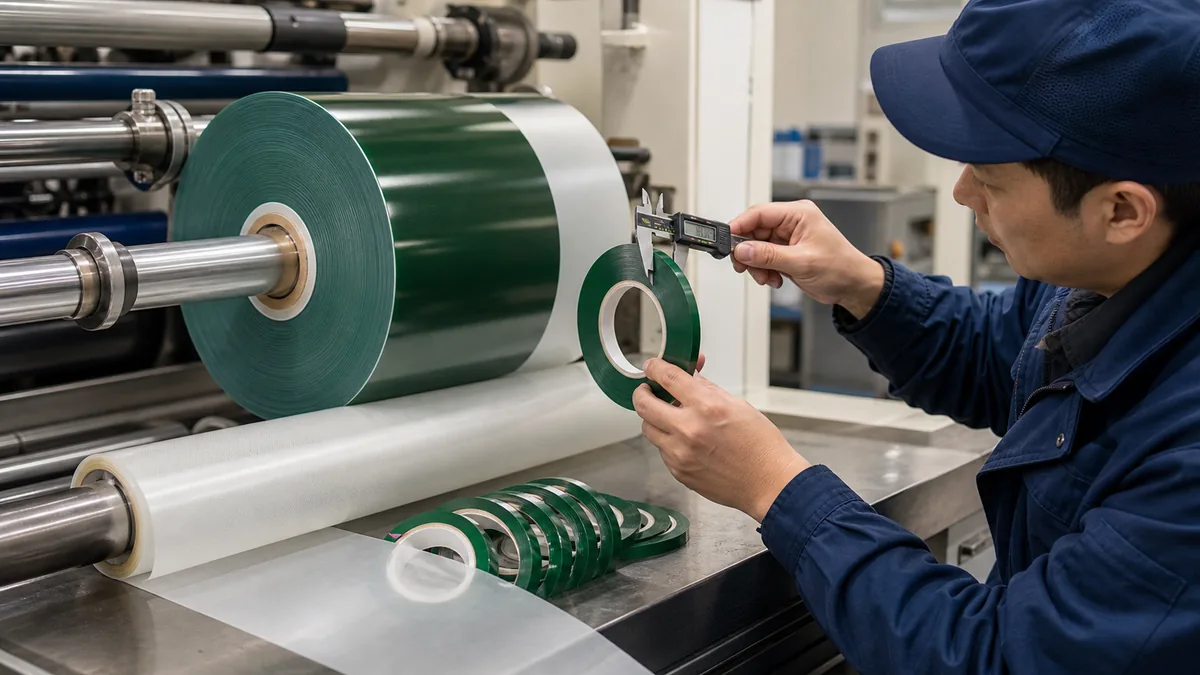
PET silicone tape slitting tolerances matter when a narrow roll must feed, locate, cut, or place consistently in an automated masking process. A useful purchase specification connects the protected feature to finished-roll width, edge condition, winding quality, liner behavior, and the equipment that will handle the tape.
Quick Answer
Specify PET silicone tape for automation from the protected feature backward. The drawing should state the required mask boundary and placement tolerance; the equipment review should then define finished tape width, permitted variation, edge quality, roll outside diameter, core, winding orientation, liner format, splice policy, and packaging. A narrow roll that meets a width check can still fail if it telescopes, blocks, curls, sheds edge debris, or unwinds inconsistently.
Build the Dimension Chain from the Masked Feature
The most important dimension is not always the tape width. A strip may be placed against a fixture edge, centered by a vision system, wrapped around a radius, or trimmed after application. Each method divides the final boundary error differently among material width, tape tracking, part location, applicator repeatability, and operator or robot setup.
Create a tolerance stack that distinguishes product requirements from converting and equipment controls. If the finished masking edge is critical, reserve enough process capability for variation in part position and application. An unrealistically tight tape-width tolerance can raise converting cost without improving the actual mask boundary.
| Input | What to define | Why it matters |
|---|---|---|
| Protected feature | Nominal boundary, allowed coverage, corners, and inspection method | Establishes the functional result |
| Application datum | Part edge, fixture, printed mark, sensor, or vision target | Controls where tape width variation appears |
| Finished roll width | Nominal value, tolerance, measurement method, and sampling | Connects converting output to the mask design |
| Placement process | Feed path, tracking, cut length, tension, speed, and pressure | Adds machine variation to the boundary |
| Acceptance | Coverage, edge location, residue, and removal criteria | Confirms performance on the part |
Specify the Complete PET Silicone Construction
Backing, adhesive, and color
PET film thickness affects stiffness, tensile behavior, conformability, cut response, and the height of the masking edge. The silicone pressure-sensitive adhesive affects unwind, surface wet-out, thermal response, and removal. Color can support detection or work-instruction control, but it does not prove a temperature rating or adhesive chemistry. Approve a traceable construction rather than a description such as “green high-temperature tape.”
Liner and non-liner formats
A self-wound roll may suit simple dispensing, while a linered format can help when the tape is kiss-cut, staged, or automatically picked. The liner must release consistently without tearing, curling into sensors, or creating static and debris problems. Define which side faces outward, whether labels may touch the edge, and how the roll is loaded.
Thermal and surface qualification remain separate
Converting accuracy does not qualify the tape for a powder-coating, plating, electronics, or curing process. The exact tape construction still needs a representative exposure trial using the production substrate, cleaning method, temperature history, dwell, and removal stage. Slitting controls geometry; it does not replace application validation.
| Construction item | RFQ detail | Incoming check |
|---|---|---|
| PET backing | Grade, thickness, color, and approved alternatives | Identity and certificate or supplier documentation as required |
| Silicone adhesive | Product code, coated side, and required use | Unwind and representative adhesion screen |
| Release liner | Material, thickness, release side, slit relationship, and print restrictions | Release behavior, curl, tears, and contamination |
| Core | Inside diameter, width, material, and edge relationship | Fit, damage, dust, and overhang |
| Finished roll | Width, tolerance, length or OD, winding direction, and splice policy | Dimensions, appearance, traceability, and packaging |
Width Is Only One Part of Roll Quality
Inspect both slit edges for nicks, feathering, adhesive ooze, loose particles, crushed layers, and damage from handling. Edge defects can disturb tracking or create a weak tear point during high-speed unwind. The core should be square to the roll, and any permitted overhang must match the dispenser design.
Winding tension should produce a stable roll without telescoping, blocking, dish shape, or stretched backing. Define whether splices are prohibited, limited, or identified. When splices are allowed, specify their construction and how the machine will detect or handle them. Packaging should protect edges and maintain roll orientation through transport and storage.
Match the Roll to the Automated Masking Cell
- Map the feed path. Record unwind direction, guides, rollers, sensors, cutter, and take-up.
- Define the roll envelope. Confirm core fit, maximum OD, face width, and flange clearance.
- Set a tension strategy. Avoid relying on stretch to correct tracking or length.
- Confirm detection. Check that tape and liner colors work with the actual sensor or vision setup.
- Control cut behavior. Evaluate backing thickness, adhesive stringing, liner cut depth, and blade condition.
- Apply pressure consistently. Define roller material, force, speed, and accessible geometry.
- Plan changeover. Use labels, orientation, and packaging that prevent reversed or mixed rolls.
- Document removal. The automated application plan must still support clean, controlled unmasking.
Qualify Converting and Application Together
Begin with dimensional and visual inspection, then run rolls from representative converting positions through the intended equipment. Include start, middle, and end of roll, normal line speed changes, planned stops, and a realistic changeover. Measure the tape at a defined conditioning state with an agreed method; squeezing a soft-edged roll with an inconsistent tool can create misleading data.
- Record roll width, core fit, sidewall condition, and winding orientation.
- Observe tracking, tension, cutter behavior, liner separation, static, and debris.
- Measure placement and mask boundary on real parts across the qualified operating range.
- Run the intended process exposure and removal sequence.
- Review changes to master-roll lot, slitter setup, blade, core, liner, packaging, or applicator settings.
Troubleshooting Common Automation Problems
| Observed problem | Check first | Corrective direction |
|---|---|---|
| Tape walks across the guide | Roll squareness, edge damage, web path, tension, and guide alignment | Correct the mechanical path and recheck finished-roll geometry |
| Width is in tolerance but mask edge is not | Part datum, tracking, stretch, cut length, and placement method | Rebuild the total tolerance stack |
| Roll telescopes during use | Winding tension, storage, temperature, flange contact, and braking | Align winding and dispensing controls |
| Cutter leaves adhesive strings | Blade condition, adhesive, backing support, speed, and temperature | Optimize the qualified cut setup |
| Liner tears or curls into a sensor | Liner grade, slit damage, release, take-up, static, and humidity | Evaluate a compatible liner and take-up route |
Related Products and Articles
Frequently Asked Questions
What slitting tolerance should I specify for PET silicone tape?
Start with the permitted mask-boundary variation and subtract the variation from part location and application equipment. Agree on a realistic finished-roll tolerance and measurement method with the converter.
Is a tighter width tolerance always better?
No. A tighter value can add cost while leaving placement, tracking, stretch, and part-datum errors unchanged. The total process capability matters.
Why does winding quality matter to automated masking?
Telescoping, dish shape, blocking, damaged edges, or a crooked core can disturb unwind tension and tracking even when tape width is acceptable.
Should automated masking tape have a release liner?
It depends on the dispensing and converting route. Self-wound tape can simplify some feeds, while linered or kiss-cut formats may support staged placement and pick-and-place handling.
What information belongs in an RFQ?
Provide the tape construction, protected feature, width and tolerance, core and roll envelope, liner, winding direction, splice policy, equipment, process exposure, quantity, packaging, and acceptance plan.
Specify a Machine-Ready PET Silicone Tape Roll
Share the mask drawing, automated feed path, roll envelope, nominal width, tolerance stack, liner preference, process exposure, removal method, and annual usage. JIAO TAO TAO can help prepare slit-roll or converted-part samples for a controlled equipment trial.
Discuss PET silicone tape convertingAcetate Cloth Tape for Current Transformer Secondary Lead Protection
Acetate Cloth Tape for Electromagnetic Brake Coil Wrapping
Related Article
Need help choosing the right industrial tape?
Send us your application details, including temperature, surface material, size, quantity and current problem. Our team will help recommend a suitable tape material or custom die-cut solution.

simon@jiaotaotao.com


+86-136 1277 5969


+86-136 1277 5969
