
Acetate Cloth Tape for Common-Mode Choke Coil Wrapping
Product Guides · EMI Filter Components
Acetate Cloth Tape for Common-Mode Choke Coil Wrapping
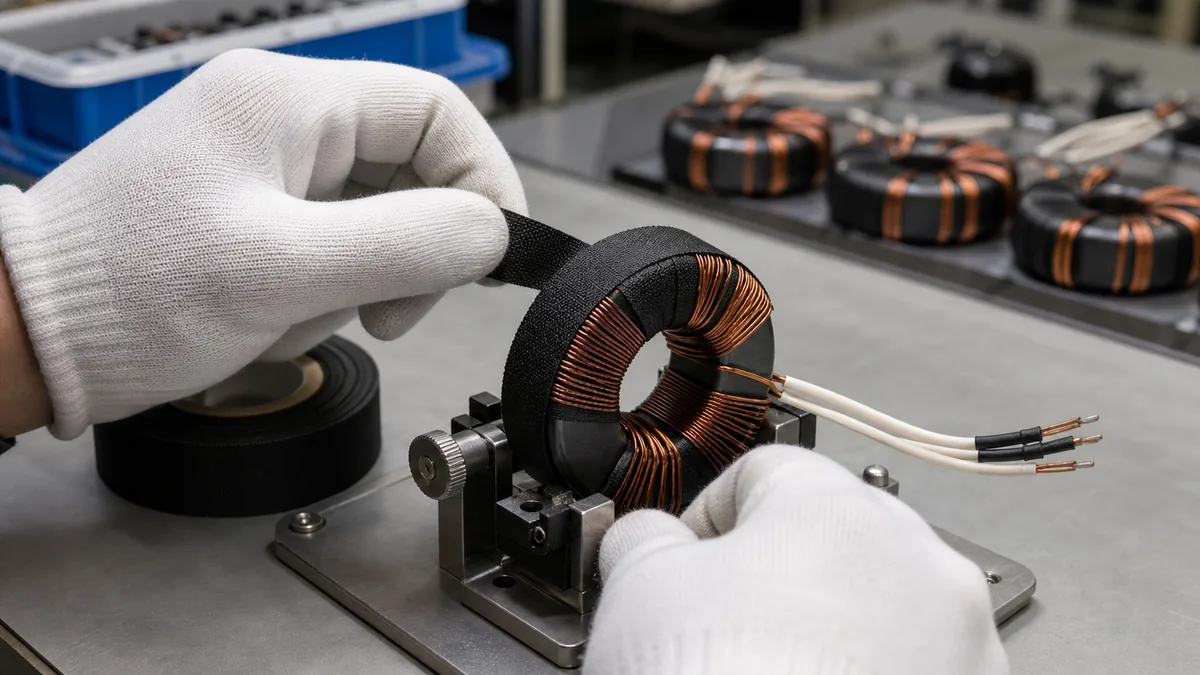
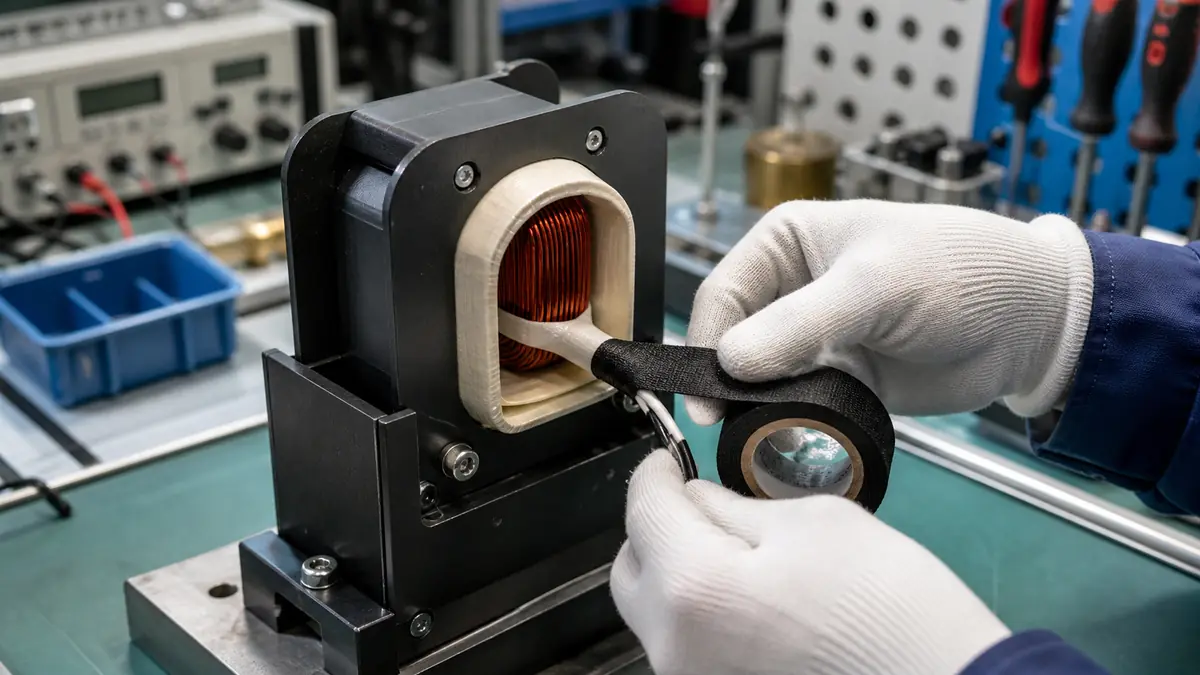
Acetate cloth tape for common-mode choke coil wrapping can provide a conformable holding, protection, and selected insulation layer around a wound ferrite component. Tape width, overlap, tension, varnish or resin compatibility, winding clearances, and final filter tests must be specified as one assembly process.
Quick Answer
Acetate cloth tape is considered for a common-mode choke when a woven, conformable wrap must follow a compact coil, retain winding or insulation components during assembly, protect a selected contact area, or create a varnish-receptive outer surface. The tape does not determine the choke's inductance, current rating, temperature class, dielectric performance, or compliance. Those results belong to the released component and its approved material system.
Where Acetate Cloth Tape Fits on a Common-Mode Choke
Common-mode chokes typically use paired or multiple windings on a shared magnetic core so unwanted common-mode current can be impeded while the intended circuit current passes. Constructions vary from small bobbin parts to toroidal windings and larger power-filter assemblies. Tape may be present below a winding, between approved layers, around lead transitions, or on the completed component.
The wrap can reduce handling damage and hold a defined geometry before varnishing, potting, mounting, or PCB insertion. It should not pull the windings across the core, hide damaged enamel, change the specified lead spacing, or become the only restraint for a heavy component.
| Wrap location | Possible function | Main design control |
|---|---|---|
| Core preparation layer | Cushioning or holding a specified barrier | Core edge condition, opening size, and winding pressure |
| Interwinding zone | Hold separation material or route crossing | Electrical spacing and added thickness |
| Lead exit | Bundle or protect a localized transition | Bend radius, terminal access, and strain relief |
| Outer coil wrap | Containment, handling protection, or varnish support | Overlap, tension, finished size, and chemical wetting |
| Mounting interface | Protect a contact point during assembly | Bracket, clamp, potting, and thermal path |
How to Select an Acetate Cloth Tape Grade
Match the adhesive to the process
Acetate cloth tapes can use different pressure-sensitive adhesives. Compare the exact construction through winding, preheat, impregnation, draining, cure, potting, cleaning, and service. The adhesive must hold when required without contaminating terminals, preventing varnish access, or moving under compression.
Screen backing weave and slit quality
The cloth should wrap without uncontrolled fray, loose fibers, hard selvage, or excessive stretch. Narrow slit width helps follow a small toroid, while a wider strip reduces turns on a rectangular or larger component. Inspect the cut edge beside fine magnet wire and verify that hand tearing is allowed only where the work instruction permits it.
Control total build
Tape thickness is only one part of the completed envelope. Overlap, seam stacking, winding height, lead crossings, retained resin, and mounting pressure all add build. Measure the largest assembled dimension, core opening, lead spacing, and PCB or enclosure clearance.
| Selection input | What to record | Selection impact |
|---|---|---|
| Choke construction | Core shape, winding style, wire or litz construction, layers, and leads | Defines conformity and wrap access |
| Tape function | Cushion, hold, protect, insulate, identify, or support impregnation | Prevents an undefined material role |
| Electrical design | Spacing, system voltage, insulation plan, and tests | Links the wrap to component qualification |
| Process chemistry | Varnish, resin, potting, cleaner, flux residue, and cure | Controls compatibility and wetting |
| Production format | Slit roll, pre-cut length, liner, color, packaging, and volume | Affects handling and repeatability |
Wrap Pattern, Overlap, and Lead Keep-Outs
The work instruction should show start point, direction, overlap window, number of passes, termination, lead path, terminal keep-outs, and finished dimensional limits. A note such as “wrap twice” can mean two turns, two complete layers, or two separate strips; use a drawing or visual standard that removes that ambiguity.
On a toroidal choke, wide tape covers more area per pass but tends to wrinkle toward the center opening. Narrow tape conforms more easily but creates more overlap. Set tension high enough to seat the cloth without displacing conductors, compressing insulation, or distorting the winding balance.
Recommended Wrapping Workflow
- Confirm the drawing. Identify every tape location, function, keep-out, and finished dimension.
- Verify materials. Check core, winding, barrier, tape code, width, color, and chemical revisions.
- Inspect the coil. Reject core damage, enamel defects, loose turns, contamination, and incorrect leads.
- Prepare the route. Install approved sleeves, barriers, ties, and lead features before the wrap.
- Anchor the first turn. Start on the specified surface away from a tight bend or terminal.
- Wrap with controlled tension. Maintain the released overlap and avoid wrinkles or seam stacks.
- Finish in a protected zone. Press the termination and keep adhesive away from contacts.
- Inspect before chemistry. Check coverage, fibers, dimensions, lead spacing, and mounting clearance.
- Run the qualified process. Apply varnish, resin, potting, or cure using released conditions.
- Test and trace. Complete dimensional, electrical, thermal, and functional checks.
Qualification and Production Validation
Use representative minimum and maximum core sizes, winding builds, tape widths, overlaps, and process exposures. Confirm that the wrap does not change lead spacing, mounting fit, impregnation, heat transfer, or measurable filter behavior beyond the design limits. The component owner should define all electrical and environmental tests.
- Inspect overlap, wrinkles, fray, exposed adhesive, terminal clearance, and final dimensions.
- Evaluate wetting, voids, cure condition, and adhesion after the approved resin or varnish process.
- Run winding resistance, insulation, inductance, impedance, temperature-rise, or other released tests as applicable.
- Include thermal cycling, vibration, humidity, and teardown where required by the component plan.
- Record tape, core, wire, chemical, and process lots for change control.
Troubleshooting Common Wrapping Defects
| Observed issue | Check first | Corrective direction |
|---|---|---|
| Wrinkles near the core opening | Tape width, wrap angle, tension, and core geometry | Screen a narrower width or revise the path |
| Final edge lifts | Termination location, adhesive, overlap, surface, and cure | Move the seam and standardize pressure |
| Varnish does not wet the wrap | Backing treatment, adhesive coverage, layer count, and viscosity | Qualify the exact tape-chemistry combination |
| Lead insulation is damaged | Tape edge, bend radius, sleeve position, and pull load | Correct routing and mechanical protection |
| Part no longer fits | Overlap, seam stacking, winding build, and retained resin | Gauge the completed envelope and reduce variation |
| Electrical result shifts | Winding position, process heat, wire damage, and test setup | Follow the choke diagnostic plan; do not guess from appearance |
Related Products and Articles
Frequently Asked Questions
Is acetate cloth tape the main insulation system of a choke?
Not automatically. Its role must be defined in the released insulation design and validated on the complete component.
Why use cloth instead of a smooth film tape?
Cloth can conform around compact winding geometry and can interact differently with selected varnishes or resins. Film may be better where controlled thinness or a smooth barrier is required.
How much overlap should be used?
Use the overlap released for the actual geometry and tape function. More overlap increases build, stiffness, and the risk of uneven impregnation.
Can the choke be potted after wrapping?
Only after the exact tape, contacted materials, potting chemistry, cure profile, and completed component have passed compatibility and performance tests.
What belongs in a tape RFQ?
Provide the choke drawing, core and winding geometry, tape role, electrical design inputs, contacted materials, process chemistry, temperature profile, wrap pattern, dimensions, volume, and qualification plan.
Turn the Wrap into a Controlled Process
Share the choke drawing, winding and lead geometry, tape function, varnish or resin system, cure profile, finished dimensions, production format, expected volume, and test plan. JIAO TAO TAO can help shortlist an acetate cloth construction for trials.
Discuss common-mode choke wrappingAcetate Cloth Tape for Electromagnetic Brake Coil Wrapping
Acetate Cloth Tape for Small Transformer Bobbin Wrapping
Related Article
Need help choosing the right industrial tape?
Send us your application details, including temperature, surface material, size, quantity and current problem. Our team will help recommend a suitable tape material or custom die-cut solution.

simon@jiaotaotao.com


+86-136 1277 5969


+86-136 1277 5969
