
How to Choose Adhesive Tape Thickness for Insulation and Masking
How to Choose Adhesive Tape Thickness for Insulation and Masking
Choose adhesive tape thickness by balancing insulation build, conformability, mechanical protection, masking accuracy and the available space in the finished assembly. A thicker tape is not automatically safer, and a thinner tape is not automatically more precise. Backing material, adhesive coat weight, overlaps and production tolerances all affect the final result.
For electrical insulation, verify the complete tape construction and finished component rather than assuming dielectric performance from thickness alone. For temporary masking, test the actual temperature, dwell time, edge geometry and removal process.
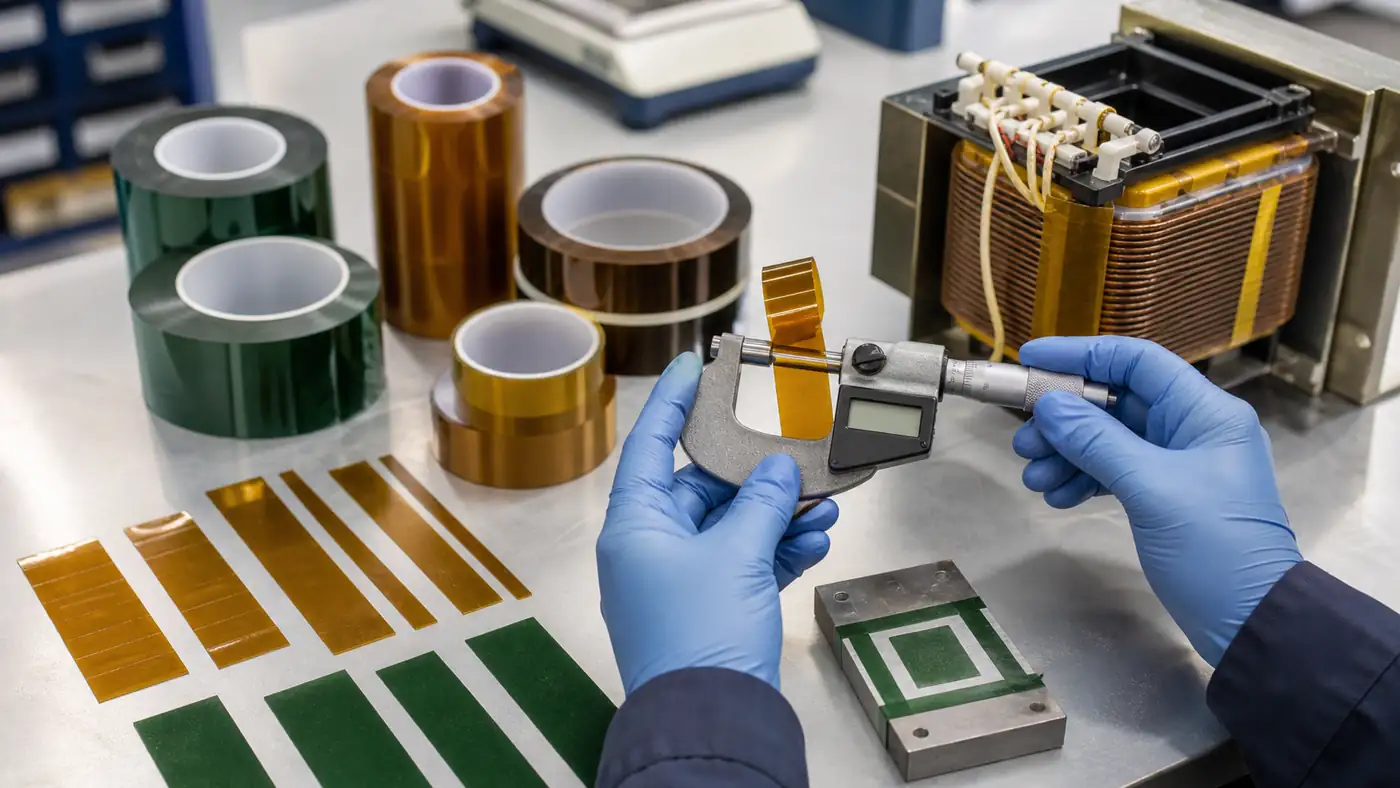
What Does Tape Thickness Include?
Total tape thickness normally includes the backing and adhesive layers. If a removable liner is supplied, the liner is usually listed separately. Buyers should confirm whether a specification refers to backing thickness, adhesive thickness or total thickness because these values are not interchangeable.
| Term | What It Measures | Why It Matters |
|---|---|---|
| Backing thickness | Film, cloth, paper or foam only | Controls strength, stiffness and insulation base |
| Adhesive thickness | Pressure-sensitive adhesive layer | Affects wet-out, tack and rough-surface bonding |
| Total thickness | Backing plus adhesive | Determines actual build in the assembly |
| Liner thickness | Release paper or film | Affects converting and automated handling, not final installed build |
How Thickness Changes Tape Performance
Conformability
Thin film tapes generally follow small components, tight radii and precision masking lines more easily. A thicker or stiffer backing may bridge across sharp transitions and create openings at the edge if it is not applied correctly.
Mechanical Protection
Additional thickness can improve puncture, abrasion and handling resistance, but material type matters as much as thickness. A woven cloth backing may resist abrasion differently from a film of similar gauge.
Electrical Insulation Build
Thicker insulation changes creepage spacing, coil dimensions and component fit. Dielectric performance must be confirmed using the exact supplied tape and the relevant test method. Do not estimate a safe working voltage by multiplying thickness alone.
Masking Edge Quality
Thin tape can create a lower step at the coating boundary. A thick tape may provide more protection but can produce a more pronounced edge or encourage coating bridging. Removal timing and coating thickness also influence the final line.
Adhesion on Rough Surfaces
A thicker adhesive coat can improve contact on textured substrates because more adhesive can flow into surface irregularities. This does not mean that a thicker backing will bond better; ask for adhesive coat information separately.
Typical Selection Logic by Application
| Application | Common Priority | Thickness Direction |
|---|---|---|
| PCB gold-finger masking | Precision, heat stability, clean removal | Thin polyimide construction |
| Transformer layer insulation | Controlled build and dielectric qualification | Thin to medium film construction |
| Battery tab insulation | Compact fit and accurate placement | Thin film or die-cut part |
| Powder coating masking | Edge sealing and oven resistance | Thin PET or polyimide, validated by cycle |
| Wire harness protection | Flexibility and abrasion resistance | Conformable cloth construction |
| Gap filling and cushioning | Compression and vibration control | Thicker foam construction |
These are selection directions rather than universal specifications. The correct thickness depends on the actual design, material grade and qualification standard.
How to Measure Adhesive Tape Thickness
- Condition the sample. Store it under the required laboratory conditions before measurement.
- Confirm what must be measured. Separate backing, adhesive, liner and total construction values.
- Use suitable equipment. A calibrated thickness gauge or micrometer with controlled contact pressure helps avoid compressing soft materials.
- Measure several locations. Check across the roll width and repeat on more than one sample.
- Record the method. Note equipment, pressure, environment and whether the liner was removed.
- Compare with tolerance. Use the supplier's agreed specification rather than only a single nominal value.
Five Questions to Ask Before Ordering
- Is the listed value backing thickness or total tape thickness?
- What tolerance applies across the width and between production lots?
- Which adhesive and coat weight are used?
- Has the exact construction been tested on my substrate and thermal cycle?
- Can the supplier provide custom slitting or die-cutting without changing the approved construction?
Common Thickness Selection Mistakes
| Mistake | Risk | Correction |
|---|---|---|
| Assuming thicker means higher voltage safety | Ignores defects, adhesive and assembly geometry | Qualify the complete insulation system |
| Comparing backing thickness with total thickness | Creates incorrect product comparison | Use the same measurement definition |
| Ignoring overlap | Installed build becomes greater than planned | Calculate overlap and compression |
| Testing only one point | Misses variation across the roll | Use a documented sampling plan |
| Changing thickness after approval | Can change fit, adhesion and removal | Revalidate every construction change |
Frequently Asked Questions
Is thicker electrical tape always better?
No. A thicker tape may add mechanical protection but also increases assembly build and may reduce conformability. Electrical safety must be verified for the complete design.
What is the difference between film thickness and total thickness?
Film thickness measures only the backing. Total thickness includes the backing and adhesive but normally excludes a removable liner.
Which thickness is best for PCB masking?
Thin polyimide constructions are commonly used for precision masking, but the correct grade depends on temperature, dwell time, adhesion and residue requirements.
Can a supplier customize tape thickness?
Manufacturers may offer different backing and adhesive constructions. Changing thickness can change performance, so the final version must be sampled and requalified.
Does adhesive thickness affect bonding?
Yes. Adhesive coat weight affects wet-out and surface contact, especially on rough substrates. It should be evaluated separately from backing thickness.
PET Silicone Tape for Motor Coil Winding and Varnish Cure
Acetate Cloth Tape vs Polyester Tape for Electrical Insulation
Related Article
Need help choosing the right industrial tape?
Send us your application details, including temperature, surface material, size, quantity and current problem. Our team will help recommend a suitable tape material or custom die-cut solution.

simon@jiaotaotao.com


+86-136 1277 5969


+86-136 1277 5969
