
PTFE Tape for Textile Seam-Sealing Machine Guide Surfaces
Technical Insights · Textile Equipment
PTFE Tape for Textile Seam-Sealing Machine Guide Surfaces
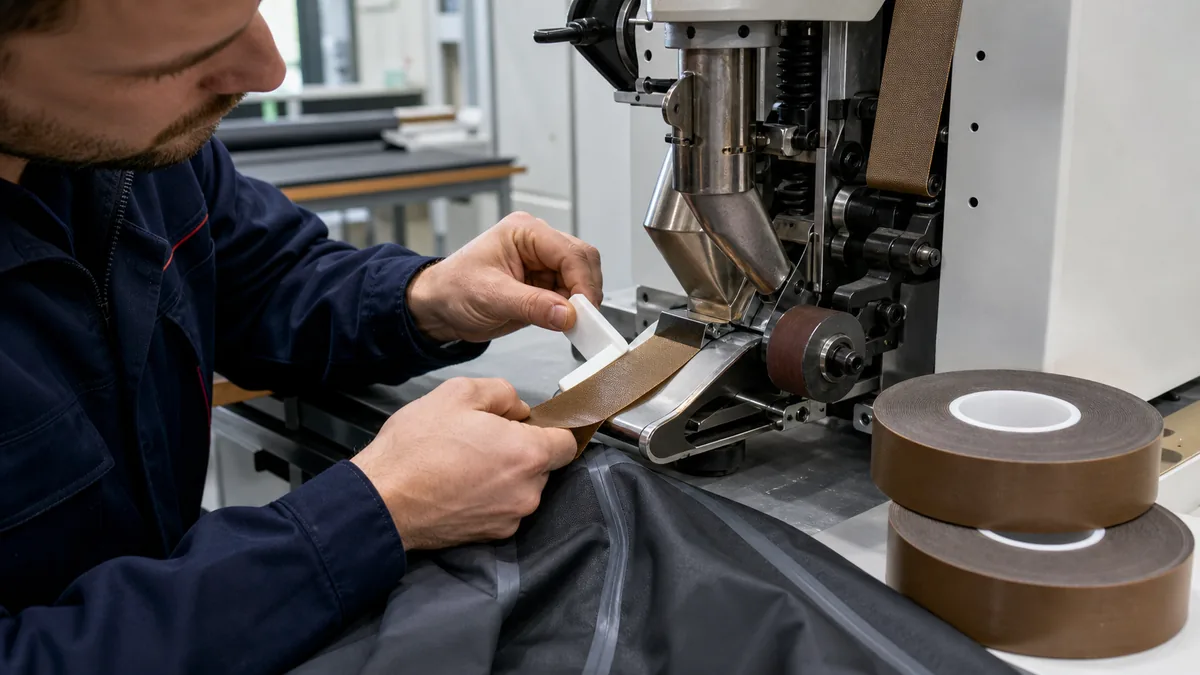
PTFE tape for textile seam-sealing machines can create a replaceable low-stick surface on an equipment location that the machine manufacturer permits. The tape must be selected and installed as part of the complete hot-air or hot-wedge process, because thickness, seams, wear, adhesive response, and guide geometry can all affect fabric tracking and seam quality.
Quick Answer
An adhesive PTFE film or PTFE-coated fiberglass tape may help reduce sticking and protect an approved guide, shoe, plate, or nearby contact surface on a textile seam-sealing machine. It should not cover the hot-air nozzle, pressure wheel, temperature sensor, drive surface, guard, or another feature unless the equipment manufacturer explicitly permits that modification. The correct construction is the one that remains flat, tracks the fabric cleanly, and survives the qualified cycle without affecting the finished seam.
Map the Textile and Seam-Tape Contact Path
Hot-air and hot-wedge machines guide a layered stack that may include coated fabric, seam-sealing tape, a liner, and shaped garment sections. The process combines heat, pressure, speed, alignment, and cooling. A PTFE cover changes the surface energy and can also add thickness or texture, so the maintenance team should first identify exactly what touches the proposed location.
Mark the active seam zone, transition edges, fasteners, sensors, vents, and clean-out access. Keep the PTFE edge away from the most pressure-sensitive region when the machine geometry allows. If the tape must cross a contact path, its joint shape and height need a seam-quality trial.
| Machine location | Possible tape role | Primary check |
|---|---|---|
| Approved guide plate | Reduce adhesive pickup and simplify cleaning | Fabric tracking, clearance, and edge position |
| Guide shoe or transition | Create a replaceable release face | Contour, wrinkle risk, and seam contact |
| Work support near the seam | Protect a local surface from compatible deposits | Pressure stack and garment marking |
| Pressure or drive wheel | Usually requires a purpose-designed component, not an improvised wrap | Manufacturer approval, traction, pressure, and guarding |
| Nozzle, wedge, sensor, or vent | Do not cover without explicit equipment approval | Heat transfer, control, airflow, and safety |
Select the PTFE Tape Construction
PTFE-coated fiberglass versus PTFE film
PTFE-coated fiberglass tape combines a woven reinforcement with a low-stick surface and pressure-sensitive adhesive. It can provide dimensional support during installation, but the weave and total thickness may be visible in a pressure-sensitive stack. Skived or extruded PTFE film tape can provide a smoother surface, while edges and puncture resistance may behave differently. Compare actual samples; “PTFE tape” is not one universal construction.
Adhesive and temperature exposure
The adhesive is behind the PTFE surface, yet heat can reach it through the guide. Record the measured temperature at the proposed bond line, normal dwell, repeated production cycles, cleaning chemistry, and shutdown conditions. Use construction-specific supplier data as a screening input, then confirm behavior on the real machine.
Thickness, surface finish, and color
Total thickness can alter clearance, fabric support, and a local pressure transition. Surface finish may influence drag and can transfer an impression to delicate fabrics. Color helps visual inspection but does not establish material identity. Specify a product code, backing form, adhesive, thickness, width, and lot traceability.
| Selection input | What to document | Why it matters |
|---|---|---|
| Machine and location | Model, approved surface, drawing or photos, nearby features | Defines geometry and modification limits |
| Process | Heat source, measured temperatures, speed, pressure, shifts, and stops | Represents real thermal and mechanical cycling |
| Textile stack | Fabric coating, seam tape, thickness, color, and sensitive finishes | Controls release, tracking, and marking risk |
| PTFE construction | Film or coated fabric, surface, total thickness, adhesive, and width | Changes wear, edge height, and installation |
| Maintenance | Cleaner, inspection interval, change method, and residue limit | Determines serviceability |
Design Seams, Edges, and Replacement Access
Use the fewest joints practical and keep overlaps outside the active seam path. A butt joint avoids a double-thickness step but can open as the tape cycles. An overlap is easier to seal but creates a raised edge. The chosen detail must be trialed with the thinnest and most appearance-sensitive textile in the qualified range.
Round external corners where possible and avoid leaving a leading edge that the fabric can catch. Do not stretch the tape to make it follow a compound contour; stored tension can lift the edge later. Add a safe pull tab only where it cannot enter the textile path or interfere with guards. Replacement should not require scraping toward a heater, sensor, finished guide, or cable.
Controlled Installation and Maintenance Workflow
- Confirm authorization. Check the machine manual and approved maintenance instruction.
- Isolate and cool. Follow lockout and verify that the work area is safe to touch.
- Inspect the machine. Repair damaged guides, loose parts, wiring, guards, or heaters before covering anything.
- Remove the old cover. Use the released method and collect all tape and adhesive fragments.
- Clean the surface. Use an approved cleaner and allow complete drying.
- Dry-fit the geometry. Mark edges, seams, clearances, and the fabric path before exposing adhesive.
- Apply progressively. Press from one end without stretch, wrinkles, trapped debris, or blocked features.
- Inspect the installation. Check flatness, edge security, clearance, and tool removal.
- Run controlled samples. Begin at released settings and inspect the complete seam.
- Record and schedule. Log construction, lot, date, location, and next inspection.
Validate the Complete Seam-Sealing Process
Use production fabrics and seam tapes that represent the qualified range, including difficult curves, junctions, changes in thickness, and long continuous seams. Evaluate startup, steady running, planned stops, restart, and cleaning. The PTFE tape should not be judged only by whether it remains attached.
- Confirm fabric and seam-tape tracking before and after installation.
- Inspect the sealed seam for position, wrinkles, gloss change, pressure marks, and edge variation.
- Perform the product owner’s released adhesion, waterproofing, appearance, and durability checks.
- Observe deposit release and verify that the approved cleaner does not damage the cover.
- Requalify changes to PTFE construction, thickness, seam layout, machine settings, fabric, seam tape, or cleaner.
Troubleshooting Guide-Surface Problems
| Observed issue | Check first | Corrective direction |
|---|---|---|
| PTFE edge lifts | Contamination, stored stretch, edge direction, heat, radius, and adhesive | Replace the cover and revise preparation or geometry |
| Raised line appears in the seam | Overlap, total thickness, pressure path, and textile sensitivity | Move or redesign the joint; evaluate a smoother construction |
| Fabric tracking changes | Guide clearance, tape edge, friction, alignment, and tension | Restore the approved path and requalify the location |
| Deposits no longer release | Deposit type, surface wear, cleaning delay, and cleaner compatibility | Use the approved cleaning method or replace the tape |
| Tape wrinkles after cycling | Contour, application tension, thermal movement, and trapped air | Correct the geometry and install without stretch |
Related Products and Articles
Frequently Asked Questions
Can PTFE tape be placed on any seam-sealing machine part?
No. Use it only on a location permitted by the machine manufacturer and the released maintenance process. Do not cover heaters, sensors, vents, drive surfaces, guards, or damaged parts.
Is PTFE-coated fiberglass tape better than PTFE film tape?
Neither is universally better. Coated fiberglass adds reinforcement and texture; PTFE film can be smoother. Compare thickness, wear, edge behavior, fabric marking, and installation on the actual machine.
Should PTFE tape joints overlap?
An overlap can seal the joint but creates a thickness step. A butt joint is flatter but may open. Keep joints outside the active seam path where possible and validate the chosen detail.
How often should the PTFE cover be replaced?
Use condition-based limits plus a scheduled inspection. Replace it when lift, wrinkles, cuts, embedded deposits, surface wear, or residue can affect safety or seam quality.
What information belongs in an RFQ?
Provide the machine, approved location, contact-path dimensions, temperature and speed range, textile and seam-tape stack, contamination, cleaner, preferred format, quantity, and validation plan.
Evaluate a Serviceable PTFE Guide Cover
Share the machine model, manufacturer-approved location, guide drawing, textile stack, measured heat exposure, pressure and speed, contamination issue, maintenance method, and seam-quality checks. JIAO TAO TAO can help shortlist PTFE film or coated-fiberglass tape for a controlled trial.
Discuss seam-sealing machine PTFE tapePolyimide Tape for Motor Slot Wedge Retention Before VPI
Polyimide Tape for PCB Reflow Thermocouple Attachment
Related Article
Need help choosing the right industrial tape?
Send us your application details, including temperature, surface material, size, quantity and current problem. Our team will help recommend a suitable tape material or custom die-cut solution.

simon@jiaotaotao.com


+86-136 1277 5969


+86-136 1277 5969
