
PTFE Tape for Rubber Vulcanizing Press Platen Release
A technical guide to PTFE film and coated-fiberglass release layers for rubber vulcanizing press platens, seams, heat transfer, and maintenance.PTFE Tape for Rubber Vulcanizing Press Platen Release
PTFE tape for rubber vulcanizing press platens can create a replaceable low-stick surface on selected flat tooling areas where uncured rubber, flash, release agents, or transferred residue would otherwise build up. It must not be used to hide damaged tooling or alter a validated mold without engineering approval. Construction, seam layout, pressure, temperature, rubber compound, surface finish, and replacement frequency all affect the result.

Key Takeaways
- Use PTFE tape only on approved platen, caul, spacer, or auxiliary surfaces.
- Measure temperature and pressure at the taped location across the complete cure cycle.
- Place seams outside critical molded surfaces when the process permits.
- Validate release, finish transfer, dimensions, cure, contamination, and repeatability with the actual rubber compound.
What the PTFE Layer Does on a Vulcanizing Press
Compression molding and vulcanizing presses expose tooling to repeated heat, pressure, rubber compound, flash, and cleaning. Adhesive-backed PTFE film or PTFE-coated fiberglass can provide a sacrificial release surface on a flat platen, caul plate, guide, or approved auxiliary contact area. The PTFE face reduces surface adhesion, while the carrier and silicone adhesive hold the layer in place through handling and cycling.
The tape is not automatically appropriate inside a precision mold cavity. Added thickness, weave print, seams, wrinkles, and adhesive movement can change the molded surface or clamping stack. Keep it out of sealing lands, vents, locating details, and dimensional surfaces unless the responsible process engineer releases that configuration.
Common PTFE Constructions Compared
| Construction | Potential advantage | Main qualification risk |
|---|---|---|
| Skived PTFE film tape | Smoother surface and lower pattern transfer | Lower reinforcement and greater sensitivity to handling damage |
| PTFE-coated fiberglass tape | Dimensional stability and durability on larger flat areas | Fabric texture or seam may transfer under pressure |
| Thicker reinforced grade | More resistance to abrasion and repeated cleaning | Greater change to stack height and heat transfer |
| Thin release grade | Lower profile and easier edge transitions | Shorter life if exposed to sharp flash or frequent scraping |
Selection Data to Record
| Parameter | Record | Decision supported |
|---|---|---|
| Rubber process | Compound family, charge form, cure sequence, and release-agent use | Compatibility and contamination screening |
| Thermal cycle | Measured platen and tape-line temperature, dwell, cool-down, and cycles per shift | Backing and adhesive temperature selection |
| Mechanical load | Pressure, platen movement, shear, abrasion, and flash direction | Carrier reinforcement and edge design |
| Surface requirement | Gloss, texture, appearance zone, dimensional tolerance, and allowable witness line | Film versus fabric and seam placement |
| Tooling surface | Material, coating, flatness, roughness, damage, and cleaning method | Adhesion, removability, and preparation |
| Maintenance target | Accepted cycle count, inspection interval, and replacement trigger | Planned maintenance rather than run-to-failure |
Choose Surface Smoothness Before Thickness
A reinforced cloth may last longer, but its texture can become visible on a soft or appearance-critical rubber part. A smooth PTFE film may reduce print-through but be easier to nick during loading or flash removal. Compare finished parts, not only tape data sheets.
Design Seams as Process Features
Large platens may require adjacent strips. Place butt or minimal-overlap seams outside the critical part zone where possible. An overlap creates a height step; a gap exposes metal and can trap residue. Document strip direction, seam tolerance, edge trim, and replacement layout.
Check Heat Transfer and Cure
Every added layer changes the thermal path. The effect may be small or significant depending on the stack, tape thickness, contact pressure, part geometry, and cure window. Use instrumented trials or the existing validated method to confirm part temperature and cure rather than assuming the previous press settings remain correct.
Installation and Maintenance Workflow
- Lock out and cool the press. Follow the machine owner’s safety procedure before accessing the platen.
- Inspect the substrate. Do not cover cracks, burrs, loose coating, deep residue, or loss of flatness.
- Clean by the released method. Remove contamination without leaving solvent, lint, or sharp debris.
- Dry-fit the layout. Mark edges, seams, holes, sensors, and keep-out zones before exposing adhesive.
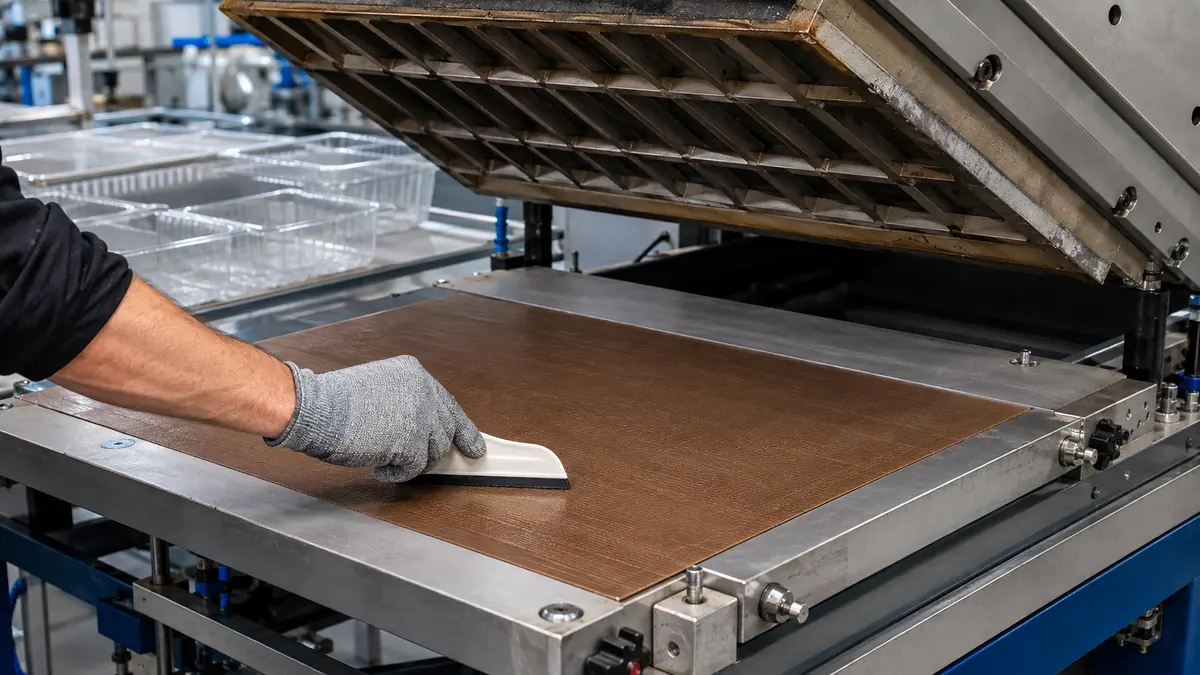
- Apply progressively. Use a suitable squeegee or roller without stretching the tape or trapping air.
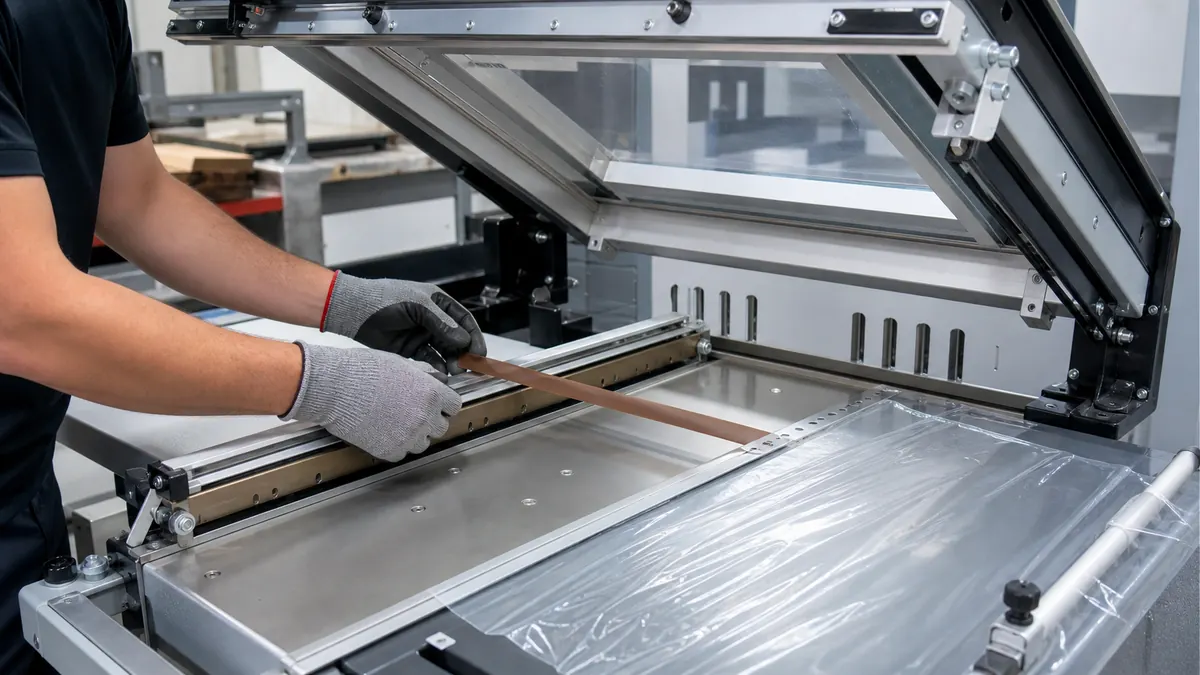
- Trim safely. Protect the platen from knife damage and keep cut edges clear of moving or sealing features.
- Run a controlled trial. Inspect release, surface appearance, dimensions, cure, and any material transfer.
- Set replacement limits. Remove the layer when it wrinkles, tears, lifts, contaminates, or exceeds the qualified cycle condition.
Troubleshooting
| Observation | Check first | Possible response |
|---|---|---|
| Wrinkles after cycling | Application tension, thermal expansion, adhesive, and platen flatness | Apply without stretch; review grade and strip orientation |
| Seam mark on the part | Overlap, seam position, pressure, and rubber softness | Move seam, use a butt layout, or evaluate smoother film |
| Tape lifts with the charge | Edge damage, contamination, adhesive exposure, and peel direction | Improve surface prep, edge protection, or replacement interval |
| Unexpected cure variation | Tape thickness, coverage, temperature sensors, and press loading | Revalidate the thermal cycle with the final taped stack |
| Adhesive residue on the platen | Temperature history, aged material, dwell, and removal method | Review grade, storage, change interval, and cool removal procedure |
Related Products and Articles
- Explore the PTFE coated fiberglass tape range.
- Review industrial PTFE tape uses and selection basics.
- Compare the material structure in the PTFE coating guide.
- Send the platen layout and cure profile for a construction review.
Frequently Asked Questions
Can PTFE tape be applied directly inside a rubber mold cavity?
Only if the responsible tooling and process engineers approve it. Tape thickness, seams, texture, and movement can alter the cavity surface, venting, dimensions, and cure.
Is PTFE film or PTFE-coated fiberglass better for a press platen?
Film favors a smoother face, while coated fiberglass often provides greater reinforcement. The correct choice depends on surface-finish tolerance, abrasion, pressure, temperature, handling, and replacement interval.
How long should the tape remain on the press?
Use a qualified inspection and replacement limit based on cycles and condition. Replace it earlier if edges lift, wrinkles form, the face is cut, release changes, or contamination appears.
Can the tape change rubber cure?
It can alter heat transfer or contact conditions. Confirm the taped process with representative temperature and finished-part cure checks before release.
What information should be sent with an inquiry?
Provide the rubber compound family, platen or caul drawing, temperature, pressure, cycle, surface-finish requirement, current release problem, cleaning method, tape dimensions, and acceptance tests.
Plan a PTFE Platen Release Trial
Share the approved tape location, platen material and size, rubber process, measured temperature, pressure, cure time, desired surface finish, cleaning method, and replacement goal. JIAO TAO TAO can help shortlist a PTFE film or coated-fiberglass format for your own validation.
Contact the technical team about vulcanizing-press release surfaces.
Polyimide Tape for Hairpin Motor Winding Joint Insulation
Polyimide Tape for Flexible Heater Insulation and Lead Protection
Related Article
Need help choosing the right industrial tape?
Send us your application details, including temperature, surface material, size, quantity and current problem. Our team will help recommend a suitable tape material or custom die-cut solution.

simon@jiaotaotao.com


+86-136 1277 5969


+86-136 1277 5969
