
PTFE Tape for Laminating Machine Heater Shoe Protection
Technical Insights · Lamination Equipment
PTFE Tape for Laminating Machine Heater Shoe Protection
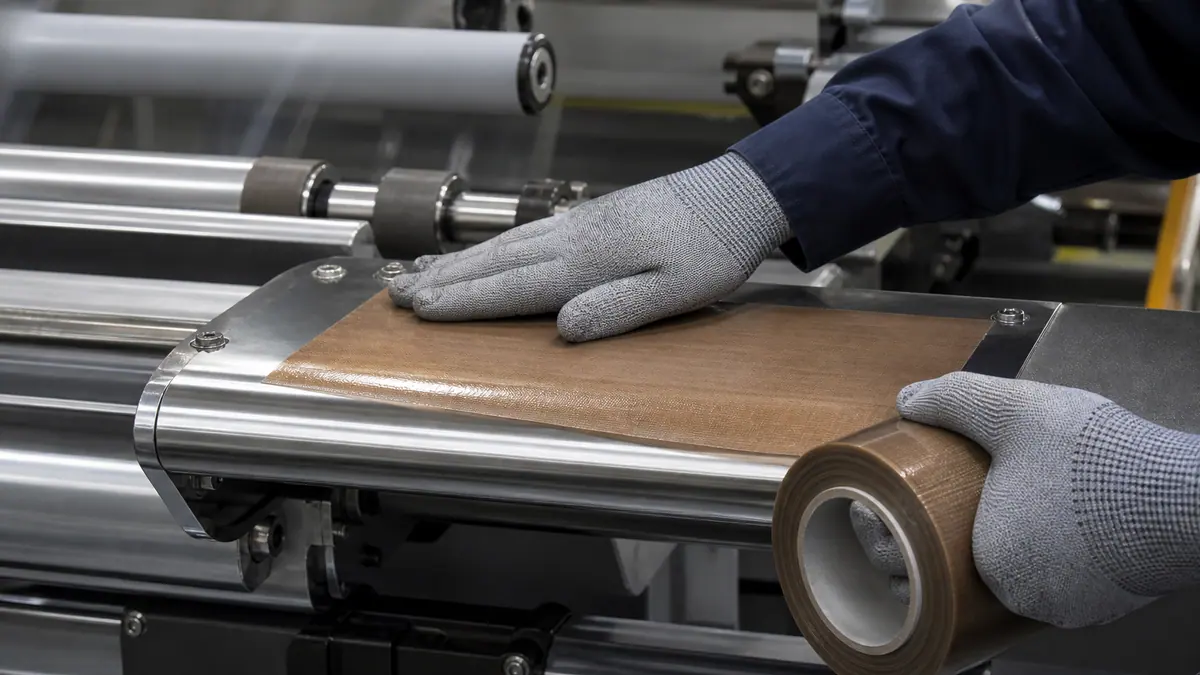
PTFE tape for laminating machine heater shoe protection creates a replaceable release surface between a heated machine component and films, adhesive layers, or accidental contamination. Stable results depend on the machine design, verified temperature, tape construction, seam position, installation method, and preventive-maintenance plan.
Quick Answer
Adhesive-backed PTFE-coated fiberglass tape can form a low-stick, replaceable cover on a heater shoe or heated guide plate when the machine manufacturer and process owner permit that construction. The tape is not a repair for a warped shoe, failed heater, damaged sensor, exposed conductor, or incorrect temperature control. Those conditions require equipment service before production resumes.
What a Heater-Shoe Cover Must Control
A laminator may bring film, paper, foil, fabric, or adhesive-coated web near a heated shoe before or during nip contact. A suitable PTFE cover can reduce sticking and make routine contamination easier to remove without scraping the base metal. However, the cover also adds thickness and a thermal interface. Its edges, overlap, and surface texture may transfer marks if they enter a critical web path.
The process team should decide whether the tape covers the complete approved face, a local wear strip, or only a contamination-prone zone. The component drawing, sensor location, web direction, cleaning access, and laminate appearance standard all affect that decision.
| Surface objective | Potential value of PTFE tape | Engineering check |
|---|---|---|
| Release from adhesive or melted film | Provides a replaceable low-stick contact layer | Actual resin, adhesive, temperature, pressure, and dwell |
| Protect the heater-shoe finish | Reduces direct scraping during normal cleaning | Manufacturer approval and base-surface condition |
| Control web drag | May lower friction at a defined guide surface | Web tension, tracking, and laminate quality |
| Simplify preventive maintenance | Allows scheduled cover replacement | Access, removal method, downtime, and residue |
| Insulate a process surface | Changes the thermal interface | Temperature control, uniformity, and equipment design review |
How to Select PTFE Tape for a Heater Shoe
PTFE coating and fiberglass reinforcement
PTFE provides the release face, while woven fiberglass can add dimensional strength for broad, heated surfaces. The weave and coating finish affect surface texture and potential marking. Buyers should distinguish adhesive-backed PTFE fiberglass tape from unsupported PTFE film and from plumbing thread-seal tape; they are different constructions for different functions.
Adhesive and liner
The pressure-sensitive adhesive must hold during the qualified thermal and mechanical cycle yet allow planned removal from the heater-shoe material. A release liner can protect the adhesive before installation and support accurate positioning on wide converted sheets. Record the exact adhesive family, liner type, storage condition, and supplier grade.
Thickness, width, and surface finish
Thickness influences durability, edge profile, conformability, and heat transfer. A wide roll or custom sheet can reduce seams, but it becomes harder to place without trapped air. A narrow roll is easier to handle around curves but creates more joints. Surface finish should be evaluated with the most appearance-sensitive laminate, not only a utility web.
| Selection input | What to document | Why it matters |
|---|---|---|
| Machine surface | Material, finish, dimensions, curvature, fasteners, sensors | Defines compatibility and safe coverage |
| Process window | Measured surface temperature, pressure, speed, dwell, stops | Screens thermal and mechanical exposure |
| Web and chemistry | Film, paper, foil, coating, adhesive, cleaners | Determines release and chemical response |
| Tape construction | Backing, coating, adhesive, thickness, width, liner | Prevents substitution by color or generic name |
| Quality criteria | Gloss, marks, wrinkles, bond, tracking, and scrap limits | Connects cover selection to finished output |
Design the Installation Before Cutting Tape
Place seams outside the critical web-contact zone whenever the machine geometry permits. When a joint is unavoidable, define overlap direction relative to web travel so an exposed edge is less likely to catch. Keep tape clear of sensors, thermocouples, vents, fasteners, grounding points, and service labels unless the equipment documentation specifically authorizes coverage.
A converted sheet can incorporate cutouts, radiused corners, and pull tabs. The drawing should define whether edges wrap onto a non-contact surface or terminate flush on the approved face. Avoid excessive tension during application; stretched tape can shrink, lift, or distort the contact surface during heat-up.
Recommended Maintenance Workflow
- Stop and isolate the machine. Follow the approved lockout procedure and verify safe service conditions.
- Confirm the maintenance scope. Check the heater shoe, sensor, tape code, drawing, and work order.
- Remove the old cover. Peel by the approved method without metal tools that can gouge the shoe.
- Inspect the base surface. Escalate warping, pits, loose hardware, electrical damage, or sensor problems.
- Clean with an approved method. Remove residue and allow the surface to dry completely.
- Dry-fit the tape. Confirm seam, edge, cutout, and pull-tab positions before exposing adhesive.
- Apply progressively. Remove liner in stages and smooth from the center to prevent wrinkles and air pockets.
- Inspect every edge. Check alignment, overlap, cutouts, and clearance from protected machine features.
- Run the restart check. Heat and operate under the released startup procedure.
- Record service life. Track tape lot, installation date, defects, cleaning, and replacement trigger.
Validation and Preventive-Maintenance Plan
Evaluate the most demanding approved web, maximum normal operating temperature, extended stops, restart conditions, and realistic contamination. Check early life and end-of-life performance. A trial should include finished-laminate inspection because a surface that looks smooth on the machine can still transfer weave, seam, gloss, or pressure marks.
- Verify web release, tracking, tension, and absence of edge catch.
- Compare surface temperature and uniformity under the machine's approved method.
- Inspect the laminate for marks, wrinkles, haze, contamination, or bond variation.
- Confirm the tape removes without damaging the heater shoe or leaving unacceptable residue.
- Define replacement triggers such as edge lift, abrasion, contamination, seam damage, or output defect.
Troubleshooting Common Defects
| Observed defect | Check first | Corrective direction |
|---|---|---|
| Web catches at the tape edge | Seam direction, edge lift, web path, and tension | Move or redesign the joint; replace damaged cover |
| Wrinkle transfers to laminate | Application tension, trapped air, shoe curvature, and width | Use progressive liner removal or a converted sheet |
| Release declines quickly | Contamination, abrasion, chemistry, temperature, and cleaning | Review grade and maintenance interval |
| Adhesive remains on the shoe | Exposure, base finish, storage, and removal temperature | Requalify adhesive and peel procedure |
| Temperature or bond varies | Cover thickness, layers, sensor clearance, heater condition | Stop and involve the equipment/process owner |
| Tape darkens or delaminates | Actual surface temperature, dwell, stops, and chemical contact | Remove from service and qualify a suitable construction |
Related Products and Articles
Frequently Asked Questions
Is this the same as plumbing thread-seal tape?
No. Heater-shoe protection commonly uses an adhesive-backed industrial PTFE film or PTFE-coated fiberglass construction, not plumbing thread-seal tape.
Can PTFE tape repair a damaged heater shoe?
No. Warping, electrical damage, failed sensors, pits, loose hardware, or control faults require equipment inspection and repair.
Should the tape overlap?
Only when the released design calls for it. Joint position, overlap direction, thickness, and the critical web-contact zone must be evaluated together.
How often should the tape be replaced?
Use a validated condition or service-life limit based on edge integrity, contamination, abrasion, release, output quality, and safe planned maintenance.
What information belongs in an RFQ?
Provide heater-shoe drawings, surface material, temperature, pressure, speed, web chemistry, tape coverage, seam limits, cleaning method, volume, and acceptance criteria.
Build a Repeatable Heater-Shoe Cover
Share the approved contact surface, measured process window, web and adhesive chemistry, seam restrictions, cleaning method, maintenance interval, and finished-output criteria. JIAO TAO TAO can help shortlist an industrial PTFE tape construction for controlled evaluation.
Discuss laminator protectionPolyimide Tape for PCB Reflow Thermocouple Attachment
Polyimide Tape for Hall Sensor Lead Protection in BLDC Motors
Related Article
Need help choosing the right industrial tape?
Send us your application details, including temperature, surface material, size, quantity and current problem. Our team will help recommend a suitable tape material or custom die-cut solution.

simon@jiaotaotao.com


+86-136 1277 5969


+86-136 1277 5969
