
Powder Coating Masking Tape 200°C: PET Silicone Green Guide
Powder Coating Masking Tape: Technical Guide for Metal Surface & Threaded Hole Protection
By Jiaotaotao Product Department - Xindy | Updated: 2026 | View Product Range →
JIAOTAOTAO Tape manufacturer — Dongguan Factory Direct
What Is Powder Coating Masking Tape?
Powder coating masking tape is a high-temperature pressure-sensitive adhesive tape constructed with a biaxially oriented polyester (PET) film backing coated with a cross-linked silicone adhesive system, applied to metal substrates prior to the powder coating and oven-curing process to protect designated areas—threaded holes, mating surfaces, bearing bores, electrical contact zones, and dimensional toleranced features—from electrostatic powder overspray and subsequent curing at 160–200°C for 15–25 minutes. It is engineered to maintain edge-seal integrity and dimensional stability through the full curing thermal cycle, then remove cleanly from metal, anodized aluminum, and pre-treated steel surfaces without adhesive residue or substrate marking.
Quick Facts
- Backing material: Biaxially oriented PET film (BoPET), 36–50 µm
- Adhesive system: Cross-linked silicone PSA
- Continuous service temperature: 200°C
- Powder coat cure cycle compatibility: 200°C × 25 min (polyester powder); 180°C × 20 min (epoxy-polyester hybrid)
- Dielectric strength: ≥ 5,000 V (per ASTM D1000)
- Residue-free removal: Zero adhesive transfer on steel, aluminum, and anodized surfaces post-200°C cure cycle confirmed
- Core uses: Threaded hole protection, mating surface masking, bearing bore coverage, electrical contact zone preservation, dimensional tolerance area protection
- Standard color: Green (13+ colors available for process color-coding)
- Manufacturer: JIAOTAOTAO Tape manufacturer, Dongguan, China (Est. 2009)

Technical Specifications & Material Science
Why PET Film Is the Standard Backing for Powder Coating Masking
Standard paper-backed masking tapes absorb moisture during storage and outgas during oven cure, causing paper fiber contamination of the powder coat boundary edge—a common defect classified as "tape bleed" in ASTM D3359 cross-cut adhesion testing. Paper backings soften above 120°C, allowing tape edges to curl and powder to migrate beneath the tape perimeter. BoPET film is dimensionally stable through the full 200°C cure cycle: thermal shrinkage <1.5% at 150°C / 30 minutes (ASTM D1504), maintaining a flat, void-free seal against the metal substrate from oven entry to exit. The film surface also resists electrostatic powder adhesion, allowing clean removal with no dry powder entrapped under the tape edge.
Silicone Adhesive: Residue-Free at 200°C Cure Conditions
The silicone PSA is a thermally cross-linked polydimethylsiloxane (PDMS) network with a Si–O backbone bond energy (~450 kJ/mol) — significantly higher than acrylic C–C (~346 kJ/mol) or rubber-based adhesives (~300 kJ/mol). At 200°C for 25 minutes, acrylic adhesives undergo chain scission and oxidative degradation, leaving carbonized adhesive deposits on metal surfaces that require solvent cleaning or mechanical abrasion to remove before re-coating or assembly. The cross-linked silicone network survives the full cure cycle without degradation, providing clean peel-off with zero adhesive transfer confirmed on steel, zinc-phosphated steel, and Type II anodized aluminum substrates.
Standard Technical Parameters — JIAOTAOTAO Tape PET Silicone Powder Coating Masking Tape
| Parameter | Value | Test Standard |
|---|---|---|
| Total Tape Thickness | 0.055 mm (55 µm) ± 5% | ASTM D1000 |
| PET Backing Thickness | 36 µm | ASTM D374 |
| Adhesive Type | Cross-linked silicone PSA | — |
| Adhesive Thickness | 19 µm ± 2 µm | ASTM D1000 |
| Continuous Service Temperature | 200°C | IEC 60454-2 |
| Cure Cycle Compatibility | 200°C × 25 min (polyester powder); 180°C × 20 min (epoxy-polyester) | IEC 60454-2 |
| Tensile Strength | ≥ 150 N/25 mm | ASTM D1000 |
| Elongation at Break | ≥ 80% | ASTM D1000 |
| Dielectric Strength | ≥ 5,000 V | UL 510 / ASTM D149 |
| Adhesion to Steel (180° Peel) | ≥ 8 N/25 mm | PSTC-101 |
| Thermal Shrinkage (150°C / 30 min) | < 1.5% | ASTM D1504 |
| Edge Bleed (200°C / 20 min cure) | < 0.2 mm | Internal method |
| Electrostatic Powder Resistance | No powder adhesion on film surface post-cure | — |
| Flame Retardancy (film) | UL94 V-0 | UL 94 |
| Available Width Range | 3 mm – 1,200 mm (custom slit) | — |
| Standard Color | Green (13+ colors available) | — |
| Shelf Life | 24 months (5–30°C, RH ≤ 65%) | — |
Powder Coating Process Applications

1. Threaded Hole & Insert Protection
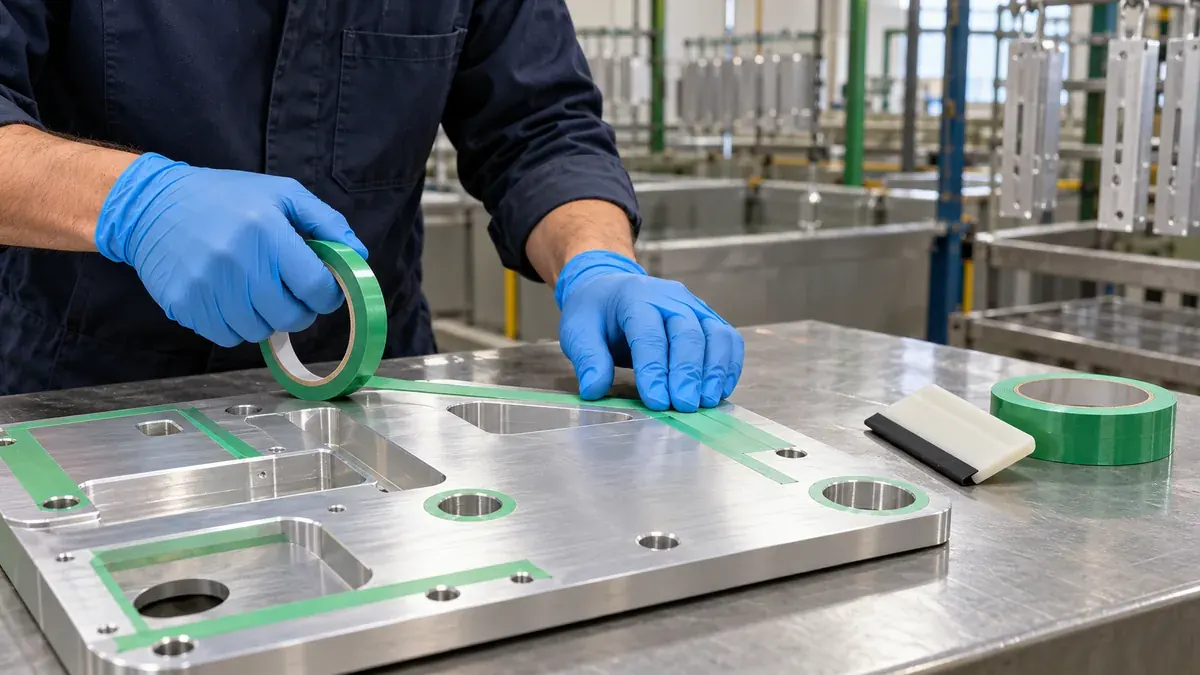
Threaded holes (M4–M24) and helical inserts on machined aluminum and steel parts are the most common masking target in powder coating lines. Powder infiltration into threads—even at 60–80 µm cured film thickness—causes thread engagement failure, requiring manual tap cleaning or thread chasing before assembly. PET silicone masking tape applied over threaded openings, sealed at the perimeter with firm thumb pressure, blocks electrostatic powder from entering thread roots during spray. The tape's elongation ≥ 80% allows it to stretch and conform to chamfered hole entrances without tearing. After oven cure, the tape peels cleanly without adhesive residue remaining in thread valleys—a critical requirement as solvent cleaning inside blind holes is impractical on high-volume lines.
2. Mating Surface & Bearing Bore Masking
Machined mating surfaces on flanges, housings, and structural brackets require dimensional tolerances of IT6–IT8 (ISO 286). A 60–80 µm powder coat film on a mating surface shifts the assembled clearance by the full film thickness, causing interference fit failures on precision assemblies. Masking tape applied to mating surfaces before powder coat entry preserves the as-machined dimension. JIAOTAOTAO Tape's edge bleed <0.2 mm at 200°C ensures the tape boundary remains within the mating surface zone, with no powder coat contamination of the critical dimensional surface.
3. Electrical Contact & Grounding Point Preservation
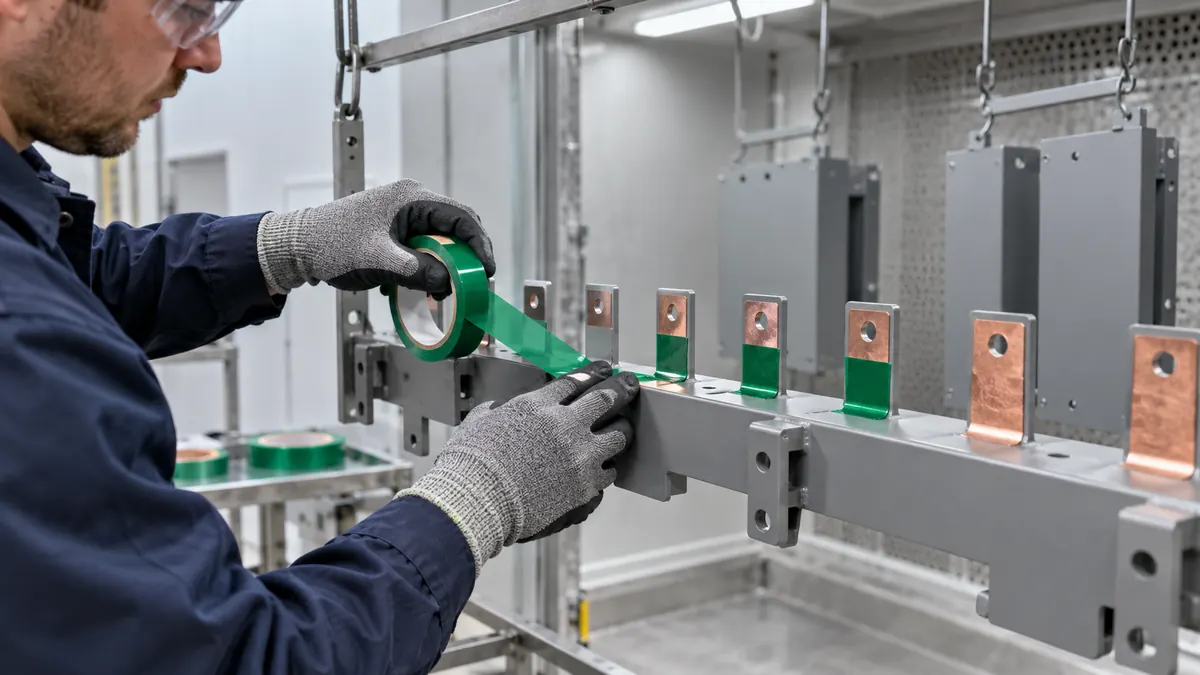
Powder coat films are electrical insulators—typical surface resistance: 10¹²–10¹⁴ Ω. On enclosures, chassis, and panel assemblies, designated grounding studs, earth bonding points, and cable lug mounting pads must remain uncoated to provide <0.1 Ω chassis-to-earth continuity per IEC 60950-1 and EN 60204-1. Applying masking tape to these contact zones before powder spray maintains the bare metal surface required for grounding compliance. Post-cure tape removal exposes the original metallic surface without adhesive residue that would increase contact resistance.
4. Anodized Aluminum — Partial Masking for Decorative / Functional Zones
Architectural aluminum extrusions and consumer electronics housings may require selective powder coating over Type II or Type III anodized aluminum areas. The tape must adhere reliably to the low surface energy anodized oxide layer without lifting during the cure cycle, while removing cleanly without stressing the anodized surface microstructure. JIAOTAOTAO Tape's silicone adhesive system, with initial peel force 8–12 N/25 mm on anodized aluminum and post-cure peel force <18 N/25 mm, satisfies both adhesion and removal requirements without surface marking or oxide layer damage confirmed by ASTM B117 (salt spray) comparison of masked vs unmasked anodized panels.
5. Multi-Step Finishing — Selective Re-Coat & Two-Tone Powder Systems
Two-tone powder coat systems apply a base color in the first oven pass, then mask the first-color area before applying the second powder in a second oven pass. The tape must adhere to the fully cured first powder coat layer (TGIC polyester, 200°C cure) as the substrate—a lower-energy surface than bare metal—while still removing cleanly after the second cure. JIAOTAOTAO Tape's silicone PSA provides 6–10 N/25 mm adhesion to cured polyester powder coat surface, maintaining edge seal through the second 200°C × 20 min cure, then peeling without delaminating the first coat layer, confirmed by ASTM D3359 cross-cut adhesion test on the masked area post second cure.
PET Silicone vs Paper vs Liquid Mask: How to Select Powder Coating Masking Tape
Four masking methods are used in powder coating production. The comparison below addresses process qualification criteria for polyester powder cure at 180–200°C.
| Parameter | PET + Silicone (JIAOTAOTAO Tape, 200°C) |
Paper + Rubber / Acrylic |
Liquid Mask (Peelable Coating) |
Polyimide (Kapton) + Silicone |
|---|---|---|---|---|
| Continuous Temp Rating | 200°C ✓ | 120°C ✗ | 150–180°C (grade dependent) | 300°C+ ✓ |
| Cure Cycle Qualified (200°C×20min) | ✓ Yes | ✗ No | Partial (check TDS) | ✓ Yes |
| Residue-Free Removal | ✓ Confirmed | ✗ Carbonized residue | ✓ Peels cleanly | ✓ Confirmed |
| Edge Bleed Control | <0.2 mm ✓ | Edge lift, uncontrolled | 1–3 mm (application dependent) | <0.1 mm ✓ |
| Application Speed | Fast (peel & apply) | Fast (peel & apply) | Slow (brush/dip + dry time) | Fast (peel & apply) |
| Cost vs Performance | Optimal ✓ | Low cost, process failure risk | Medium cost, complex process | High cost (3–5×) |
| Color Options | 13+ colors | Beige / green | Red / blue (limited) | Amber only |
| Die-Cut Custom Shapes | ✓ Available | Limited | ✗ Not applicable | ✓ Available |
Selection rule: For polyester and epoxy-polyester powder cure at 180–200°C, PET silicone tape is the qualified standard specification at optimal cost and application speed. Paper-backed tapes are not qualified for cure temperatures above 150°C and should be removed from approved materials lists for powder coat applications. Liquid masking is appropriate for complex 3D contours where tape application is impractical, but adds process steps and drying time. Polyimide tape provides additional thermal margin but at 3–5× cost premium with no benefit for standard polyester powder cure conditions.

Customization & Supply Capabilities
JIAOTAOTAO Tape manufacturer is established in Dongguan, Guangdong (2009), operating 8 automated coating lines across a 6,000 m² production facility. Certifications: ISO 9001:2015 · SGS · UL94 V-0. All products supplied direct from factory — no distributor margin.
- Custom Width Slitting: 3 mm to 1,200 mm in 0.5 mm increments, ±0.5 mm tolerance. Narrow widths (6–25 mm) standard for threaded hole and stud masking; wide rolls (300–1,200 mm) for large panel zone masking.
- Die-Cut Masking Discs & Pads: Round, rectangular, and custom-profile shapes for repeatable threaded hole, boss, and mating surface coverage. Kiss-cut on liner for peel-and-place production use. Tolerance ±0.2 mm.
- Punched Hole Discs: Circular die-cut pads with center punched hole for application over protruding studs or alignment pins — covers the surrounding mating surface while leaving the pin centerline accessible.
- Roll Arrays: Multiple die-cut shapes gang-laid on a single liner — one peel covers a standardized masking pattern per part design, reducing per-unit application time on high-volume powder coat lines.
- Process Color-Coding: 13+ standard colors. Recommended: green = powder coat masking zone, yellow = inspection checkpoint, blue = anodizing masking.
- Custom Roll Length: Standard 33 m; OEM options at 50 m / 100 m. Core ID: 25 / 50 / 76 mm for compatibility with tape dispensers on production lines.
- Free Qualification Samples: 1–3 widths dispatched within 5 business days. Specify powder type (polyester / epoxy-polyester / polyurethane), cure temperature and dwell time, and substrate (steel / aluminum / anodized) for adhesive weight recommendation.
- MOQ: 1 carton (~20–50 rolls for standard widths). Die-cut tooling: one-time setup fee, no per-run MOQ premium after tooling approval.
- Lead Time: Standard slit widths: 7–15 business days ex-factory. Custom die-cut shapes: 15–25 business days including tooling fabrication.
FAQ for Powder Coating Engineers & Procurement
Q1: What oven temperature does powder coating masking tape need to withstand, and does PET silicone tape qualify?
Polyester TGIC powder coatings cure at 180–200°C for 15–25 minutes; epoxy-polyester hybrid powders at 160–180°C for 15–20 minutes; polyurethane powders at 170–190°C for 15–20 minutes per ASTM D522 cure schedule specifications. JIAOTAOTAO Tape PET silicone masking tape is rated to 200°C continuous, covering all standard powder coat cure profiles. The tape has been process-qualified through 200°C × 25-minute oven cycles with zero edge lift, zero adhesive transfer, and edge bleed <0.2 mm recorded on steel and aluminum substrates.
Q2: Will powder coating masking tape leave adhesive residue on metal surfaces after the oven cure?
Zero adhesive residue is confirmed by 180° peel testing on zinc-phosphated steel, Type II anodized aluminum, and bare cold-rolled steel panels post-200°C × 20-minute cure per PSTC-101. The cross-linked silicone PSA network retains full cohesive strength through the cure cycle—no adhesive mass transfers to the substrate surface. Acrylic-adhesive tapes oxidize and carbonize above 150°C, leaving brown adhesive deposits that require acetone wipe-down or mechanical abrasion before coating adhesion is restored, adding process steps and rework cost.
Q3: When is the best time to remove powder coating masking tape — before or after the oven?
Remove tape immediately after oven exit, while the part is still warm (60–80°C). At this temperature, the silicone adhesive is at minimum peel force (6–10 N/25 mm), and the powder coat is still slightly flexible, allowing the tape edge to release cleanly without chipping the coating boundary. As the part cools to room temperature, both the adhesive and the cured powder coat harden, increasing removal force and the risk of chipping the powder coat edge adjacent to the tape boundary. Establish a process SOP specifying removal within 90 seconds of oven exit, before the parts enter the cooling conveyor buffer.
Q4: Can masking tape be applied to pre-treated metal surfaces (iron phosphate, zinc phosphate, chromate)?
Yes. Silicone PSA provides 8–12 N/25 mm initial adhesion to iron phosphate (Stage 3 pretreatment per SSPC-SP1), zinc phosphate (Stage 5 pretreatment), and chromate conversion coatings (MIL-DTL-5541). The tape does not absorb pretreatment chemistry and does not accelerate corrosion of the pretreated surface under the tape footprint during oven exposure. On freshly pretreated parts, allow surface to dry completely (<1% residual moisture) before tape application—wet pretreatment surfaces reduce adhesion by 20–30% and may cause edge lift during preheat.
Q5: What is the recommended tape width for masking standard threaded holes in powder coating?
For threaded hole masking, tape width should equal hole diameter + 6–8 mm overlap onto the surrounding surface. For M6 (6 mm diameter): use 12–14 mm tape. For M10 (10 mm): use 16–18 mm. For M16 (16 mm): use 22–24 mm. Custom round die-cut pads are more efficient for high-volume production: a disc sized to the hole diameter + 4 mm covers the hole and seals the perimeter in a single peel-and-press operation, with no tape cutting or tearing required. JIAOTAOTAO Tape manufacturer supplies pre-punched center-hole discs for protruding stud masking as well.
Q6: Does the tape withstand the electrostatic powder spray environment without lifting or repositioning?
Yes. Electrostatic spray guns operate at 60–100 kV DC, creating an electric field between gun and grounded workpiece. The PET film backing is electrically non-conductive (dielectric strength ≥5,000 V), preventing the electrostatic field from penetrating the tape and charging the substrate below the tape. The charged powder particles are repelled from the tape surface and deposit on surrounding unmasked metal—effectively creating a Faraday cage effect that reduces powder infiltration under the tape edge. Combined with the silicone adhesive seal, this provides <0.2 mm edge bleed even at high-volume spray rates (250 g/min powder throughput).
Q7: How does JIAOTAOTAO Tape compare to 3M 401+, Nitto No.973, and standard green paper masking tape for powder coating?
3M 401+ and Nitto No.973 are PET/silicone constructions with 200°C cure-cycle ratings—equivalent specifications to JIAOTAOTAO Tape's silicone series in backing thickness (36–50 µm) and adhesive system. Standard green paper masking tape (rubber or acrylic adhesive) is not rated above 120°C and is a disqualified material for any polyester powder cure process—its use results in edge lift, powder infiltration, and carbonized adhesive residue requiring post-cure rework. JIAOTAOTAO Tape matches 3M/Nitto performance at direct-factory pricing, eliminating 30–60% distributor margin, with 13+ color options and full OEM die-cut capability not available from standard distributors.
Request a Data Sheet, Free Sample, or Factory Quote
JIAOTAOTAO Tape manufacturer green PET silicone powder coating masking tape — 200°C continuous rating · zero adhesive residue · ≥5,000 V dielectric · UL94 V-0 · 13+ colors — covers all polyester, epoxy-polyester, and polyurethane powder cure cycles. Available in standard slit widths from 3 mm, custom die-cut discs and pad arrays, and OEM/private label formats. Direct from Dongguan factory.
Contact JIAOTAOTAO Tape Manufacturer Directly:
- 📋 Request TDS / Cure Cycle Qualification Report: simon@jiaotaotao.com
- 🧪 Free Sample: State powder type, cure temperature & dwell time, substrate material — dispatched within 5 business days
- 💬 WhatsApp / WeChat: +86-136 1277 5969
- 🔗 Full Polyester Tape Range: www.clothadhesive.com/polyester-tape.html
- 📝 Online Inquiry: Send Inquiry →
Gold Finger Masking Tape: Polyimide Guide for PCB Edge Connector Protection
Wave Soldering Tape 280°C: PET Silicone Guide & Specs
Related Article
Need help choosing the right industrial tape?
Send us your application details, including temperature, surface material, size, quantity and current problem. Our team will help recommend a suitable tape material or custom die-cut solution.

simon@jiaotaotao.com


+86-136 1277 5969


+86-136 1277 5969
