
High Temperature Masking Tape for Powder Coating | 180°C Silicone Tape Industrial Guide
High Temperature Masking Tape for Powder Coating | 180°C Silicone Tape Industrial Guide
Introduction: Why Powder Coating Demands Specialized High Temperature Masking Tape
Powder coating is one of the most demanding masking environments in industrial finishing. Parts enter a curing oven at temperatures typically ranging from 160°C to 200°C — far beyond the capability of standard masking tapes. Rubber adhesives melt, paper backings char, and adhesive residue bonds permanently to the part surface, causing costly rework or scrapping.
For procurement teams at metal fabrication shops, automotive component manufacturers, furniture manufacturers, agricultural equipment OEMs, and coating service providers, high temperature masking tape is a critical consumable that directly impacts production efficiency, surface quality, and rework rates.
This guide covers the complete specification, application, and sourcing picture for high temperature masking tape in powder coating operations — based on real product data from industrial silicone masking tape manufacturing.

Understanding the Powder Coating Process and Its Tape Requirements
The Curing Cycle
Powder coating applies an electrostatically charged dry powder to a grounded metal part. The coated part then passes through a curing oven where heat causes the powder to melt, flow, and chemically cross-link into a durable finish. Standard cure cycles:
- Temperature: 160–200°C (most common: 180°C)
- Time in oven: 15–30 minutes at temperature (total oven time 30–60 minutes including ramp-up)
- Substrate: Steel, aluminum, zinc, and occasionally plastics with special low-temperature powders
Any tape used as masking must survive this complete thermal cycle — including the ramp-up phase, full cure temperature, and cool-down — without failing, residue transfer, or becoming difficult to remove.
What Standard Masking Tape Cannot Do
Standard crepe paper masking tapes with rubber adhesives are rated for a maximum of 80–100°C. At powder coat cure temperatures:
- Rubber adhesive melts and transfers permanently to the part surface
- Paper backing chars or becomes brittle, making removal difficult
- Adhesive residue under the powder coat creates adhesion failures
- Tape edge lifting during the cure allows powder to bleed under the masked area
The result is contaminated parts, adhesive residue requiring solvent cleaning, and compromised coating quality — all of which drive up production cost.

Silicone Adhesive: Why It's the Right Choice for High Temperature Masking
The key differentiator in high temperature masking tape is the adhesive system. Silicone adhesive is engineered for thermal stability that standard rubber and acrylic adhesives cannot match.
Silicone Adhesive Properties
| Property | Silicone Adhesive | Rubber Adhesive | Acrylic Adhesive |
|---|---|---|---|
| Maximum Continuous Temperature | 180–200°C | 80–100°C | 120–150°C |
| Residue at 180°C | None (clean removal) | Heavy residue | Moderate residue |
| Flexibility at Temperature | Maintains flexibility | Becomes brittle | Variable |
| Chemical Resistance | Excellent | Good | Good |
| Cost | Higher | Lower | Medium |
Silicone adhesive maintains its viscoelastic properties through the full powder coat cure cycle, then releases cleanly when cooled — leaving no adhesive transfer on the metal surface.
JTT-HTMT-180: Industrial-Grade Silicone Masking Tape for Powder Coating
The JTT-HTMT-180 silicone masking tape is engineered specifically for high-temperature industrial masking operations including powder coating. Key specifications:
| Parameter | Specification |
|---|---|
| Substrate | Crepe paper |
| Adhesive Type | Silicone adhesive |
| Total Thickness | 0.135 mm – 0.16 mm |
| Adhesion Strength | 600–800 g / 25 mm |
| Maximum Temperature | 180°C |
| Oven Dwell Time | 30–60 minutes at 180°C |
| Color Options | Beige, green, custom |
| Customization | Width, length, color, core size, packaging |
The crepe paper backing provides conformability on curved and irregular metal surfaces — critical for masking complex fabricated parts — while the silicone adhesive system delivers both thermal stability and clean removal.
Powder Coating Masking Applications: Where High Temp Tape Is Used
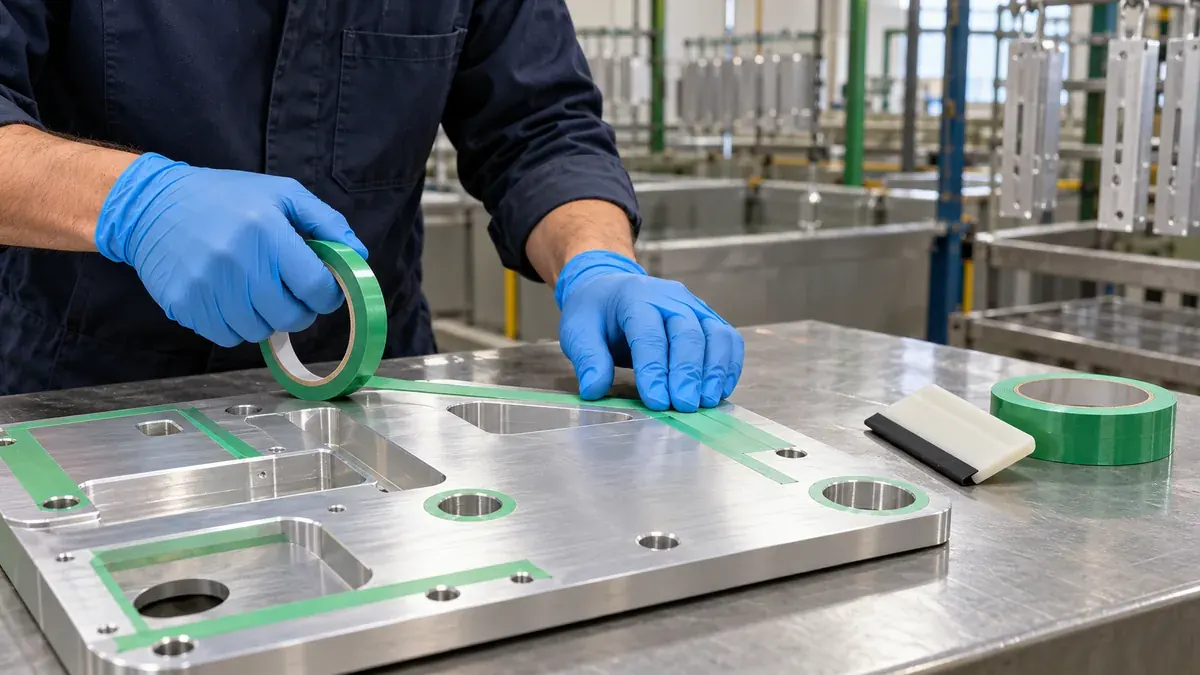
Threaded Holes and Fastener Areas
The most common masking task in powder coating: protecting threaded holes, tapped inserts, and fastener interfaces from powder infiltration. Powder in threads causes assembly failures and is extremely difficult to remove post-cure. High temperature masking tape applied to thread openings — either directly or with tape caps — prevents powder intrusion.
Tape requirement: Secure adhesion to metal surface, no edge lift during cure, clean removal post-cure.
Mating and Seating Surfaces
Parts with precision mating surfaces — bearing housings, seal surfaces, gasket faces — require masking to maintain dimensional accuracy. A layer of powder coating (typically 60–120 microns) on a mating surface can cause assembly interference.
Tape requirement: Precise edge definition, no adhesive residue that could contaminate seal surfaces.
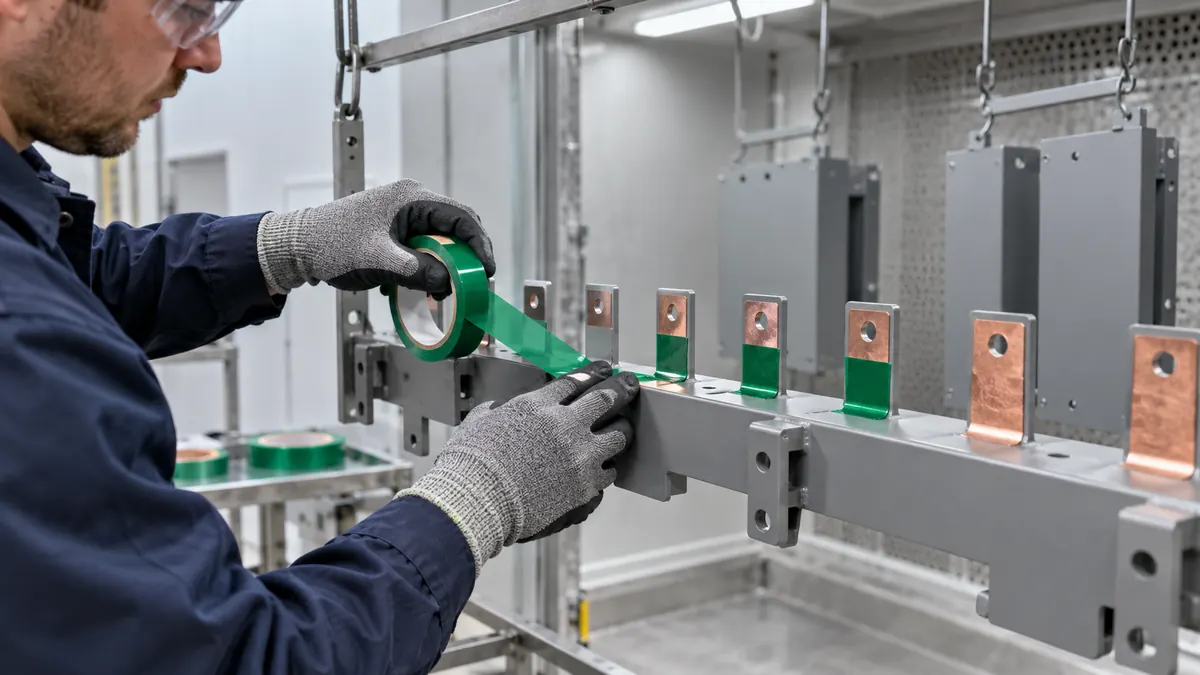
Electrical Contact Points and Ground Connections
Electrical cabinets, panels, bus bar systems, and grounding surfaces must remain conductive. Powder coating is an electrical insulator, so masking these areas is safety-critical. High temperature masking tape provides a clean, precise masking boundary.
Tape requirement: Zero residue; any adhesive contamination on electrical contact surfaces creates resistance and potential overheating.
Logo, Label, and Rating Plate Areas
Manufacturers mask areas where product labels, rating plates, or logos will be affixed post-coating. A powder coat film beneath a label prevents proper adhesion of the label adhesive and causes premature label failure.
Tape requirement: Clean removal after cure, sharp edge definition.
Weld Joints and Heat-Affected Zones
Some fabrication operations leave weld spatter or scale that requires masking during blasting or pre-treatment as well as powder coating. High temperature tape applied in the correct sequence protects these areas.
Automotive and Transportation Components
Vehicle frames, wheels, truck bodies, agricultural equipment, and trailers are high-volume powder coat applications. These large parts have complex geometries requiring tape in multiple widths and configurations.
Procurement implication: High-volume production operations need tape in multiple widths (12 mm to 100 mm+), consistent roll-to-roll performance, and reliable supply continuity.

Selecting the Right Width: A Guide for Production Engineers and Procurement Teams
High temperature masking tape for powder coating is used in widths ranging from 6 mm (narrow thread masking) to 100 mm or wider (large surface masking). Matching width to application minimizes tape usage and labor cost:
| Application | Recommended Width |
|---|---|
| Small threaded holes (M4–M8) | 6–12 mm |
| Medium threaded holes / ports (M10–M16) | 12–19 mm |
| Electrical contacts, ground pads | 12–25 mm |
| Mating surfaces, bearing bores | 19–50 mm |
| Trim lines, paint boundaries | 18–25 mm |
| Large surface masking | 50–100 mm |
| Complex contoured masking | 24–50 mm (conformable backing) |
Working with a supplier who offers custom-width slitting allows production operations to standardize on application-specific widths, reducing waste and application time.
Production Line Integration: How Powder Coaters Use High Temp Masking Tape
Understanding how tape is used in production helps procurement teams and distributors specify the right packaging format and educate their customers.
Masking Station Setup
In a typical powder coat production line, a dedicated masking station is positioned between the pre-treatment (cleaning/phosphating) and powder application operations. Operators:
- Apply tape to threaded holes, mating surfaces, and other mask-required areas
- Insert tape caps or foam plugs for through-holes (secured with tape)
- Apply tape to trim lines for two-tone or partially coated parts
Masking station efficiency is directly tied to tape application speed — hand-tearability of the crepe paper backing is a significant productivity factor. High temp masking tape should tear cleanly by hand without tools.
Oven Cycle
After powder application, parts enter the curing oven. The tape must:
- Maintain adhesion and edge seal during ramp-up (prevents powder migration)
- Withstand full cure temperature (180°C) for the specified dwell time
- Not release gas, smoke excessively, or contaminate the oven environment
Silicone adhesive systems are specifically engineered for these requirements.
De-masking
After parts exit the oven and cool to handling temperature (typically below 60°C), masking tape is removed. Critical performance factor: clean, one-piece removal without adhesive residue. Any adhesive transfer requires solvent cleaning before the part can proceed — adding labor cost and potential surface contamination.
JTT-HTMT-180's silicone adhesive system is designed for clean, residue-free removal after the full 180°C cure cycle.

Comparing High Temperature Masking Tape Options: What B2B Buyers Need to Know
Not all "high temperature" masking tapes are rated for the same temperature or dwell time. Understanding the temperature rating system is essential for correct product specification:
Temperature Rating Tiers
80–100°C (Standard Masking Tape): Rubber adhesive, crepe paper. Suitable for low-temperature spray paint drying only. NOT suitable for powder coating.
120–150°C (Medium-High Temperature Tape): Acrylic adhesive, crepe paper or polyester. Suitable for some automotive refinish processes. Marginal for powder coating at lower cure temperatures.
180°C (High Temperature Silicone Tape): Silicone adhesive, crepe paper or polyimide. Fully rated for standard powder coat cure cycles. This is the specification tier for powder coating.
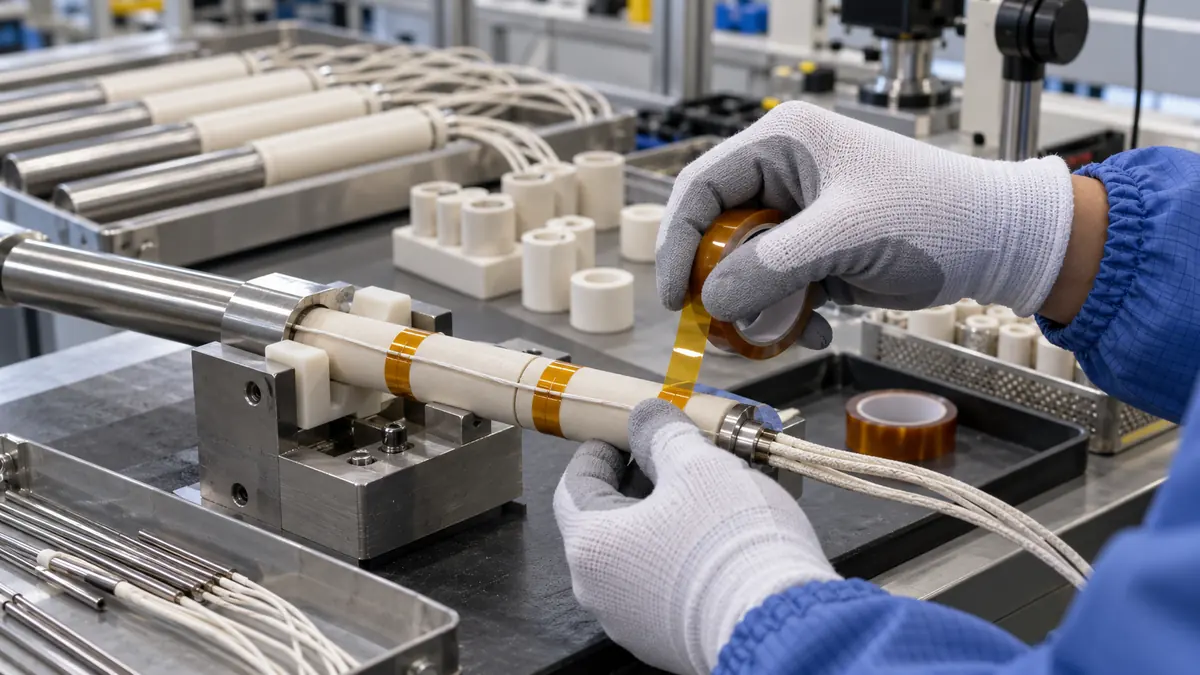
200°C+ (Extreme High Temperature Tape): Silicone adhesive on polyimide (Kapton) or glass fabric backing. For high-performance powder systems, e-coat combined with powder, or specialty industrial coatings requiring higher cure temperatures.
Buyer advisory: Always confirm the dwell time specification alongside the temperature rating. A tape rated for 180°C at 5-minute dwell is not equivalent to one rated for 180°C at 60-minute dwell. JTT-HTMT-180 is rated for 30–60 minutes at 180°C — covering standard powder coat cure cycles.
Quality Verification: Testing Protocol for Incoming High Temp Masking Tape
Procurement managers sourcing high temperature masking tape for production-critical applications should establish a receiving inspection protocol:
Visual Inspection
- Uniform tape wind on core (no telescoping, no adhesive squeeze-out)
- No backing tears, holes, or manufacturing defects
- Consistent color and width
Adhesion Test
- Apply tape to clean steel panel; press firmly
- Measure peel adhesion (180°) — target 600–800 g / 25 mm per JTT-HTMT-180 specification
- Compare against specification sheet
Thermal Simulation Test
- Apply tape to steel panel; place in oven at 180°C for 30 minutes
- Remove from oven; allow to cool to 40°C
- Remove tape; inspect for:
- Adhesive residue (pass = zero residue)
- Backing integrity (pass = no charring or brittleness)
- Edge seal maintenance (pass = no powder bleed if simulated with marker pen)
Batch-to-Batch Consistency
- Compare adhesion and thickness measurements across multiple production batches
- Request Statistical Process Control (SPC) data from supplier for ongoing quality monitoring
Packaging and Supply Formats for Industrial Distribution
High temperature masking tape for powder coating is typically supplied in:
Standard Roll Format: 18mm–50mm × 50m, individually poly-wrapped. The standard supply format for most industrial distributors and MRO suppliers.
Jumbo Rolls / Slit-to-Width: Large master rolls slit to custom widths for production operations with specific application requirements. Enables just-in-time slitting and reduces per-unit cost for high-volume operations.
Carton Pack: 24–48 rolls per carton, standard case configuration for distributor stocking and production line supply. Carton labeling should include: product code, width, length, temperature rating, lot number, and manufacturing date.
Custom-Labeled OEM Pack: For distributors running private-label industrial supply programs, custom-branded cartons and individual roll labels are available from factory-direct suppliers.

Conclusion: Specifying the Right High Temperature Tape Saves Money and Rework
In powder coating operations, masking tape is a low-cost consumable that has an outsized impact on production outcomes. Using tape rated below the cure temperature means:
- Adhesive residue on parts → solvent cleaning cost
- Edge lift during cure → coating bleed → rework or scrap
- Tape tearing on removal → fragment contamination risk
Specifying JTT-HTMT-180 silicone masking tape — rated for 180°C for 30–60 minutes with clean silicone adhesive removal — eliminates these failure modes and supports consistent, high-quality production outcomes.
For B2B distributors serving the powder coating, metal fabrication, and industrial finishing markets, stocking a complete temperature-rated masking tape range — from standard rubber-adhesive tape for prep work to full 180°C silicone tape for oven masking — positions your product offering to capture the full procurement spend of your industrial customers.
Related Articles:
- High Temperature Masking Tape for Automotive Spray Painting: Spec Guide for Body Shop Distributors
- High Temperature Masking Tape for Electronic Component Protection: PCB and Wave Soldering Applications
- UV Masking Tape for Outdoor Powder Coating and Construction Finishing
Product Reference: High Temperature Silicone Masking Tape JTT-HTMT-180
High Temperature Masking Tape for Automotive Spray Painting | Body Shop Distributor Guide
Artists Masking Tape for Illustration & Commercial Art | Wholesale Supply Guide
Related Article
Need help choosing the right industrial tape?
Send us your application details, including temperature, surface material, size, quantity and current problem. Our team will help recommend a suitable tape material or custom die-cut solution.

simon@jiaotaotao.com


+86-136 1277 5969


+86-136 1277 5969
