
Industrial Double-Sided Tape for Solar Junction Box Gasket Positioning
Buying Guides · Photovoltaic Assembly
Industrial Double-Sided Tape for Solar Junction Box Gasket Positioning
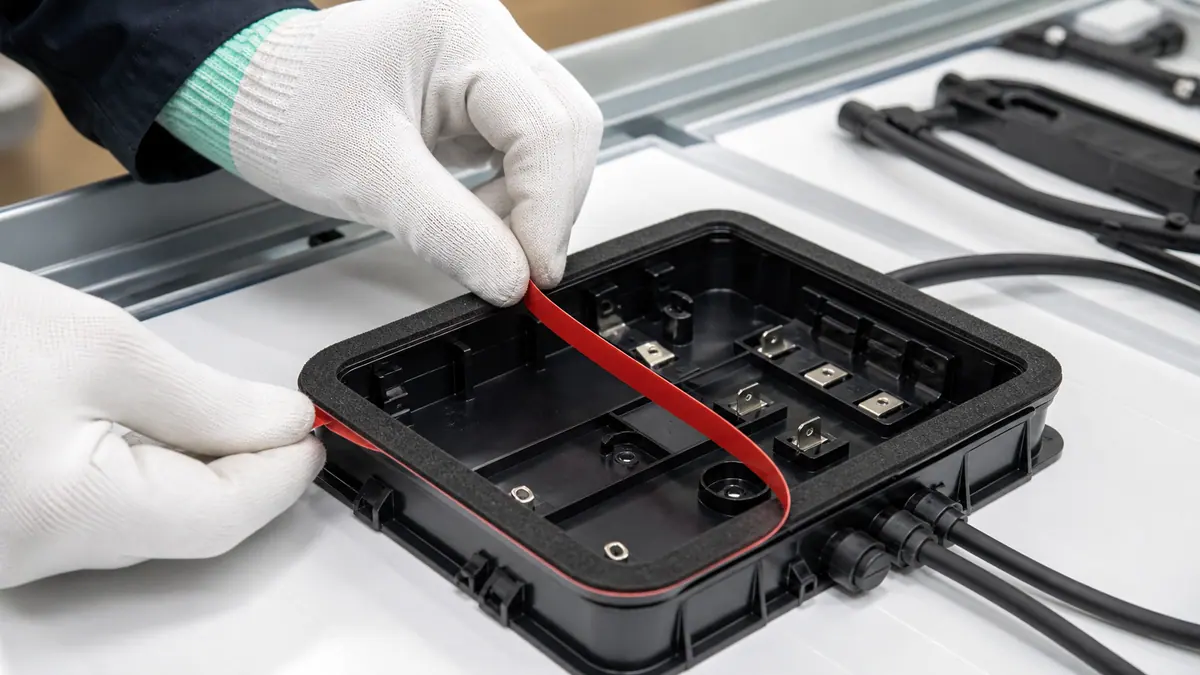
Industrial double-sided tape for solar junction box gasket positioning can hold a foam or elastomer gasket at its defined datum during handling and assembly. The tape is a converting and placement aid within an engineered sealing system; it does not by itself certify enclosure sealing, outdoor durability, electrical safety, or module reliability.
Quick Answer
A thin transfer tape, film-carrier double-sided tape, or foam-backed construction may help keep a solar junction box gasket in position while the box, cover, module backsheet, potting system, sealant, fasteners, or other released components are assembled. The suitable route depends on where the gasket sits, whether the adhesive remains in the final stack, the materials it contacts, the compression design, and the environmental qualification owned by the module manufacturer.
Define the Tape's Limited Assembly Role
Some gasket designs rely on compression for their sealing function and use adhesive only to prevent movement before closure. Others integrate a pressure-sensitive adhesive into the permanent stack. Those are different design intents. The bill of materials and drawing should state whether the tape is a temporary handling aid, a permanent gasket-bonding layer, or part of a multi-material converted component.
The design owner must also decide which interface is bonded: gasket to junction-box flange, gasket to cover, or gasket to another defined surface. The tape should not cover drainage, venting, cable entry, potting, creepage, clearance, fastening, or inspection features unless the released design specifically includes that coverage.
| Assembly function | What double-sided tape may do | What it cannot establish alone |
|---|---|---|
| Pre-position the gasket | Hold geometry before closure or transfer | Final compression and seal performance |
| Support automated placement | Provide a liner and carrier for feeding | Robot accuracy without datum control |
| Reduce gasket stretch | Stabilize a converted part during handling | Correct dimensions if the gasket was cut or stored poorly |
| Keep corners seated | Provide local initial hold | Durability under thermal cycling and outdoor exposure |
| Remain in the final stack | Bond approved gasket and housing surfaces | Enclosure, module, electrical, or safety certification |
Compare Double-Sided Tape Constructions
Transfer adhesive
A carrier-free transfer adhesive can create a thin bondline and conform to a converted gasket surface. It may be harder to handle without a stable liner and can show dimensional movement during die cutting or placement. Qualification should include the actual gasket porosity and edge condition.
Film-carrier double-sided tape
A PET or other film carrier can improve dimensional stability, die-cut registration, and handling. The carrier also creates a defined layer that may affect stiffness and the final compression stack. Confirm whether the bondline should remain continuous around corners and splices.
Foam-backed construction
A foam tape may accommodate limited surface variation, but it adds its own compression behavior. It should not be added casually beneath a gasket because the two compressible layers interact. The assembly owner must approve the combined thickness, force, recovery, and environmental response.
| Construction | Useful when | Key qualification question |
|---|---|---|
| Transfer adhesive | A thin, conformable bondline is required | Can it be converted and placed without stretching or adhesive roll-up? |
| Film-carrier tape | Dimensional control and die-cut stability matter | Does the carrier affect corner conformity or compression? |
| Thin foam tape | The released stack permits added compliance | How does it interact with the primary gasket under compression? |
| Single-side laminated gasket | The adhesive is applied to the gasket before conversion | Are lamination pressure, roll direction, and liner controlled? |
| Zone-applied adhesive | Only handling tabs or selected lands need hold | Can discontinuities create lift, paths, or placement variation? |
Die-Cut Geometry and Liner Design
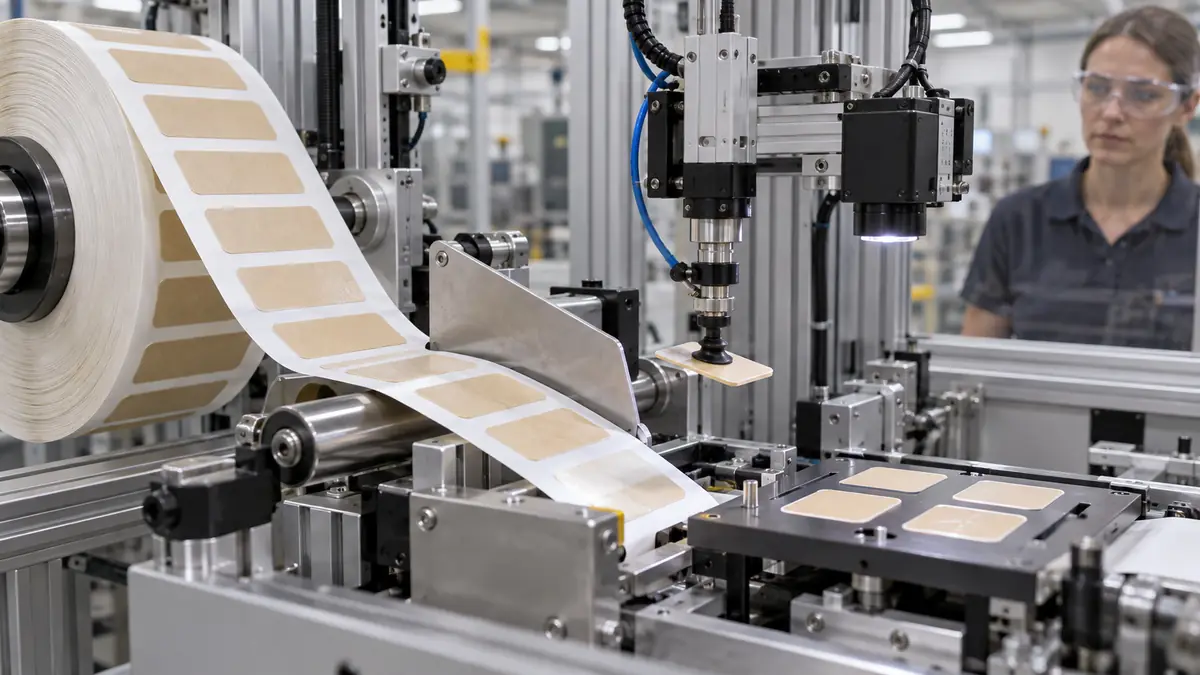
A perimeter gasket is often better supplied as a kiss-cut part on a release liner than assembled from hand-cut strips. The converted drawing should define outside and inside profiles, corner radii, cable and fastener clearances, splice rules, tolerances, liner overhang, pull tabs, and orientation features. Registration between gasket and adhesive layers is as important as the nominal gasket dimensions.
A split liner can expose one zone while keeping the remainder supported. A stiff carrier liner may help robotic pickup, while a flexible liner may suit manual placement around a curved flange. The supplier should receive the intended presentation direction, pickup method, vacuum-cup exclusion zones, liner discard plan, and traceability requirement.
Recommended Assembly Workflow
- Confirm the released stack. Verify junction box, gasket, adhesive, liner, backsheet, sealant, and closure method.
- Condition materials. Follow approved storage and line-side conditioning limits for every component.
- Inspect surfaces. Reject dust, oil, mold release, moisture, scratches, or damaged gasket edges.
- Locate from a datum. Use housing features, a nest, or vision marks defined by the process.
- Expose adhesive progressively. Peel only enough liner to start placement without touching the bond area.
- Place without stretch. Lower the gasket into position rather than pulling it around the perimeter.
- Apply controlled pressure. Use the approved roller, fixture, or press path and avoid local over-compression.
- Inspect the complete loop. Check corners, splices, liner removal, clearances, and visible lift.
- Complete the final assembly. Perform the released closure, potting, sealing, fastening, and cure steps.
- Verify and trace. Record lots, placement result, process settings, and required tests.
Qualification and Supplier Approval
Initial adhesion on a clean molded coupon is not enough. Evaluate approved junction-box resin lots, gasket materials, backsheet or cover surfaces, mold-release variation, cleaning method, application pressure, open time, closure delay, and credible production contamination. Include dimensional extremes and realistic corner placement error.
- Measure gasket and adhesive registration before assembly.
- Check position after handling, cable routing, closure, and any potting or cure process.
- Evaluate the complete assembly through the manufacturer's required environmental and mechanical program.
- Verify sealing, insulation, creepage, clearance, pull, peel, electrical, and visual criteria defined by the product owner.
- Use only substantiated material and compliance documentation; do not infer ratings from foam color or tape family.
- Apply change control to adhesive, carrier, foam, liner, gasket, housing resin, tooling, and surface preparation.
Troubleshooting Placement Defects
| Observed defect | Check first | Corrective direction |
|---|---|---|
| Gasket grows or corners wander | Stretch during lamination, die cutting, liner peel, and placement | Support the part and use a progressive placement fixture |
| Corner lifts before closure | Surface energy, contamination, corner radius, liner memory, and pressure | Review geometry, preparation, and adhesive construction |
| Adhesive extends into the opening | Die registration, roll direction, tooling wear, and material movement | Tighten converting controls and incoming inspection |
| Liner tears or leaves fragments | Slit design, tab size, die strike, storage, and peel direction | Redesign the liner and verify the removal sequence |
| Gasket compresses unevenly | Stack thickness, tape overlap, housing flatness, closure load | Review the complete sealing stack with design engineering |
| Bond varies by lot | Housing resin, mold release, gasket surface, tape age, conditioning | Expand incoming controls and supplier change notification |
Related Products and Articles
Frequently Asked Questions
Does double-sided tape provide the junction box seal?
Not automatically. It may position or bond a gasket, but the complete released enclosure stack and validation program determine sealing performance.
Should the adhesive stay in the final assembly?
The bill of materials and design drawing must decide. Temporary positioning and permanent gasket bonding are different requirements.
Is transfer tape or film-carrier tape better?
Transfer adhesive offers a thin conformable layer; a film carrier can improve converting stability. Select through trials on the actual gasket and housing.
Why use a split release liner?
A split liner can support the gasket while exposing adhesive in a controlled sequence, reducing stretch and accidental contact during manual or automated placement.
What information belongs in an RFQ?
Provide the gasket and housing drawings, materials, surface condition, stack thickness, compression design, liner and automation needs, quantities, and qualification criteria.
Convert the Gasket into a Placement-Ready Part
Share the junction-box and gasket drawings, substrate materials, compression stack, adhesive role, liner presentation, assembly sequence, automation method, expected volume, and required validation. JIAO TAO TAO can help shortlist a double-sided construction and converted format for evaluation.
Discuss gasket positioningIndustrial Double-Sided Tape for Wiring Duct Mounting
Industrial Double-Sided Tape for HVAC Acoustic Foam Bonding
Related Article

Need help choosing the right industrial tape?
Send us your application details, including temperature, surface material, size, quantity and current problem. Our team will help recommend a suitable tape material or custom die-cut solution.

simon@jiaotaotao.com


+86-136 1277 5969


+86-136 1277 5969
