
Industrial Double-Sided Tape for HVAC Acoustic Foam Bonding
Buying Guides · HVAC Fabrication
Industrial Double-Sided Tape for HVAC Acoustic Foam Bonding
Industrial double-sided tape for HVAC acoustic foam bonding can hold a qualified liner to galvanized sheet during fabrication and, where the complete assembly permits, support the finished bond. Selection must account for the foam skin, cell structure, duct surface, airflow, condensation, temperature, fire-and-smoke requirements, mechanical retention, and service inspection.

Quick Answer
Double-sided tape can simplify dry assembly of acoustic foam or a composite liner to galvanized steel, coated metal, or another approved HVAC panel. It can provide immediate hold while a duct section is formed, reduce wet-adhesive handling, and support consistent coverage. The tape does not automatically replace pins, clips, weld-on retainers, facing systems, edge seals, or other mechanical features required by the duct design.
What the Tape Does in an Acoustic-Liner Assembly
The adhesive may serve as a temporary positioning aid during forming, a continuous laminating layer, or one component of a hybrid attachment system. Those roles are not interchangeable. A positioning strip can be acceptable for holding foam before mechanical retainers are installed, while a permanent bond carries longer-term airflow, vibration, gravity, humidity, and thermal cycling.
Define which face of the foam receives tape. Open cells, dusty cut faces, skins, films, foils, and fabric facings present different bonding surfaces. If the liner manufacturer restricts adhesives or requires a specific facing, treatment, or coverage pattern, that requirement takes priority.
| Assembly role | Typical objective | Approval question |
|---|---|---|
| Fabrication positioning | Hold the liner while the panel is folded or closed | What provides final retention? |
| Permanent lamination | Maintain intimate contact across the service life | Has the complete assembly passed environmental and mechanical testing? |
| Perimeter fixation | Control edges before sealing or fastening | Can the center move, flutter, or collect moisture? |
| Hybrid attachment | Combine immediate tack with approved retainers | Are tape and mechanical spacing defined together? |
| Converted adhesive shape | Fit cutouts, seams, and inspection zones | Are coverage, tolerance, and liner tabs controlled? |
Compare Double-Sided Tape Constructions
Adhesive transfer tape
Transfer tape leaves only adhesive after the liner is removed. It can create a thin bond line and conform well to broad flat surfaces, but the unsupported adhesive can be more difficult to handle, reposition, and die cut. Foam porosity and surface dust can limit effective contact.
Film-carrier double-coated tape
A PET or other film carrier stabilizes the adhesive during slitting, laminating, and die cutting. The carrier can improve dimensional control and make liner removal more predictable. Total thickness remains low, so it does not bridge large gaps or compensate for a rough duct panel.
Foam-carrier tape
A thin foam carrier may accommodate minor surface variation and create a thicker bond line, but it adds compliance, thickness, and another material to the HVAC assembly. It should not be selected merely because the bonded part is foam. Compression, airflow edge exposure, and fire-and-smoke requirements need specific evaluation.
| Construction | Useful strength | Main watchpoint |
|---|---|---|
| Transfer adhesive | Thin, conformable continuous adhesive layer | Handling, foam absorption, and liner control |
| Film carrier | Stable converting and controlled thickness | Limited gap filling on rough or corrugated surfaces |
| Foam carrier | Compliance for selected surface variation | Added thickness, edge exposure, and material qualification |
| Pattern-coated or die-cut | Controlled coverage and keep-out zones | Drawing, orientation, scrap removal, and cost |
| High-tack system | Faster initial hold on a compatible surface | High tack does not guarantee aging or foam cohesion |
Inputs for Tape and Die-Cut Design
Start with the exact liner construction: foam chemistry, density, cell structure, thickness, facing, skin, cut direction, and cohesive strength. A bond can appear strong while the foam itself tears below the adhesive. Record the metal substrate too, including galvanized finish, coating, oil, passivation, texture, and fabrication lubricant.
Coverage can be full-surface, striped, perimeter, or a custom pattern. Full coverage maximizes contact but increases material use and can trap air during lamination. Narrow strips are easier to apply but may concentrate load or leave unsupported areas. The released drawing should define strip width, spacing, perimeter distance, seam overlap, edge seal, and all keep-out zones.
| Design input | What to provide | Why it changes selection |
|---|---|---|
| Acoustic material | Foam type, density, thickness, surface, facing, and supplier limits | Controls wet-out and cohesive failure |
| Duct surface | Galvanized grade, coating, texture, oil, and cleaner | Controls metal-side adhesion |
| Environment | Service temperature, humidity, condensation, airflow, chemicals, and cleaning | Defines aging exposure |
| Attachment role | Temporary positioning, permanent bond, or hybrid retention | Defines load and validation scope |
| Conversion format | Master laminate, slit strips, sheets, die cuts, liner tabs, and packaging | Controls labor and placement repeatability |
| Compliance plan | Applicable project, material, fire, smoke, and air-quality requirements | Prevents unsupported compliance assumptions |
Recommended Lamination Workflow
- Verify approved materials. Confirm duct panel, acoustic liner, tape, facing, retainers, and drawing revisions.
- Inspect the metal. Remove only the oil, dust, moisture, and debris allowed by the approved cleaning process.
- Inspect the foam. Reject torn, wet, contaminated, compressed, or dusty bonding faces according to the liner plan.
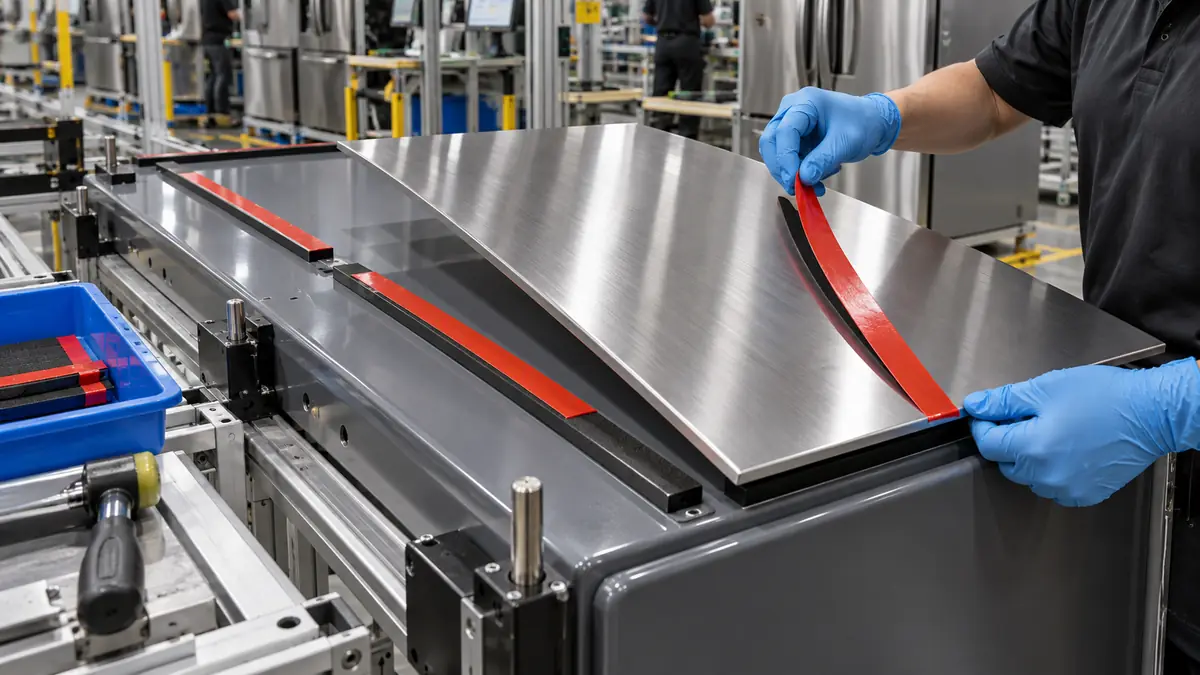
- Apply tape to the stable surface. Laminate to metal or faced foam as specified, using controlled roller pressure.
- Keep the liner in place. Do not touch exposed adhesive or contaminate it during panel handling.
- Dry-fit the liner. Check orientation, edges, penetrations, seams, and mechanical-retainer locations.
- Peel in stages. Remove a short liner section, align from a datum, then continue while smoothing the foam.
- Apply uniform pressure. Use the specified roller or platen without crushing the acoustic material.
- Finish edges and retainers. Install the approved edge seal, pins, clips, or facing details.
- Inspect and identify. Check coverage, wrinkles, gaps, lifted edges, foam damage, liner scraps, and traceability.
Qualification and Production Checks
Use representative duct metal and the real acoustic liner, not a smooth laboratory foam substitute. Include worst-case oil control, metal texture, foam lot variation, seam geometry, and the time between lamination and loading. Test the complete assembly after the specified dwell and environmental conditioning.
- Measure peel or separation behavior using the project's chosen method and note whether failure occurs in adhesive, interface, or foam.
- Expose samples to the expected temperature, humidity, condensation, vibration, airflow, and cleaning sequence.
- Inspect edges, seams, penetrations, and overhead orientations for lift or flutter.
- Confirm mechanical retainers and edge treatments work with—not against—the tape pattern.
- Complete all required fire, smoke, emissions, hygiene, and acoustic checks on the applicable construction.
- Record foam lot, tape lot, metal condition, cleaning, application pressure, dwell, and results.
Troubleshooting Foam-to-Metal Bonds
| Observed problem | Check first | Corrective direction |
|---|---|---|
| Tape stays on metal but foam releases | Foam dust, skin, porosity, cohesive strength, and pressure | Use an approved bonding face or compatible adhesive construction |
| Tape lifts from galvanized steel | Oil, passivation, cleaner, texture, temperature, and wet-out | Improve the approved preparation and screen the metal-side adhesive |
| Edges curl after conditioning | Foam memory, edge load, coverage, humidity, and liner tension | Revise perimeter geometry, retention, or material pairing |
| Foam is crushed during lamination | Roller hardness, pressure, speed, and local support | Reduce and control pressure while maintaining adhesive contact |
| Wrinkles trap air | Liner-removal sequence, panel size, operator access, and datum | Use staged peeling, a layup fixture, or converted liner tabs |
| Bond weakens near condensation | Water path, edge seal, adhesive exposure, and substrate condition | Correct moisture design and validate a compatible system |
Related Products and Articles
Frequently Asked Questions
Can double-sided tape replace mechanical liner fasteners?
Not automatically. The duct design, liner supplier, project requirements, orientation, airflow, and validation determine whether tape is a positioning aid, permanent bond, or part of a hybrid attachment system.
Is foam tape always the best tape for bonding acoustic foam?
No. The word “foam” describes the liner, not the required tape carrier. Transfer, film-carrier, or foam-carrier constructions may be considered based on the surfaces, gap, thickness, environment, and approval plan.
Why does tape fail on galvanized duct panels?
Possible causes include fabrication oil, passivation, dust, moisture, texture, low application pressure, short dwell, or an incompatible adhesive. Test the exact production metal and cleaning process.
Should the tape cover the full foam surface?
Coverage must be engineered. Full coverage maximizes contact but changes cost and lamination handling; strips or patterns reduce material but may leave unsupported zones. Define and validate the pattern on the drawing.
What belongs in an HVAC acoustic-foam tape RFQ?
Provide the foam and facing data, duct metal and finish, attachment role, service environment, required approvals, coverage drawing, tape thickness limit, liner format, retainers, annual volume, and acceptance tests.
Specify the Whole Liner Stack
Share the acoustic material, facing, duct substrate, service environment, attachment role, coverage pattern, mechanical retention, edge treatment, compliance plan, and fabrication method. JIAO TAO TAO can help shortlist a double-sided tape and converted format for controlled evaluation.
Discuss HVAC acoustic foam bondingIndustrial Double-Sided Tape for Solar Junction Box Gasket Positioning
Industrial Double-Sided Tape for Automotive Door Sill Trim Bonding
Related Article

Need help choosing the right industrial tape?
Send us your application details, including temperature, surface material, size, quantity and current problem. Our team will help recommend a suitable tape material or custom die-cut solution.

simon@jiaotaotao.com


+86-136 1277 5969


+86-136 1277 5969
