
Acetate Cloth Tape for Transformer Lead Exit Reinforcement
Acetate Cloth Tape for Transformer Lead Exit Reinforcement
Acetate cloth tape for transformer lead exit reinforcement provides a conformable woven wrap at the transition between a wound coil, insulated lead wires and the routing path toward terminals. The tape can help organize leads and protect a localized bend, but it should be selected from the transformer’s real temperature class, insulation design, impregnation process and mechanical layout.
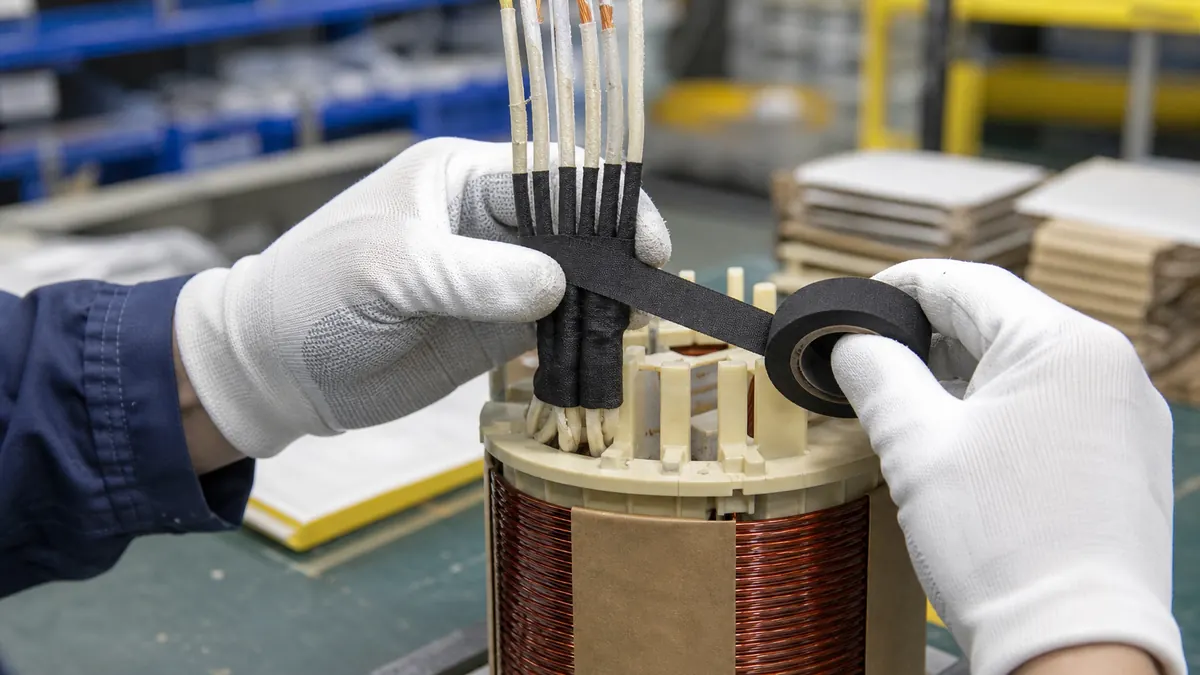
What Makes the Lead Exit Different From the Coil Body
The coil body is usually supported by a bobbin, paper, film or other designed insulation. At the lead exit, conductors change direction and may contact a bobbin edge, tie point or adjacent winding. Assembly handling can pull on the bundle before the transformer is installed. A localized cloth wrap can conform to the transition and provide a controlled outer surface.
Acetate cloth is not a substitute for required sleeving, barriers, spacing or approved insulation components. It should be treated as one material within the documented transformer construction.
Define the Application Before Choosing Tape
| Application input | Questions to answer | Why it matters |
|---|---|---|
| Lead construction | Magnet wire, sleeved lead, insulated hook-up wire or splice bundle? | Controls surface compatibility and required protection |
| Exit geometry | Bobbin radius, edge condition, bend direction and available wrap length? | Affects conformability and tape width |
| Temperature | Winding rise, oven exposure, duty cycle and local hot spots? | Must fit the exact tape construction and transformer design |
| Impregnation | Dip varnish, vacuum impregnation, potting or no resin contact? | Can change adhesive and cloth behavior |
| Mechanical load | Lead forming, tie-down, vibration and installation handling? | Determines reinforcement and routing needs |
| Production method | Manual wrap, pre-cut strip, automated dispenser or fixture? | Guides format and length control |
Acetate Cloth Compared With Other Tape Directions
| Tape direction | Typical reason to evaluate it | Limitation to check |
|---|---|---|
| Acetate cloth tape | Conformable woven backing and tidy wrap around irregular lead transitions | Total build, fraying, adhesive compatibility and temperature class |
| Polyester film tape | Thin, smooth film insulation and dimensional stability | Less textile-like conformity around uneven bundles |
| Polyimide film tape | Thin construction for higher process-temperature requirements | Cost, stiffness and adhesive behavior on the actual materials |
| Glass cloth tape | Reinforcement in selected elevated-temperature constructions | Greater thickness and rougher handling than thin films |
The correct comparison is between named constructions with supplier data, not between generic material labels. Adhesive chemistry, cloth weave, total thickness, edge quality and conversion method can all affect application.
How to Apply a Repeatable Lead-Exit Wrap
Remove the source of damage first
Inspect the bobbin, core, paper and lead route. Tape should not conceal a sharp edge, nicked conductor or unsupported splice. Correct the mechanical condition before defining the wrap.
Use a controlled starting point
Begin where the tape can contact a stable surface without interfering with terminals or a future soldering area. A standard strip length and illustrated work instruction help prevent excessive overlap.
Wrap without compressing the bundle
Acetate cloth conforms well, but high tension can distort sleeving, pull leads from the winding or create an unnecessary hard transition. Apply enough tension for contact while preserving the designed lead route.
Finish away from the peel direction
Place the end so later lead forming, varnish flow or installation does not peel it back. Use consistent pressure and define any dwell required before the next process.
Validation Checklist
- Build samples with production bobbins, leads, insulation and the intended tape width.
- Inspect overlap, coverage, terminal clearance and finished bundle thickness.
- Run lead forming, tie-down and handling operations to check for movement or flagging.
- Expose the wrapped assembly to the actual impregnation, potting or oven process.
- After conditioning, inspect adhesion, cloth edge, residue, stiffness and lead routing.
- Complete all electrical, thermal and mechanical qualification required by the transformer design.
Common Problems and Corrective Questions
| Problem | Possible reason | Review |
|---|---|---|
| Tape edge lifts | Low surface contact, wrong finish location or process incompatibility | Cleaning, pressure, end placement and exposure |
| Cloth frays during application | Slitting quality or repeated edge abrasion | Converted edge, dispenser and handling method |
| Lead bundle becomes too stiff | Excess overlap, wide tape or high tension | Strip length, width and wrap count |
| Varnish changes the wrap | Construction has not been screened with the real chemistry | Immersion, cure and post-cure inspection |
| Terminal area is obstructed | Wrap location varies by operator | Datum, pre-cut length and visual fixture |
FAQ
Is acetate cloth tape suitable for every transformer temperature class?
No. Suitability depends on the exact tape construction and the transformer’s approved insulation system, temperature profile and service conditions. Verify supplier data and qualify the complete design.
Can acetate cloth tape replace lead sleeving?
Not automatically. Sleeving and outer cloth tape may perform different functions. Any change must be reviewed by the transformer designer.
Should the tape be applied before or after varnish impregnation?
The sequence depends on the design and chemistry. Compare the intended sequence in representative builds and inspect both process behavior and the finished assembly.
Can acetate cloth tape be supplied as pre-cut strips?
Yes. Pre-cut strips can control length and overlap for repeated lead-exit geometries, provided liner and packaging suit the station.
Related Products and Articles
- Acetate cloth electrical tape range
- What acetate cloth tape is used for
- Polyester film tape for insulation
- Polyimide tape for higher-temperature insulation
Request a Transformer Lead-Wrap Sample
Share the lead construction, bobbin and exit geometry, tape width, insulation-system requirements, impregnation chemistry, oven cycle and expected quantity. JIAO TAO TAO can help compare acetate cloth formats for a controlled transformer build. Discuss your transformer lead exit.
PTFE Tape for Textile Fusing Press Platen Protection
PTFE Tape for Blister Packaging Heat-Seal Plates
Related Article


Need help choosing the right industrial tape?
Send us your application details, including temperature, surface material, size, quantity and current problem. Our team will help recommend a suitable tape material or custom die-cut solution.

simon@jiaotaotao.com


+86-136 1277 5969


+86-136 1277 5969
