
Acetate Cloth Tape for Speaker Voice-Coil Insulation
Acetate Cloth Tape for Speaker Voice-Coil Insulation
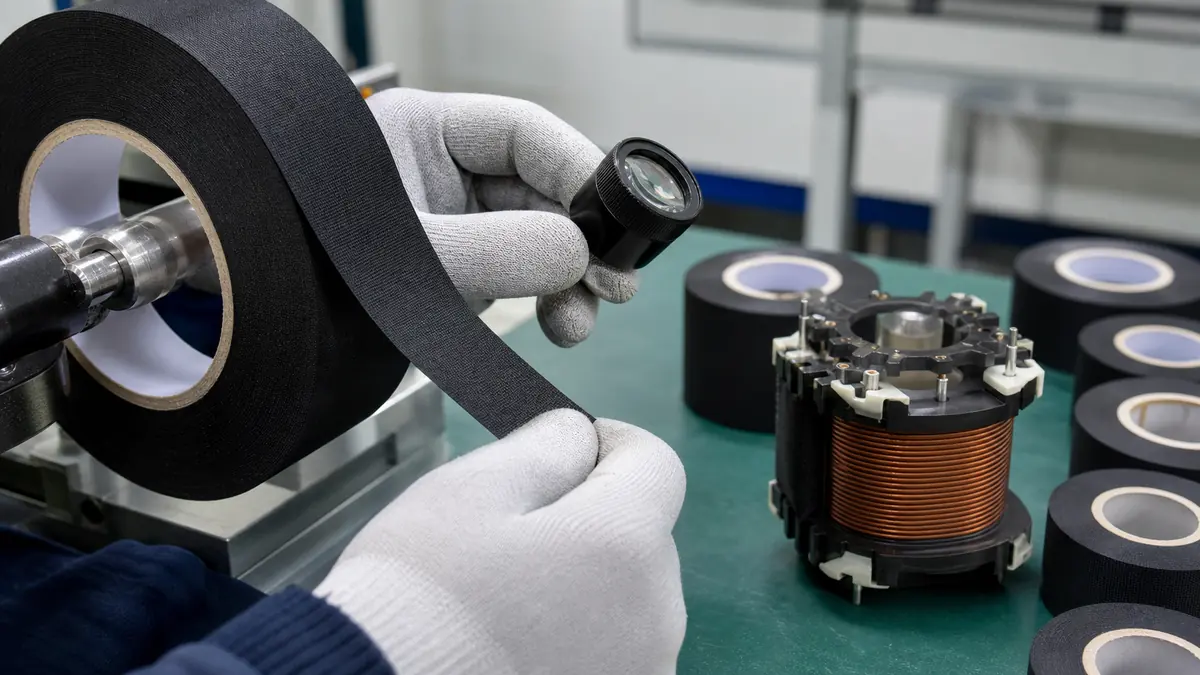
Acetate cloth tape for speaker voice-coil insulation can add a flexible insulating and reinforcing band around selected coil, lead, or former areas when the tape construction is compatible with the loudspeaker design. Because the moving assembly has strict mass, clearance, thermal, and adhesive requirements, every tape must be approved in the complete voice-coil build rather than selected from a generic electrical-tape description.
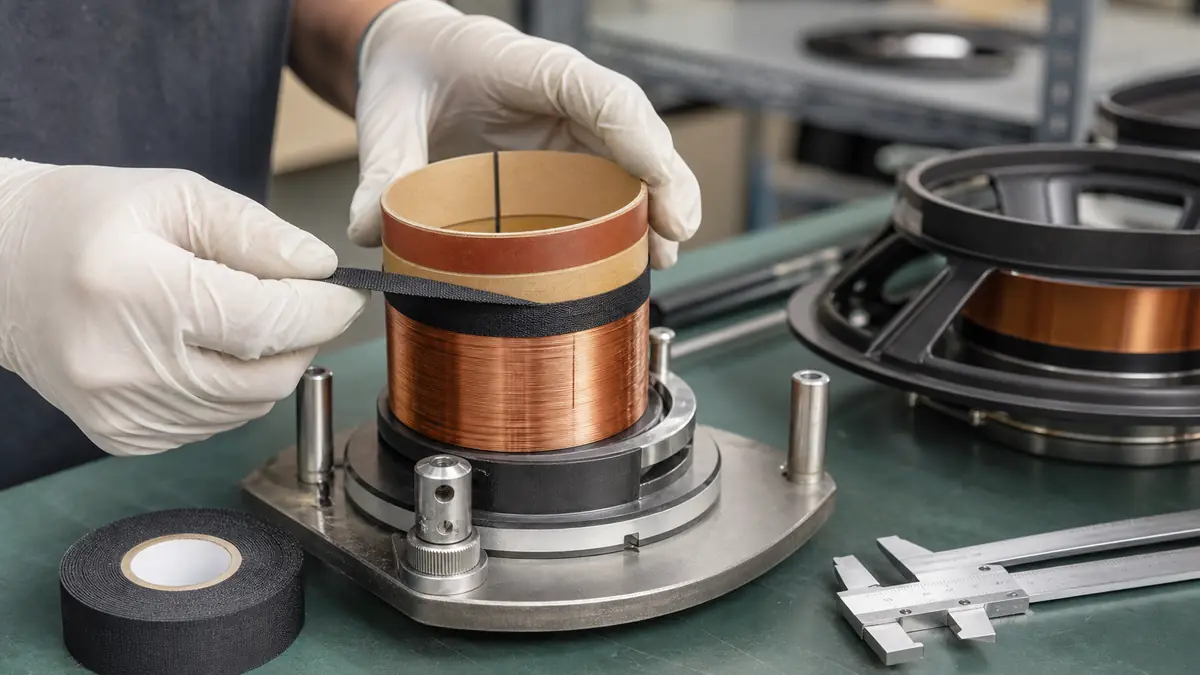
Where Tape May Fit in a Voice-Coil Assembly
A loudspeaker voice coil is a moving electromechanical component. The former, winding wire, lead-out areas, adhesives, and surrounding magnetic gap must remain dimensionally controlled. Depending on the approved design, a narrow cloth tape band may be considered for winding-edge protection, lead restraint, local insulation, or mechanical reinforcement.
The tape must not be assumed to replace the coil maker's winding adhesive, impregnation system, former insulation, or engineered edge treatment. Its role should be defined on the drawing and verified against the real excursion, temperature, clearance, and acoustic requirements.
Winding-edge reinforcement
A narrow band may help protect an approved winding boundary or secure a transition area. The finished overlap and tape edge must remain outside any prohibited magnetic-gap or bonding zone.
Lead-out management
Where a flexible lead exits the winding, a small cloth tape piece may provide restraint or abrasion protection. The placement must preserve lead flex and avoid a sharp stress concentration.
Why Acetate Cloth Is Considered
Acetate cloth tape combines a woven backing with a pressure-sensitive adhesive. Compared with a smooth film, the cloth surface can provide flexibility and a different mechanical interface around a cylindrical form. However, commercial products vary in backing weave, adhesive type, thickness, flame performance, electrical data, and thermal capability. Use supplier documentation and application trials for the exact product under review.
Voice-Coil Tape Selection Parameters
| Parameter | Why it matters in a moving coil | What to validate |
|---|---|---|
| Total thickness and overlap | Influences radial clearance and local mass | Does the finished coil clear the magnetic gap through the full tolerance range? |
| Backing flexibility and edge quality | Affects conformity around the former and risk of loose fibers | Can the tape form a smooth band without wrinkles, fraying, or lifted edges? |
| Adhesive compatibility | The tape may contact enamel wire, former material, varnish, or winding adhesive | Does it bond without softening, migration, or adverse interaction after aging? |
| Thermal behavior | Voice coils heat during operation | Does the exact tape remain stable in the approved power and temperature test? |
| Electrical insulation need | Protected areas may have specific dielectric or creepage requirements | Does supplier data and the finished assembly test satisfy the design requirement? |
| Mass and balance | Added material becomes part of the moving assembly | Does tape placement affect sensitivity, resonance, symmetry, or dynamic behavior? |
| Chemical and process exposure | Solvents, impregnation, bonding, or curing steps may affect the adhesive | Can the tape survive the complete manufacturing sequence? |
Comparing Candidate Insulation and Reinforcement Materials
| Material format | Potential benefit | Key limitation to review |
|---|---|---|
| Acetate cloth tape | Flexible woven backing and conformable banding format | Thickness, fibers, adhesive compatibility, mass, and documented thermal performance |
| Polyimide film tape | Thin film construction with a different thermal and electrical profile | Stiffness, edge behavior, adhesive choice, and whether film conformity is adequate |
| PET film tape | Smooth, dimensionally stable, and available in thin slit widths | Process temperature, edge conformity, and required insulation performance |
| Non-adhesive insulation or varnish system | May be integrated into the coil maker's primary design | Requires the specified winding, impregnation, cure, and process controls |
Designing the Tape Band
Control the width
The slit width should match the functional area and stay clear of the magnetic gap, spider or cone bond, and any lead-flex zone. A narrow width that is difficult to slit or handle consistently may benefit from a die-cut tab or carrier.
Define the overlap
An uncontrolled double-thickness seam can create a high spot and mass imbalance. The drawing or work instruction should define the overlap length, seam location, orientation, and maximum finished profile.
Manage cut edges and fibers
Converted edges should be inspected for fraying or loose particles. Handling tools, liner design, and storage should keep the adhesive and cloth surface clean before assembly.
Suggested Application Workflow
- Confirm the tape function and location. Use the approved coil drawing and do not add tape as an undocumented repair.
- Inspect the former and winding. Verify surface condition, wire position, cured adhesive condition, and cleanliness.
- Use a controlled slit width or die-cut piece. Avoid hand-torn edges and variable strips.
- Apply even tension. Follow the cylindrical surface without stretching the cloth or displacing winding wire.
- Form the specified overlap. Place the seam in the approved position and prevent stacked or folded edges.
- Press the full band. Use a suitable fixture or roller that supports the former and does not deform the coil.
- Inspect profile and clearance. Check for lift, wrinkles, fraying, excessive overlap, adhesive squeeze, and contact with keep-out zones.
- Continue the approved cure or assembly sequence. Reinspect after any process that can change the tape or adhesive.
Prototype and Reliability Checks
Evaluate the tape in production-representative coils and complete loudspeaker assemblies. Relevant checks may include finished dimensions, magnetic-gap clearance, seam profile, lead restraint, electrical isolation, adhesive interaction, thermal cycling or power testing defined by the speaker designer, mechanical excursion, acoustic sweep, noise inspection, and post-test edge condition. Use the customer's or engineering team's approved limits; do not substitute generic tape values for system-level validation.
Common Problems and First Checks
| Problem | Possible contributors | First checks |
|---|---|---|
| Band edge lifts | Surface contamination, low contact area, poor overlap, or incompatible adhesive | Review surface condition, tape grade, pressure, and downstream cure exposure |
| Coil rub or reduced clearance | Excess thickness, folded seam, misplacement, or tolerance stack | Measure the finished profile and seam position against the drawing |
| Loose fibers | Poor slitting, damaged edges, or uncontrolled handling | Inspect converted edges and presentation before assembly |
| Lead fatigue near the tape | Excessive restraint or a sharp tape boundary | Review lead routing, flex zone, tape position, and excursion test result |
| Change in acoustic behavior | Added mass, asymmetry, clearance change, or adhesive interaction | Compare controlled taped and untaped prototypes under the approved test plan |
Related Tape Resources
- Explore acetate cloth tape constructions for electrical insulation and coil work.
- Read what acetate cloth tape is used for in industrial electrical assemblies.
- Send your voice-coil drawing and process details for slit-width or die-cut review.
Frequently Asked Questions
Can acetate cloth tape be used on every speaker voice coil?
No. Voice-coil materials, clearances, mass targets, temperatures, adhesives, and test requirements vary. The exact tape must be approved in the finished assembly.
Is acetate cloth tape the same as fabric wire-harness tape?
Not necessarily. Woven backing type, adhesive, thickness, electrical data, and thermal performance can differ. Specify the construction rather than relying on appearance.
How much overlap should the tape band have?
The coil drawing should define it. The overlap must provide the intended restraint while staying within finished-profile, mass-balance, and clearance limits.
Can tape replace winding varnish or the primary coil adhesive?
Not unless the loudspeaker design explicitly says so. Tape is normally evaluated as a local insulating or reinforcing element within a broader coil construction.
What should be included in a supplier sample request?
Provide the former and wire materials, tape function, slit width, allowable thickness, overlap geometry, process exposures, operating test conditions, quantity, and required roll or die-cut presentation.
Review an Acetate Cloth Tape Format for Your Voice Coil
Share the coil drawing, former and winding materials, target tape location, width, overlap, finished-clearance limit, manufacturing sequence, and validation plan. The JIAO TAO TAO team can help prepare slit rolls or converted pieces for your own loudspeaker testing.
Double-Sided Polyimide Tape for FPC Stiffener Bonding
Acetate Cloth Tape for Solenoid Coil Wrapping
Related Article
Need help choosing the right industrial tape?
Send us your application details, including temperature, surface material, size, quantity and current problem. Our team will help recommend a suitable tape material or custom die-cut solution.

simon@jiaotaotao.com


+86-136 1277 5969


+86-136 1277 5969
