
PCB Masking Tape 280°C: PET Silicone Guide for Wave Soldering
PCB Masking Tape: A Technical Guide for Wave Soldering, SMT Reflow & Gold Finger Protection
By JTT-Tape Engineering Team | Updated: 2026 | View Product Range →
What Is PCB Masking Tape?
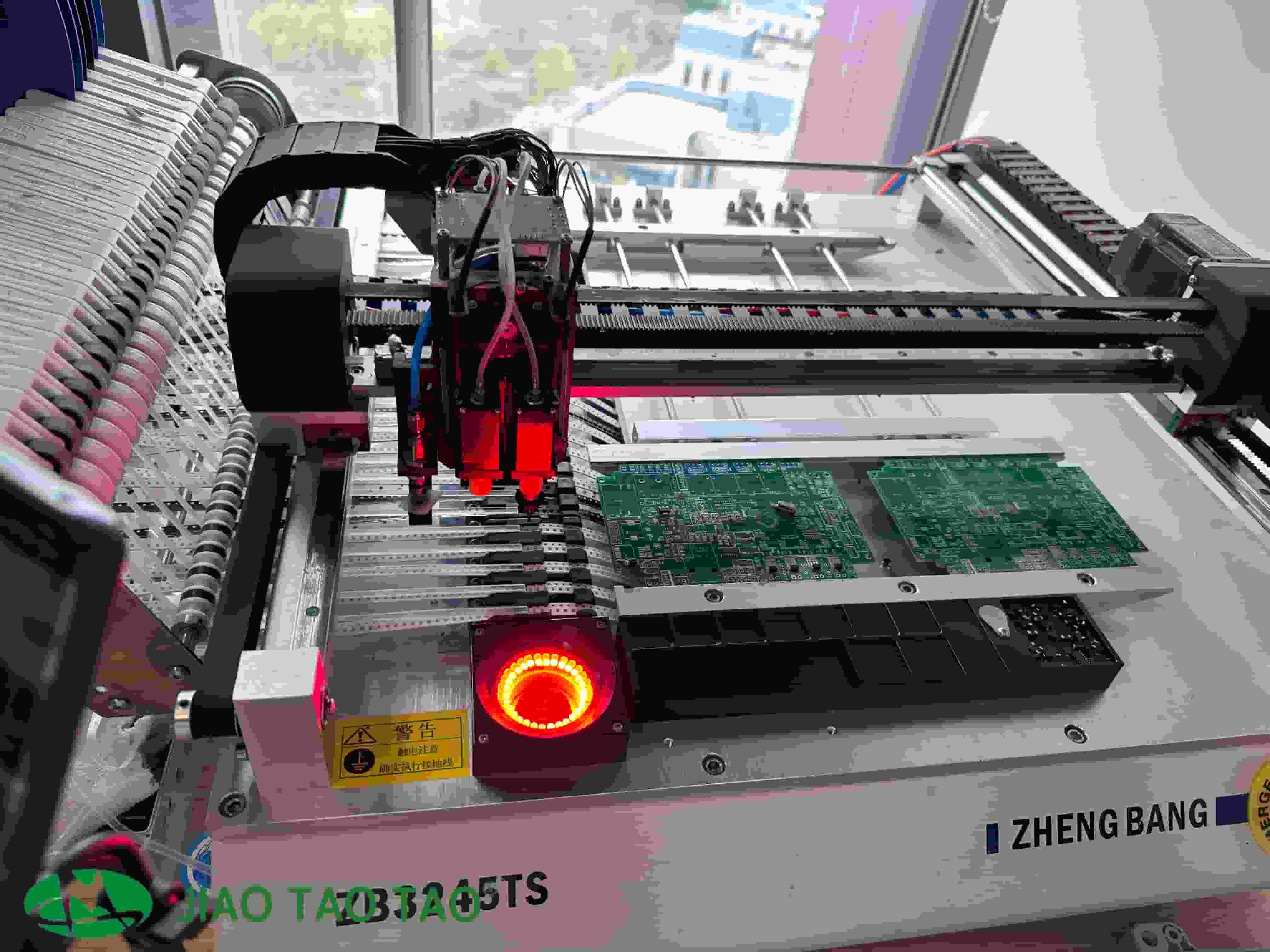
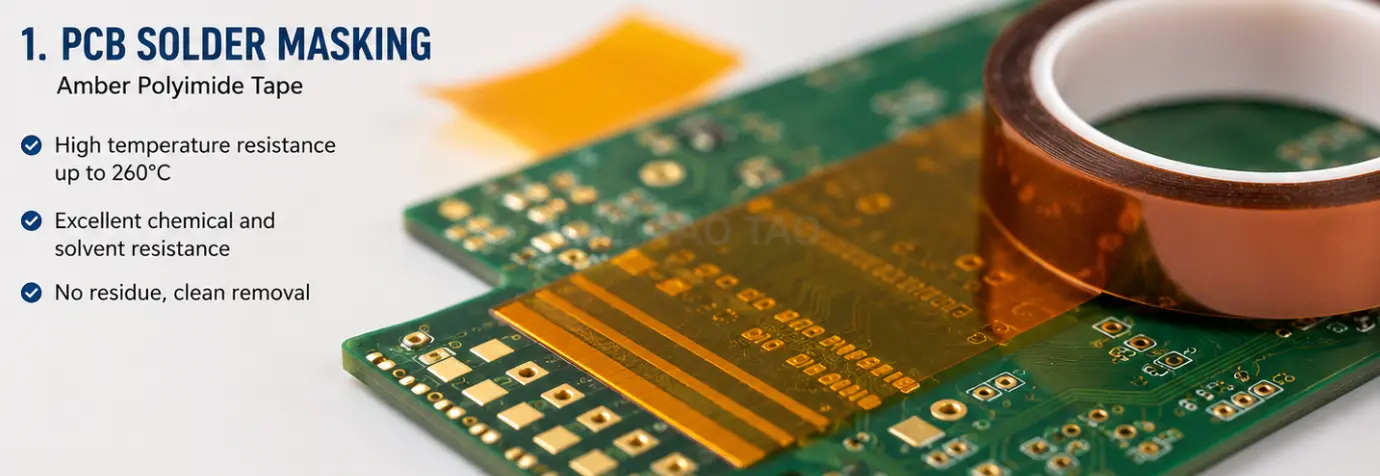
PCB masking tape is a high-temperature-rated pressure-sensitive adhesive tape applied to printed circuit boards prior to soldering, conformal coating, or surface finishing processes to protect specific areas—gold fingers, edge connectors, test points, pre-installed components, and through-hole pins—from solder, flux, coating material, or chemical exposure. The JTT-Tape PCB masking tape is constructed with a biaxially oriented polyester (PET) film backing coated with a high-performance silicone adhesive, rated to 280°C short-term and 200°C continuous, enabling it to survive wave soldering bath contact (250–260°C), SMT reflow profiles (peak 245–260°C per IPC-J-STD-020), and selective soldering operations without adhesive transfer, delamination, or solder penetration at masked edges.
Quick Facts
- Backing material: Biaxially oriented PET film (BoPET), 36–50 µm
- Adhesive system: Cross-linked silicone PSA
- Continuous service temperature: 200°C
- Short-term peak temperature: 280°C (wave soldering / selective soldering)
- Dielectric strength: ≥ 5,000 V (per ASTM D1000)
- Residue-free removal: Zero adhesive transfer confirmed after full solder thermal cycle
- Core PCB uses: Wave soldering masking, SMT reflow protection, gold finger masking, selective soldering, conformal coating masking, ICT test point protection
- Available colors: 13+ standard colors for process color-coding
Technical Specifications & Material Science
Why PET Film Is the Correct Backing for PCB Masking
Biaxially oriented PET film provides three properties critical for PCB masking performance. First, dimensional stability: thermal shrinkage <1.5% at 150°C for 30 minutes (ASTM D1504) prevents tape-edge curl at soldering temperatures, which would allow solder or flux to wick beneath the tape and contaminate gold-plated surfaces. Second, solvent resistance: PET is chemically inert to the isopropyl alcohol, acetone, and flux activators used in PCB cleaning processes. Third, conformability: PET film with elongation ≥80% allows the tape to conform over component leads, PCB edge profiles, and connector bodies without tearing during application.
Silicone Adhesive: The Critical Differentiator at 280°C
Standard acrylic adhesive PCB tapes are rated to 120–150°C. Contact with wave solder at 255°C for even 3–5 seconds causes acrylic adhesive to undergo thermal decomposition, leaving a carbonized residue on gold fingers and connector pads that requires aggressive solvent cleaning—often damaging the gold plating or adjacent soldermask. The cross-linked silicone adhesive in JTT-Tape PCB masking tape withstands 280°C short-term contact with zero adhesive mass transfer. The Si–O polymer backbone (bond energy ~450 kJ/mol) remains intact through multiple solder passes, enabling the tape to be used across repeat-process boards without adhesive quality degradation.
Standard Technical Parameters — JTT-Tape PET Silicone PCB Masking Tape
| Parameter | Value | Test Standard |
|---|---|---|
| Total Tape Thickness | 0.055 mm (55 µm) ± 5% | ASTM D1000 |
| PET Backing Thickness | 36 µm | ASTM D374 |
| Adhesive Type | Cross-linked silicone PSA | — |
| Adhesive Thickness | 19 µm ± 2 µm | ASTM D1000 |
| Continuous Service Temperature | 200°C | IEC 60454-2 |
| Short-Term Peak Temperature | 280°C (wave soldering contact) | IEC 60454-2 |
| Tensile Strength | ≥ 150 N/25 mm | ASTM D1000 |
| Elongation at Break | ≥ 80% | ASTM D1000 |
| Dielectric Strength | ≥ 5,000 V | UL 510 / ASTM D149 |
| Adhesion to Steel (180° Peel) | ≥ 8 N/25 mm | PSTC-101 |
| Thermal Shrinkage (150°C / 30 min) | < 1.5% | ASTM D1504 |
| Edge Bleed (200°C / 30 min) | < 0.1 mm | Internal method |
| Flame Retardancy (film) | UL94 V-0 | UL 94 |
| Flux & Solvent Resistance | IPA, acetone, rosin flux (RMA/RA grade) | — |
| Available Width Range | 3–1,200 mm (custom slit) | — |
| Shelf Life | 24 months (5–30°C, RH ≤ 65%) | — |
PCB Assembly Applications

1. Wave Soldering — Gold Finger & Edge Connector Protection
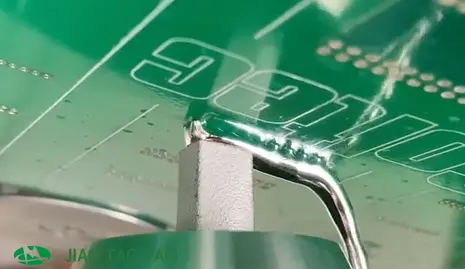
Wave soldering bath temperatures range from 245–260°C for SnAgCu (SAC305) lead-free alloys, with contact duration of 3–8 seconds per IPC-A-610 process guidelines. Gold-plated edge connectors (ENIG or hard gold per IPC-4552) must be protected from solder bridging, flux contamination, and mechanical contact with the solder wave. PET silicone masking tape rated to 280°C short-term withstands these conditions with edge bleed <0.1 mm and complete residue-free removal post-process. Even a single tape-edge lift event during wave contact exposes the gold finger to solder contamination—invalidating the connector and requiring costly rework or board scrapping.
2. SMT Reflow — Component & Connector Protection
SMT reflow profiles for SAC305 solder paste peak at 245–260°C for 20–40 seconds above liquidus (IPC-J-STD-020, MSL qualification). Pre-populated through-hole connectors, electrolytic capacitors, and battery holders on mixed-technology PCBs cannot tolerate reflow temperatures and require masking before board entry into the reflow oven. PET silicone tape's dimensional stability (shrinkage <1.5% at 150°C) prevents the tape from pulling away from the masked component body during the preheat zone (150–180°C), maintaining coverage through the peak zone. Remove tape within 60 seconds of oven exit, before the board cools below 40°C, to minimize peel force increase.
3. Selective Soldering — Precision Area Masking
Selective soldering targets individual through-hole component leads on mixed SMT/THT boards using a mini-wave nozzle at 260–280°C. Adjacent SMT components, test pads, and fine-pitch connectors within 2–5 mm of the soldering target must be protected. PET silicone tape cut to narrow widths (3–10 mm) provides precise edge control with the dimensional stability to stay in position during nozzle approach. The tape's resistance to rosin-based flux activators (RMA and RA grades) prevents flux wicking beneath the tape edge—a failure mode that causes soldermask discoloration and potential delamination of adjacent copper traces.
4. Conformal Coating Masking
Conformal coating (acrylic, polyurethane, silicone, or epoxy per IPC-CC-830) is applied to finished PCBs in aerospace, automotive, and industrial control applications. Connectors, test points, battery contacts, and adjustment potentiometers must remain coating-free. PET silicone masking tape provides a clean coating dam with no bleed-through to masked surfaces, and removes without tearing the cured coating film at the tape edge—a failure mode with paper-backed masking tapes that fractures the coating boundary and creates delamination paths for moisture ingress.
5. ICT & Flying Probe Test Point Protection
In-circuit test (ICT) fixtures require bare copper or HASL test pads with contact resistance <50 mΩ. During wave soldering or post-process cleaning, these pads can acquire flux residue or solvent contamination that elevates contact resistance and causes ICT false failures. Masking test point pads with PET silicone tape during soldering and cleaning operations preserves pad surface cleanliness. The tape's clean removal after flux wash (IPA or saponifier at 40–60°C) leaves pads in qualified condition without requiring additional surface preparation before ICT.
PET Silicone vs Polyimide vs Acrylic: How to Select PCB Masking Tape
Three tape constructions are commonly specified for PCB masking. The following comparison addresses the parameters that determine suitability for soldering process conditions.
| Parameter | PET + Silicone (JTT-Tape, 280°C) |
Polyimide (Kapton) + Silicone |
PET + Acrylic |
|---|---|---|---|
| Short-Term Peak Temp | 280°C | 300°C+ | 150–180°C ⚠ |
| Wave Soldering Qualified | ✓ Yes | ✓ Yes | ✗ No |
| SMT Reflow Qualified | ✓ Yes | ✓ Yes | ✗ No |
| Residue-Free Removal | ✓ Confirmed | ✓ Confirmed | ✗ Risk above 150°C |
| Dielectric Strength | ≥ 5,000 V | ≥ 7,000 V | 3,000–5,000 V |
| Backing Thickness | 36–50 µm | 12.5–50 µm | 36–75 µm |
| Flux Resistance (RMA/RA) | ✓ Excellent | ✓ Excellent | ⚠ Moderate |
| Cost vs Performance | Optimal (medium cost) | High cost (3–5×) | Low cost, process risk |
| Color Options | 13+ colors | Amber / transparent only | Limited |
| Width Availability | 3–1,200 mm | 3–610 mm (typical) | 3–1,200 mm |
Selection guidance: For wave soldering, SMT reflow, and selective soldering applications with peak temperatures up to 280°C, PET silicone tape delivers equivalent thermal and adhesive performance to polyimide (Kapton) tape at significantly lower cost—making it the standard specification for high-volume PCB assembly operations. Polyimide tape is justified only where continuous operating temperatures exceed 200°C (e.g., permanent insulation in high-power transformers), or where backing thickness below 20 µm is required for impedance-sensitive microwave PCBs. PET acrylic tape is not qualified for any soldering process above 150°C and should not be used in wave or reflow applications.
Customization & Supply Capabilities
JTT-Tape PCB masking tape is manufactured by JIAOTAOTAO New Materials Co., Ltd. (Dongguan, Guangdong), established 2009, with 8 automated coating lines across a 6,000 m² facility. Certifications: ISO 9001:2015, SGS, UL94 V-0. Direct-from-manufacturer supply options include:
- Custom Width Slitting: 3 mm to 1,200 mm, ±0.5 mm tolerance, in 0.5 mm increments. Narrow slits (3–10 mm) commonly used for selective soldering and gold finger masking.
- Die-Cut PCB Masking Pads: Custom shapes for specific PCB layouts—connector outlines, test pad arrays, component keepout frames. Tolerance ±0.2 mm. Kiss-cut on liner for clean peel-and-place in production.
- Roll Arrays: Multiple pad widths gang-cut on a single liner for multi-zone masking in one peel operation. Reduces application cycle time on high-volume PCB lines.
- Color Options: 13+ standard silicone series colors—amber, yellow, blue, red, green, black, transparent, pink, orange, purple, rose red, deep yellow, white. Color-coded masking for multi-process PCB lines (e.g., yellow = wave solder zone, blue = conformal coating zone).
- Custom Roll Length: Standard 33 m; OEM options at 50 m / 100 m. Core ID: 25 / 50 / 76 mm.
- Private Label / OEM Packaging: Core labeling, carton printing, and branded packaging for distributor and EMS company programs.
- Free Qualification Samples: 1–3 widths dispatched within 5 business days. Specify solder process type (wave / reflow / selective), substrate material, and gold finger pitch for adhesive weight recommendation.
- MOQ: 1 carton (~20–50 rolls) for standard slit specifications. Die-cut tooling: one-time setup fee, no per-run MOQ premium thereafter.
- Lead Time: Standard widths: 7–15 business days ex-factory. Custom die-cut: 15–25 business days.
FAQ for Engineers & Procurement

Q1: What is the maximum temperature PCB masking tape can withstand during wave soldering?
JTT-Tape PET silicone PCB masking tape is rated to 280°C short-term—covering SAC305 wave soldering bath temperatures of 250–260°C with a thermal safety margin of 20–30°C. The tape survives the full wave contact duration of 3–8 seconds without adhesive transfer, tape-edge lift, or solder penetration. For selective soldering nozzle temperatures reaching 270–280°C, this tape remains the correct specification. Processes exceeding 280°C should evaluate polyimide tape.
Q2: Will PCB masking tape contaminate gold fingers or leave adhesive residue after wave soldering?
No. The cross-linked silicone adhesive system remains fully cohesive through 280°C solder bath contact, with zero adhesive mass transfer confirmed by 180° peel testing on ENIG-finished test coupons post-wave soldering cycle. Gold finger contact resistance remains within IPC-4552 specification after tape removal. This contrasts with acrylic-adhesive tapes, which carbonize above 150°C and deposit residue on gold surfaces requiring IPA cleaning or mechanical abrasion—both of which risk gold plating damage.
Q3: When should the tape be removed after wave soldering or SMT reflow?
Remove tape within 30–60 seconds of exiting the wave solder machine or reflow oven, while the board temperature is still above 40°C. At elevated temperature, silicone adhesive peel force is at its minimum (typically 6–10 N/25 mm). As the board cools to room temperature, the adhesive re-anchors to the substrate surface, increasing peel force by 30–50% and raising the risk of adhesive transfer or PCB soldermask delamination on fine-pitch components. Establish a standard operating procedure specifying removal within 60 seconds of oven exit.
Q4: Can PCB masking tape be used for conformal coating masking, and will it prevent coating bleed-through?
Yes. PET silicone masking tape provides a clean coating dam for acrylic, polyurethane, silicone, and epoxy conformal coatings applied by spray, selective coat, or brush per IPC-CC-830. The silicone adhesive forms a continuous, void-free seal against the PCB soldermask surface that prevents low-viscosity coating materials from wicking beneath the tape edge. After curing, the tape removes without tearing the coating film at the boundary—a failure common with paper-backed or foam masking tapes that creates a ragged coating edge and potential moisture ingress path.
Q5: What width should be specified for gold finger masking, and can custom die-cut shapes be supplied?
Gold finger masking width is determined by the edge connector contact length plus 2–3 mm overlap onto the PCB soldermask on each side. Standard gold finger lengths of 10–30 mm are typically covered by 15–40 mm wide tape. For high-volume production, custom die-cut pads sized precisely to the connector footprint—with ±0.2 mm tolerance—are available kiss-cut on release liner, enabling robotic or semi-automated application at cycle times <2 seconds per pad. Specify PCB connector pitch, contact count, and contact length when requesting a die tooling quote.
Q6: Is PCB masking tape compatible with no-clean flux processes and aqueous wash cleaning?
Yes to both. The silicone adhesive and PET backing are inert to no-clean flux activators (organic acid, rosin, and synthetic resin chemistries per J-STD-004). In aqueous wash cleaning systems operating at 40–60°C with saponifier concentration 5–10%, the tape remains adhered and intact through the wash and rinse stages if removal is deferred to post-cleaning. If tape must survive both wave soldering and aqueous cleaning before removal, confirm compatibility with the specific saponifier chemistry—alkaline saponifiers above pH 11 may soften the silicone adhesive over extended (>30 min) soak times.
Q7: How does JTT-Tape PCB masking tape compare to 3M 1280 or Nitto 923S?
3M 1280 and Nitto 923S are PET/silicone constructions with wave soldering ratings of 260–280°C, 55–65 µm total thickness, and similar adhesion profiles to JTT-Tape's PCB silicone series. JTT-Tape matches these performance specifications—280°C short-term, ≥5,000 V dielectric, residue-free removal—at direct-factory pricing without distributor margin. Additionally, JTT-Tape offers 13+ color options versus the single amber/yellow standard color of most competing brands, enabling process color-coding at no cost premium. Custom die-cut pads and private label supply are available directly from the Dongguan factory.
Request a Data Sheet, Free Sample, or Factory Quote
JTT-Tape PET silicone PCB masking tape—280°C short-term peak, 200°C continuous, ≥5,000 V dielectric strength, residue-free removal, UL94 V-0, 13+ colors—is the direct-factory alternative to 3M 1280 and Nitto 923S for wave soldering, SMT reflow, selective soldering, conformal coating masking, and gold finger protection. Available in standard slit widths from 3 mm, custom die-cut pad arrays, and private label formats from the Dongguan source factory.
Contact the Manufacturer Directly:
- 📋 Request Technical Data Sheet (TDS): simon@jiaotaotao.com
- 🧪 Free Qualification Sample: Specify solder process (wave / reflow / selective), gold finger pitch, and board substrate — dispatched within 5 business days
- 💬 WhatsApp / WeChat: +86-136 1277 5969
- 🔗 Full Silicone Polyester Tape Range: www.clothadhesive.com — Silicone Polyester Tape
- 📝 Online Inquiry Form: Send Inquiry →
Gold Finger Masking Tape: Polyimide Guide for PCB Edge Connector Protection
High Temperature Masking Tape: Industrial Guide & Specs
Related Article

Need help choosing the right industrial tape?
Send us your application details, including temperature, surface material, size, quantity and current problem. Our team will help recommend a suitable tape material or custom die-cut solution.

simon@jiaotaotao.com


+86-136 1277 5969


+86-136 1277 5969
