
Circuit Board Masking Tape Solutions for PCB Soldering and Protection
Circuit Board Masking Tape Solutions for PCB Soldering and Protection
Circuit board masking tape is used to protect selected PCB areas during soldering, reflow, wave solder, coating, temporary insulation, and electronics assembly. The right tape helps solve real production problems such as residue after heating, edge lifting during the process, masking failure on pads or connectors, and unstable protection on static-sensitive boards.
Instead of choosing tape only by name, PCB manufacturers usually get better results by matching the tape to the process: solder masking, connector protection, static-sensitive handling, or repeatable die-cut masking parts.

What Problems Does Circuit Board Masking Tape Solve?
| Common PCB Problem | What Usually Happens | What the Right Tape Should Do |
|---|---|---|
| Residue after solder or heat process | Board cleaning becomes harder and yield drops | Remove cleanly after masking |
| Tape shrinks or lifts during heating | Pads, connectors, or protected zones become exposed | Stay stable during the process cycle |
| PCB area needs controlled insulation | Standard masking tape cannot provide enough process reliability | Support masking with stable insulation behavior |
| Static-sensitive board handling | Conventional tape may not fit ESD-sensitive applications | Use an ESD-safe masking direction |
| Manual cutting slows production | Masking consistency and line efficiency both drop | Use die-cut parts for repeatable placement |
Solution 1: PCB Solder Masking Needs Higher Heat Stability
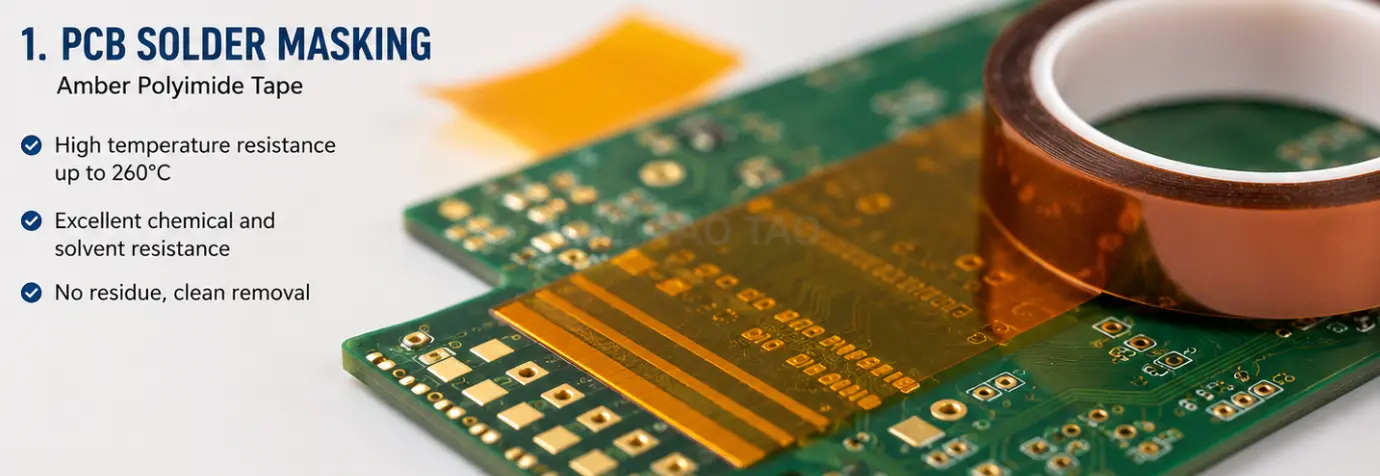
In PCB solder masking, the tape must protect specific board areas and still come off cleanly after the process. If the tape edge lifts or the adhesive breaks down, solder exposure and cleanup risk both increase.
Recommended direction: single-sided polyimide tape is usually the main solution for PCB masking when higher process heat and stable removal are needed.

Solution 2: Static-Sensitive Boards Need ESD-Safe Masking
In electronics lines where static control matters, the masking material needs to fit both the process and the board environment. This is especially important in sensitive electronics handling, assembly, and selected SMT-related conditions.
Recommended direction: ESD polyimide tape is usually the better choice when the masking process also needs ESD-safe handling support.
Solution 3: Board Edge, Connector, and Temporary Protection Need Clean Removal
Some circuit board masking jobs involve temporary protection, auxiliary insulation, or cleaner line control on less extreme process sections. In those cases, a stable polyester film structure can be more practical than using one tape type for every station.
Recommended direction: silicone polyester tape is often suitable for selected board masking and clean-removal protection tasks where PET film stability is preferred.
Solution 4: Repetitive PCB Masking Needs Die-Cut Parts, Not Hand Cutting
When the same PCB masking point repeats across many boards, custom die-cut parts improve placement speed, shape repeatability, and production consistency. This is useful for masking windows, dots, strips, insulation tabs, and custom-shaped protection parts.
Recommended direction: use custom die-cutting or die-cut adhesive tape solutions when PCB masking needs shaped parts instead of standard rolls.
Which Circuit Board Masking Tape Solution Fits Your PCB Process?
For solder masking and higher process heat
Choose polyimide tape when the process needs stable heat resistance, controlled masking, and clean removal.
For ESD-sensitive board environments
Choose ESD polyimide tape when static-sensitive assemblies need masking plus ESD-safe material direction.
For selected clean-removal board protection
Choose silicone polyester tape when PET film stability fits the masking task better.
For repeatable shaped masking parts
Choose die-cut converting when the board design needs precision masking pieces rather than hand-cut tape.
What Should PCB Buyers Check Before Choosing Masking Tape?
| Check Point | Why It Matters |
|---|---|
| Process type | Wave solder, reflow, temporary insulation, or connector masking need different priorities |
| Clean removal requirement | Residue risk affects rework and board cleanliness |
| Static sensitivity | Some board environments need an ESD-safe masking direction |
| Manual or automated application | Repeatable jobs often benefit from die-cut parts |
| Masking shape complexity | Windows, dots, and strips usually need more controlled converting |
FAQ
What is circuit board masking tape mainly used for?
It is mainly used to protect selected PCB areas during soldering, reflow, wave solder, temporary insulation, connector protection, and electronics assembly processes.
Which tape is better for PCB solder masking?
For many PCB solder masking jobs, polyimide tape is the main solution because it is commonly used where higher heat stability and clean removal are required.
When should I use ESD polyimide tape on a circuit board?
Use ESD polyimide tape when the board or assembly process is static-sensitive and still needs controlled masking or insulation support.
Can circuit board masking tape be supplied as die-cut parts?
Yes. PCB masking tape materials are often converted into die-cut dots, strips, tabs, and shaped masking parts for repeatable placement.
Why does PCB masking tape leave residue after processing?
This usually happens when the adhesive system or tape structure is not well matched to the board surface, process heat, or removal condition.
Conclusion
Circuit board masking tape is a process solution, not just a general tape item. The right direction depends on the actual PCB problem: solder masking, ESD-safe handling, clean-removal protection, or repeatable die-cut masking parts. When the tape matches the board process correctly, masking becomes cleaner, more stable, and easier to control across production.
Looking for a circuit board masking tape solution for PCB soldering, connector protection, ESD-safe masking, or die-cut board parts? JIAO TAO TAO supports OEM/ODM supply, custom widths, thickness selection, die-cut conversion, and bulk production for polyimide, ESD polyimide, polyester, and custom PCB masking projects.
+86-13612775969
+86-13612775969
simon@jiaotaotao.com
Send Inquiry Online
What Is High Temperature Masking Tape?
Related Article

Need help choosing the right industrial tape?
Send us your application details, including temperature, surface material, size, quantity and current problem. Our team will help recommend a suitable tape material or custom die-cut solution.

simon@jiaotaotao.com


+86-136 1277 5969

+86-136 1277 5969
