
Heat Resistant Tape: A Technical Buyer's Guide for Industrial Applications
Heat Resistant Tape: A Technical Buyer's Guide for Industrial Applications
By JTT-Tape Engineering Team | Updated: 2026 | View Product Range →
What Is Heat Resistant Tape?
Heat resistant tape is a pressure-sensitive adhesive tape constructed with a high-temperature-stable backing—most commonly biaxially oriented polyester (PET) film or polyimide film—coated with either a silicone or acrylic adhesive system. It is engineered to maintain dimensional stability, adhesion integrity, and clean removability at sustained operating temperatures ranging from 150°C to 260°C, depending on the adhesive and backing specification. Industrial use cases include powder coating masking, transformer winding insulation, PCB wave soldering protection, and anodizing line hold-down.
Quick Facts
- Backing material: Biaxially oriented PET film (typical thickness: 36–75 µm)
- Adhesive system: Silicone (up to 260°C) or Modified Acrylic (up to 200°C)
- Temperature resistance limit: 150°C continuous (acrylic) / 200–260°C continuous (silicone)
- Dielectric strength: 3,000–7,000 V (per ASTM D1000)
- Core industrial uses: Powder coating masking, transformer insulation, PCB soldering protection, anodizing, heat sublimation printing
- Clean removal: No adhesive residue after exposure at rated temperature

Technical Specifications & Material Science
Backing: Biaxially Oriented PET Film
The biaxially oriented polyester (BoPET) film used in industrial heat resistant tape undergoes simultaneous machine-direction and transverse-direction stretching during manufacture. This process aligns the polymer chains in two axes, resulting in high tensile strength (>150 N/25 mm), low thermal shrinkage (<1.5% at 150°C for 30 min per ASTM D1504), and a smooth surface that accepts precise adhesive coat weights. PET film retains mechanical integrity up to approximately 220°C short-term; above this threshold, dimensional stability degrades.
Adhesive System: Silicone vs Acrylic
Silicone adhesive systems are cross-linked organopolysiloxane networks. The Si–O backbone bond energy (~450 kJ/mol) significantly exceeds that of C–C bonds (~346 kJ/mol), conferring thermal stability to 200–260°C continuous and short-term excursions to 300°C. Critically, silicone adhesives do not undergo thermal decomposition into sticky residues at rated temperatures—enabling clean, residue-free removal after powder coating or wave soldering cycles. Modified acrylic adhesive systems offer lower cost and adequate performance to 150–180°C, but may leave residue if exceeded.
Standard Technical Parameters — JTT-Tape PET Silicone Heat Resistant Tape
| Parameter | Value | Test Method |
|---|---|---|
| Total Thickness | 0.055 mm (55 µm) ± 5% | ASTM D1000 |
| PET Film Backing Thickness | 36 µm | ASTM D374 |
| Adhesive Type | High-performance silicone | — |
| Continuous Service Temperature | 200°C (392°F) | IEC 60454-2 |
| Short-Term Peak Temperature | 260°C (30 min max) | IEC 60454-2 |
| Tensile Strength | ≥ 150 N/25 mm | ASTM D1000 |
| Elongation at Break | ≥ 80% | ASTM D1000 |
| Dielectric Strength | ≥ 5,000 V | UL 510 / ASTM D149 |
| Adhesion to Steel (180° Peel) | ≥ 8 N/25 mm | PSTC-101 |
| Roll Length (Standard) | 33 m | — |
| Available Width (Standard) | 3–1,200 mm (custom slit) | — |
| Flame Retardancy | UL94 V-0 (film) | UL 94 |
| Shelf Life | 24 months (5–30°C, RH ≤ 65%) | — |
Industrial Applications

1. Powder Coating & Electrostatic Spray Masking
Powder coating ovens operate at 180–220°C for 15–30 minutes. Standard pressure-sensitive tapes using rubber or low-grade acrylic adhesives soften, bleed adhesive onto the substrate surface, or allow paint penetration under the tape edge. PET silicone heat resistant tape withstands these thermal cycles with edge bleed resistance <0.1 mm and removes cleanly without residue, protecting threaded holes, mating surfaces, and precision bores. Its dimensional stability under heat prevents the tape edge from curling—a failure mode that allows overspray ingress.
2. Transformer Winding & Motor Coil Insulation
High-frequency and distribution transformers generate localized winding temperatures classified under IEC 60085 thermal class F (155°C) or H (180°C). PET silicone tape with a dielectric strength of ≥5,000 V serves as interlayer insulation between winding layers, preventing turn-to-turn short circuits. The tape's elongation of ≥80% allows conformance over wire bundles without cracking the adhesive layer—critical for maintaining insulation continuity under vibration and thermal cycling.
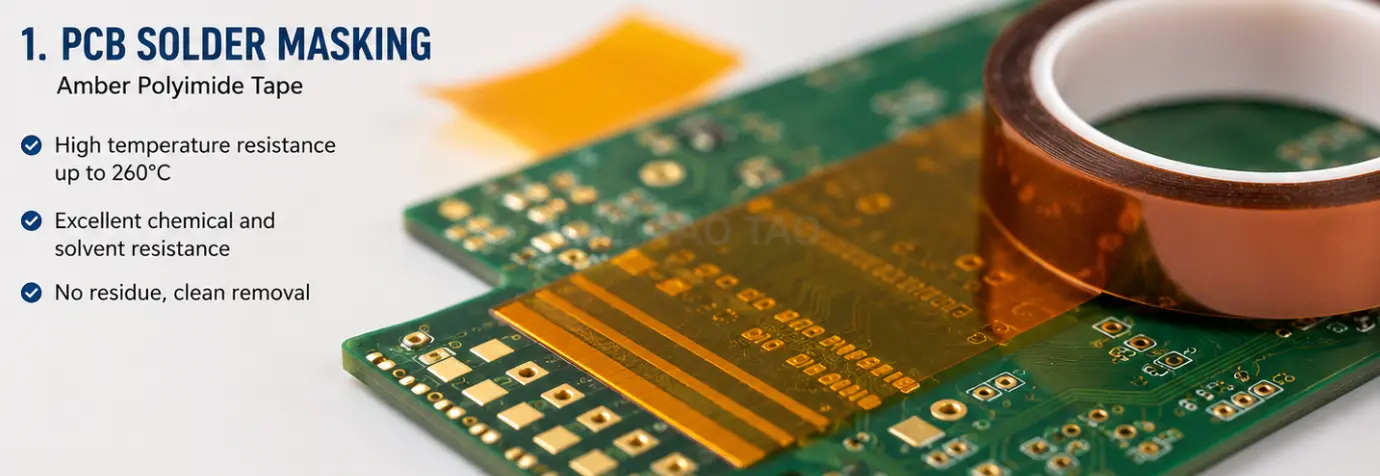
3. PCB Wave Soldering & SMT Reflow Protection
Wave soldering bath temperatures reach 250–260°C; SMT reflow profiles typically peak at 245–260°C per IPC-7711/7721. Components, gold fingers, or connector pads that must remain solder-free require masking with tape that survives the full thermal profile without delaminating or transferring adhesive onto plated contacts. PET silicone tape rated for 260°C short-term is the industry-standard solution for this application, replacing plugs and liquid solder masks where reuse and speed are priorities.
4. Anodizing & Electroplating Line Protection
Anodizing tanks operate with sulfuric acid electrolytes at 18–22°C, but pre-treatment steps—including alkaline etching baths and oven drying cycles at 60–120°C—require masking tape with chemical resistance to acids/alkalis and moderate heat tolerance. PET film's inherent chemical resistance combined with the silicone adhesive's non-interaction with common plating chemistry makes it suitable for protecting machined surfaces, ID bores, and cosmetic faces throughout the anodizing sequence.
5. Heat Transfer & Sublimation Printing Fixture
Dye-sublimation presses operate at 180–200°C for 30–60 seconds. PET silicone tape is used to register and hold transfer paper precisely on substrates (textiles, ceramic, metal panels) during the press cycle. The tape must release cleanly after the heat cycle without ink transfer or adhesive migration onto the printed surface. A tape with silicone adhesive and a smooth, low-profile backing prevents embossing marks in the final print.
Silicone vs Acrylic vs Polyimide: How to Choose the Right Heat Resistant Tape
Procurement engineers frequently face three options. The table below compares them on the parameters that drive purchasing decisions in high-temperature applications.
| Parameter | PET + Silicone Adhesive | PET + Acrylic Adhesive | Polyimide (Kapton) + Silicone |
|---|---|---|---|
| Continuous Temp Limit | 200°C | 150°C | 260°C |
| Short-Term Peak | 260°C | 180°C | 300°C+ |
| Residue-Free Removal | ✓ Yes | ⚠ Risk above 150°C | ✓ Yes |
| Dielectric Strength | ≥ 5,000 V | 3,000–5,000 V | ≥ 7,000 V |
| Relative Cost | Medium | Low | High |
| Tensile Strength | 150–200 N/25mm | 120–160 N/25mm | 150–250 N/25mm |
| Conformability | Good | Good | Excellent (thinner) |
| Best Use Case | Powder coating, transformer, sublimation | General masking <150°C | Aerospace, precision PCB, >260°C |
| Availability (standard widths) | 3–1,200 mm | 3–1,200 mm | 3–610 mm (typical) |
Decision rule: For applications operating continuously at 150–200°C with clean removal requirements and cost sensitivity—powder coating, transformer insulation, sublimation printing—PET + silicone adhesive provides the optimal performance-to-cost ratio. Polyimide tape is justified where operating temperatures exceed 200°C continuously, or where the application demands the thinnest possible insulation layer (<25 µm backing). Acrylic-adhesive PET tape is appropriate only where peak temperatures remain reliably below 150°C.

Customization & Supply Capabilities
JTT-Tape, manufactured by JIAOTAOTAO New Materials (Dongguan), operates 8 automated coating lines across a 6,000 m² facility established in 2009. The following OEM and custom supply services are available to B2B buyers:
- Custom Slitting: Width tolerance ±0.5 mm, available from 3 mm to 1,200 mm. Jumbo rolls slit to finished rolls per customer specification.
- Custom Roll Length: Standard 33 m; OEM options at 50 m, 100 m, or specified yardage. Core ID: 25 mm, 50 mm, 76 mm available.
- Die-Cutting: Custom shapes, frames, gaskets, or kiss-cut sheets for automated dispensing on production lines. Die-cutting tolerance: ±0.2 mm.
- Color Customization: 13+ standard colors available in silicone series (black, transparent, amber, green, blue, red, yellow, pink, orange, purple, rose red, deep yellow, white). Custom color matching on request.
- Private Label & OEM Packaging: Custom core printing, carton labeling, and spool packaging for distributor and brand programs.
- Free Sample: Pre-production sample rolls (typically 1–3 widths) dispatched within 5 business days for qualification testing.
- MOQ Flexibility: Standard MOQ 1 carton (~20–50 rolls depending on width). Large-volume blanket orders with scheduled releases accepted.
- Lead Time: Standard specifications: 7–15 business days ex-factory. Custom die-cut or non-standard: 15–25 business days.
- Certifications: ISO 9001:2015, SGS tested, UL94 V-0 film.
FAQ for Engineers & Procurement

Q1: What is the maximum temperature that PET silicone heat resistant tape can withstand?
JTT-Tape PET silicone tape is rated for 200°C continuous service and tolerates short-term excursions to 260°C for up to 30 minutes. Performance above 260°C risks adhesive carbonization and backing deformation. For sustained operations above 200°C, polyimide (Kapton) tape should be evaluated. All ratings reference IEC 60454-2 test protocol.
Q2: Will heat resistant tape leave residue after removal from powder-coated or anodized surfaces?
Silicone adhesive formulations do not undergo adhesive transfer at rated temperatures—the crosslinked silicone network remains cohesive during thermal cycling. Residue-free removal is confirmed by 180° peel testing on stainless steel panels after 30-minute soak at 200°C. Acrylic adhesive tapes used above their rated temperature (>150°C) may leave carbonized residue requiring solvent cleaning.
Q3: Can heat resistant tape be used directly in wave soldering and SMT reflow processes?
Yes. PET silicone tape with a 260°C short-term rating is qualified for wave soldering (bath: 250–260°C, contact time: 3–7 seconds) and SMT reflow (peak: 245–260°C, IPC-J-STD-020 profile). The tape protects gold fingers, connectors, and pre-populated components. It must be removed while still warm (within 30 seconds of exiting the oven) to minimize adhesion force increase from cooling.
Q4: What dielectric strength does this tape provide, and is it sufficient for transformer insulation?
Dielectric strength is ≥5,000 V per ASTM D149 / UL 510 test conditions. This exceeds the minimum requirements for Class F and Class H motor/transformer winding insulation per IEC 60085. For applications requiring dielectric strength >7,000 V, polyimide tape or thicker PET constructions (75 µm backing) should be specified. Always verify with the application's working voltage plus appropriate safety margins.
Q5: What custom widths and lengths are available, and what is the minimum order quantity?
Standard widths range from 3 mm to 1,200 mm in 0.5 mm increments with ±0.5 mm tolerance. Roll length: standard 33 m; custom 50 m, 100 m available. MOQ is typically 1 carton (~20–50 rolls for standard widths). OEM die-cut shapes require a tooling setup fee with no additional MOQ premium once tooling is amortized. Free qualification samples are dispatched within 5 business days.
Q6: How should heat resistant tape be stored, and what is its shelf life?
Storage conditions: 5–30°C, relative humidity ≤65%, away from direct sunlight, UV sources, and ozone-generating equipment. Rolls should remain in original packaging and stored horizontally or on a mandrel to prevent core deformation. Shelf life is 24 months from production date under stated conditions. Silicone adhesive tapes are not affected by short-term ambient temperature fluctuation but must not be frozen (<0°C).
Q7: How does PET silicone heat resistant tape compare to 3M 8905 or equivalent benchmark products?
3M 8905 is a PET film / silicone adhesive construction with a 200°C continuous rating, 55 µm total thickness, and ≥4,500 V dielectric strength—specifications closely aligned with JTT-Tape's silicone series. JTT-Tape products are manufactured on automated coating lines with ISO 9001:2015 and SGS verification, offering equivalent technical performance at direct-factory pricing with OEM customization capabilities that OEM distributors cannot match. Sample comparison testing is available on request.
Request a Data Sheet, Free Sample, or Factory Quote
PET silicone heat resistant tape with a 200°C continuous / 260°C short-term rating, ≥5,000 V dielectric strength, and verified residue-free removal covers the majority of industrial masking, insulation, and fixturing applications that procurement engineers encounter—including powder coating, transformer winding, wave soldering protection, anodizing masking, and sublimation printing.
JIAOTAOTAO (JTT-Tape) manufactures these tapes at source, with 8 automated coating lines, ISO 9001:2015 certification, and full OEM capability—custom width slitting, die-cutting, roll length, and private label. No intermediary margin.
Get Direct Factory Support:
- 📋 Request Technical Data Sheet (TDS): simon@jiaotaotao.com
- 🧪 Request Free Sample: State width, length needed, and application — samples dispatched in 5 business days
- 💬 WhatsApp / WeChat: +86-136 1277 5969
- 🔗 View Full Polyester Tape Range: www.clothadhesive.com/polyester-tape.html
- 📝 Submit Inquiry Online: Send Inquiry Form →
High Temperature Masking Tape: Industrial Guide & Specs
Double Sided Thermal Tape Guide
Related Article

Need help choosing the right industrial tape?
Send us your application details, including temperature, surface material, size, quantity and current problem. Our team will help recommend a suitable tape material or custom die-cut solution.

simon@jiaotaotao.com


+86-136 1277 5969

+86-136 1277 5969
