
How Much Heat Can Kapton Tape Withstand?
How Much Heat Can Kapton Tape Withstand?
In industrial manufacturing, electronic assembly, and aerospace engineering, standard adhesive tapes fail catastrophically when introduced to heat. They melt, burn, and leave conductive residue that destroys delicate components. This is why engineers rely on Kapton (polyimide) tape for extreme thermal management.
Quick Answer
Kapton tape is exceptionally heat-resistant. It can operate continuously in extreme temperatures from -269°C to +260°C (-452°F to 500°F). It can also handle short-term heat spikes up to 400°C (752°F) without melting, burning, or losing its shape.

The Kapton Tape Temperature Spectrum
When B2B procurement managers source high-temperature tape, they must look at two distinct metrics: Continuous Operating Temperature and Short-Term Peak Resistance. Polyimide film excels in both categories.
| Thermal Condition | Temperature (°C / °F) | Material Behavior & Reliability |
|---|---|---|
| Cryogenic Cold | -269°C / -452°F | Tape remains flexible. Does not shatter or crack under stress. |
| Continuous Maximum | +260°C / +500°F | Maintains full dielectric strength and mechanical stability indefinitely. |
| Short-Term Heat Spike | +400°C / +752°F | Survives sudden thermal shocks (like soldering) without melting or losing shape. |
Why Doesn't Kapton Tape Melt?
To understand its incredible heat resistance, we must look at the material science. Most common packaging and electrical tapes (like PVC, PET, or Polyethylene) are made from thermoplastic polymers. When exposed to heat, the molecular bonds in thermoplastics loosen, causing the material to soften and eventually melt into a liquid state.
Kapton tape is manufactured from polyimide, which is a thermosetting polymer. Once the polyimide film is formed, its chemical structure becomes permanently cross-linked. It cannot be melted. If you subject polyimide to temperatures far beyond its absolute limits (e.g., above 500°C), it will eventually carbonize (char) and turn to ash, but it will never melt and flow onto your sensitive PCB components.
The Role of the Adhesive
The polyimide film is only half of the equation. A tape is useless if its adhesive fails under heat. Industrial-grade Kapton tapes utilize a specially formulated thermosetting silicone adhesive. Unlike cheap acrylic adhesives that turn to gooey residue at 150°C, the silicone adhesive cures and hardens slightly under extreme heat, ensuring a secure hold and a perfectly clean, residue-free peel afterward.

Source Industrial-Grade Polyimide Tape Direct from the Factory
Need tape that guarantees performance up to 400°C without leaving a sticky residue? We supply premium generic polyimide tape to B2B manufacturers worldwide at highly competitive pricing.
Applications That Rely on This Extreme Heat Resistance
Because polyimide tape can shrug off 400°C heat spikes, it is the primary consumable used in several high-stress manufacturing processes:
♨️ Wave Soldering (PCBs)
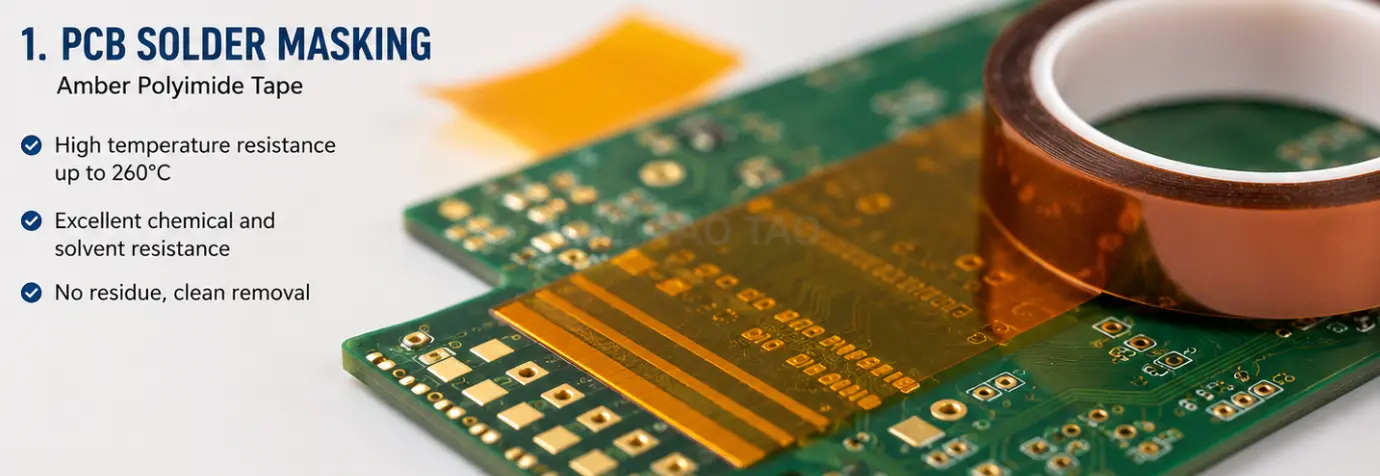
During automated electronics assembly, circuit boards pass over a wave of molten solder. Kapton tape masks the gold fingers and edge connectors, protecting them from the 250°C+ liquid metal and preventing solder bridging.
🚗 EV Battery Packing
Lithium-ion batteries generate massive heat during rapid charging and discharging. Polyimide tape wraps the cells to provide continuous Class H thermal insulation and prevent thermal runaway propagation.
🎨 Powder Coating
Industrial metal parts are sprayed with powder and then baked in curing ovens reaching 200°C. Kapton tape masks threaded holes and mating surfaces, surviving the oven without leaving adhesive behind.
Kapton Tape Electrically Conductive?
What is Kapton Tape Used For?
Related Article

Need help choosing the right industrial tape?
Send us your application details, including temperature, surface material, size, quantity and current problem. Our team will help recommend a suitable tape material or custom die-cut solution.

simon@jiaotaotao.com


+86-136 1277 5969


+86-136 1277 5969
